

Most lead generation for lawyers stops at “lead delivered.” An agency sends you a pile of calls and form fills, reports the count, and never tells you which ones became clients.
We work the other direction. Not leads, not impressions, not clicks. Cases. That is the whole basis of our law firm PPC services.
Everything below is organized around that one idea: the work only counts if you can trace it to a signed retainer. This guide breaks down every channel we run for plaintiff-side firms, how to get started with each, and how each one is tracked back to a signed case.
What Is Lead Generation for Lawyers?
Lead generation for lawyers is the process of attracting potential clients in a specific practice area and turning their interest into a contact your intake team can work, whether that is a phone call, a form fill, or a chat.
A lead is not a client. It is a prospective client who has raised a hand. The job is to move that lead to a signed case, and then to know exactly which campaign produced it.
Legal lead generation is one slice of your broader digital marketing, and it is the slice most directly responsible for turning strangers into new clients.
It is also the easiest place to waste money, because most agencies stop measuring at the lead and never tell you which marketing efforts actually produced cases.
A lead is not a case (and why that changes everything)
Leads do not pay your overhead. Cases do, and revenue follows on a delay, because a case is opened and then litigated over the next 12, 18, or 24 months.
So the number we manage toward is signed cases, not lead volume. The rule we hold every channel to is simple: if you cannot attribute it to a signed case, you cannot scale it.
Anything you cannot measure, you are funding on faith.
Why lead generation for lawyers is different
Legal is one of the most expensive categories in all of paid advertising, the intent windows are short, and you are bound by your state bar’s advertising rules.
A click on an attorney keyword can cost more than a click in almost any other industry, which means a wasted click is expensive and an untracked one is worse.
It also means the firms that win are not the ones who spend the most. They are the ones who know which spend turns into cases.
How Much Does Lead Generation for Lawyers Cost?
Before the numbers, here is what a focused paid campaign delivered for one personal injury firm in under a year.
It varies widely by practice area and market, so treat these as ranges, not promises.
The figures below come from third-party keyword data and industry reporting, not from our own accounts.
| Metric | Typical range | Notes |
|---|---|---|
| Cost per click (high-intent attorney terms) | $50–$130 | US keyword data for high-commercial-intent terms like “ppc for lawyers” and “law firm ppc.” Broad legal averages run lower. |
| Cost per click (most competitive) | $100–$900+ | Personal injury and similar high-value areas in large metros, per PPC practitioner reports. |
| Monthly ad budget | $5K–$40K+ | Roughly $5K–$10K in smaller markets, $20K–$40K+ in competitive metros. |
| Cost per qualified lead | Hundreds | A single qualified legal lead routinely runs into the hundreds before anyone signs. |
Notice what is missing from that table: cost per signed case. That is the number that actually decides whether a campaign is working, and it depends on your practice area, your market, and how well your intake converts.
A firm paying a high cost per lead can be far more profitable than a competitor paying less, if more of those leads turn into cases.
We model that math by practice area before recommending a budget. A trucking case is worth more than a fender-bender, and your spend per lead should reflect that.
The 9 Channels That Sign Cases
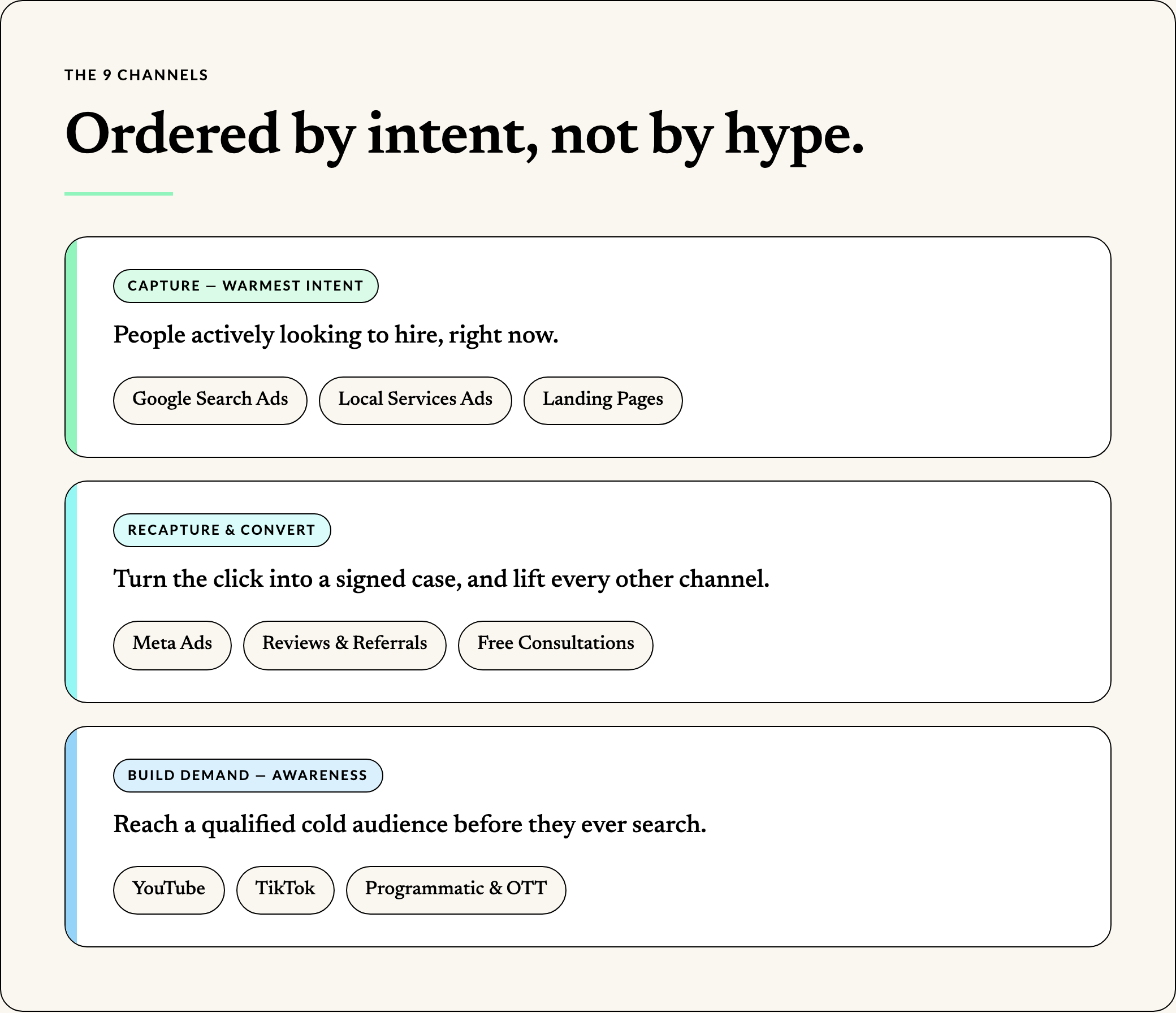
Below are the nine channels we use to generate leads for law firms, ordered roughly the way we prioritize them: the ones that capture warm, high-intent demand first, then the awareness layers that feed them.
For each, here is how to get started and how we track it back to a signed case.
Google Search Ads

If you only run one channel, run this one. There is no other tactic that captures an audience this warm.
Someone types “criminal defense lawyer Miami” and you have the chance to put your firm in front of them at the exact moment they need you.
Those keywords are expensive for a reason: the economics work. If a firm is willing to pay a high price per click, it is because they have done the math and know that spend comes back as cases.
How to get started
- Tighten your geography. Do not target the whole country if you practice in one state. Run per-state or per-market campaigns so the ad and landing page match where the searcher actually is.
- Optimize toward the right action. Tell Google to optimize for phone calls, form submissions, and live chats, not soft events. Counting a landing-page view as a conversion is how budgets get wasted.
- Control your targeting and your negatives. Match types, geography, time of day, device, and a disciplined negative-keyword list keep you out of searches that will never sign.
- Send the click to a dedicated landing page, never your homepage.
Microsoft (Bing) Ads is the one other search channel worth adding once Google is humming.
It is smaller, but the clicks are often cheaper and the audience skews older.
How it’s attributed
Every click carries a Google Click ID or UTM parameter into your CRM. When a lead becomes a case, we trace it back to the exact campaign, ad group, and keyword that produced it.
That is how you stop guessing and start defunding the 80% that does not work.
Google Local Services Ads (LSAs)

Local Service Ads for Law Firms are the closest thing your firm can do to buying cases.
They sit at the very top of the search page on high-intent attorney searches, they are pay-per-lead rather than pay-per-click, and most of the activity comes from phone calls, which are the highest-intent leads you can get.
They are available for personal injury, workers’ compensation, criminal defense, and DUI, among others, but not for areas like mass torts, tax, corporate, or IP.
How to get started
- Get your settings right first: correct practice-area job types, the geographies you are actually barred in, and your hours. Set up a separate Google Business Profile per state if you cover more than one.
- Turn off “general law firm leads.” This single setting quietly burns budget on calls that have nothing to do with your practice. We have seen a firm’s spend drop by about 70% the moment it is switched off, with no drop in signed cases.
- Protect your answer rate. If you are answering fewer than 90% of LSA calls, you are lighting money on fire. Route unanswered calls to an answering service after two or three rings.
- Feed it reviews. Review count, rating, and velocity are major ranking factors for LSAs, so a steady stream of a few reviews a week lifts how often your ad shows.
- Then leave it alone. There is no ad decay with LSAs. Constant tinkering throws the account back into a learning phase. Book your leads, mark lead quality, and let it run.
How it’s attributed
We install a unique tracking number (usually through CallRail) on the LSA profile, so a call is tied to the platform the moment it rings, with a whisper message telling intake where it came from.
From there it flows into your CRM and we follow the lead through to a booked case.
Landing Pages

The landing page is the most overlooked part of lead generation, and it is where a lot of technically strong campaigns fall apart.
A great campaign pointed at a weak page just buys expensive bounces. The page has to match the intent of the search and make the case for your firm in seconds.
How to get started
- Match the search. If someone searches “Nevada personal injury lawyer,” the headline they land on should say exactly that.
- Sell fast with proof. Pull in settlement amounts, reviews, accolades, and testimonials above the fold. Make the case for why your firm, in this practice area, very quickly.
- Win on mobile and speed. The page has to load in a split second and feel flawless on a phone, branded so it reads as part of your own site.
- Make the action obvious. One clear call, one clear form, so the page captures leads while intent is still high.
How it’s attributed
The form submit fires the conversion action and ports the lead into your CRM with its click ID attached. Build a real form submission as the conversion, not a page view.
Meta Ads (Facebook and Instagram)

Every firm should at least be running retargeting on Meta. When a prospective client visits your site and does not call, retargeting recaptures them, and the likelihood they come back and convert is far higher than for a cold audience.
Meta also has far fewer retargeting restrictions for law firms than Google does.
Leads here are cheaper and lower quality than Google, so it is a volume play: you might sift more leads to find a good one, and that can still win on cost.
How to get started
- Get the foundation right: a properly installed pixel, a clear definition of a conversion, and strong creative. Those three carry the account, and on Meta creative does the heavy lifting.
- Do not treat Meta like Google. You are interrupting someone’s scroll, so the first three to five seconds of the creative are everything.
- Pre-qualify on the page to train the algorithm. Ask the qualifying questions up front (for personal injury: injured in the last few years, confirmed injury, in your state, not already represented). Fire the conversion only for people who qualify, so Meta learns to find more of them.
- Retargeting pays off more the longer the sales cycle, so it tends to do more for family law than for personal injury.
How it’s attributed
We run the Conversions API and feed qualified-lead data back as the conversion, then make sure leads land in the CRM.
Because most ad tracking is last-click, awareness gets undercounted, so intake should always ask, “How did you hear about us?”
YouTube Ads

YouTube sits in the awareness part of your plan, not the bottom of the funnel.
It is a way to put your firm in front of a cold audience with video before they ever search, which builds the demand that your Google campaigns later capture.
Treat it as a complement to search, not a replacement for it.
How it’s attributed
Awareness channels rarely show up cleanly in last-click reporting, so they are measured through lift in branded search and the intake question, “Have you seen our ads before?” rather than a direct form path.
TikTok Ads

We will be straight with you on this one. TikTok is a top-of-funnel, awareness play, not a reliable direct case driver, and in our own testing it has not produced the way search and LSAs do.
If you are already signing cases from TikTok, that is great, and you should double down. For most plaintiff firms, the budget works harder elsewhere first.
Programmatic and OTT (Connected TV)

This is our fastest-growing service, and it exists to drive awareness from an already-qualified audience. OTT, or connected TV, runs your ads on streaming services like Hulu and Roku.
Programmatic and geofencing let you target by behavior and location: for personal injury, we can serve ads to people who have recently been to an emergency room; for criminal defense, to people near a police station.
It is an awareness layer, so it works alongside your search campaigns, not on its own.
How it’s attributed
Like other awareness channels, this is measured through lift and intake questions rather than last-click, which is why a “How did you hear about us?” field at intake matters.
Reviews and Referrals

Reviews are not a soft metric. They lift your conversion rate on every paid marketing campaign, and they directly affect how high your firm ranks in the Google map pack and in Local Services Ads.
The catch is that Google has cracked down on shortcuts, so this has to be done in-house: a steady, genuine stream of a few reviews a week, asked for at the right moment in your case management workflow.
Referrals are the other lane, and they are not something you buy. More affluent clients especially still find attorneys by word of mouth.
The reason to grow your paid channels is that paid revenue does not carry a referral fee, so a stronger paid engine improves the economics of every other source.
Free Consultations

A free consultation lowers the friction of becoming a lead, which is why it is standard for plaintiff-side firms. But the offer is only as good as the intake behind it.
A free consult that no one answers quickly, or that nobody is qualified to run, just generates leads you never convert.
Pair the offer with fast response, a clear definition of a qualified lead, and pre-qualifying questions, so your calendar fills with people you can actually sign.
Lead Generation Strategies That Pay Off Over the Long Term
The channels above drive cases now. These build over a longer horizon.
They are worth doing, but they reward patience, and none of them should be your only engine if you are trying to grow aggressively.
Local SEO and your Google Business Profile
Your Google Business Profile is often the cheapest unlock you have. Getting your categories right and your reviews up can surface more cases without spending another dollar on ads.
If you are listed under the wrong category, you have no shot at the local map pack for the searches that matter, and reviews are what move you up it.
Organic SEO, content, and email marketing
Search engine optimization is a real channel, but it is a longer-term play, often six to twelve months before it pays off, and you cannot grow a firm on search engine rankings alone anymore, because Google keeps monetizing more of the page.
It is also worth being honest that with AI, producing content has become close to table stakes. Anyone can spin up pages now, so organic alone is rarely a moat.
Email marketing sits in the same long-term bucket: it will not fill your calendar this month, but it is a cheap way to nurture past consultations and referral sources until they are ready to sign.
Showing up in AI search (ChatGPT and AI Overviews)
People increasingly find firms through AI tools and AI Overviews, not just the classic blue links. We treat that the same way we treat everything else: as a discovery surface you have to build attribution for.
Strong reviews, a clean Google Business Profile, and clear, well-structured content are what get a firm surfaced in these answers today.
The tactics are still young, so the honest move is to build the foundation and measure what shows up, not to overclaim a formula.
Pay-per-lead services
Third-party lead marketplaces sell you leads directly, and they can fill a calendar fast.
The tradeoff is ownership and attribution: the same lead is often sold to several firms at once, you do not control the source, and it is hard to tie those leads to signed cases or scale them predictably.
Google’s own Local Services Ads are the cleaner version of pay-per-lead, because the lead is yours and it is measurable.
We do not sell leads, traffic, or tasks. We want to be held accountable to business outcomes, and that is hard to do with leads you do not own.
How to Choose the Right Lead Generation Channel for Your Firm
Every channel above can generate leads. The question is which ones generate cases, and the answer is different for every firm.
The most common mistake we see is launching everything at once: Google, LSAs, Meta, TikTok, YouTube, SEO, and a new website, all in the same month. The result is budget dilution, mixed signals, and attribution chaos.
Here is the framework we use instead to find the quality leads that actually convert.
- Start where intent is warmest. That is almost always Google Search and LSAs, because they capture people actively looking to hire. Earn the right to expand into awareness channels later.
- Judge channels by their share of cases, not their share of spend. If a channel is 15% or less of your budget but 30% or more of your signed cases, fund it. If it is 25% or more of your budget and 10% or less of your cases, shrink it or fix it.
- Find your 20%. Roughly 80% of your cases will come from about 20% of your activity. The whole job is to find that 20% quickly and double down, which is exactly where the name Pareto comes from.
- Ask the two diagnostic questions. Is marketing sending enough good leads, and is intake converting them at a viable rate? Almost every growth problem is one or the other, and the answer tells you whether to add a channel or fix the one you have.
Frequently Asked Questions
Are lead generation companies worth it for law firms?
They are worth it when the leads are exclusive to your firm and tracked through to signed cases. They waste money when you buy shared leads and judge success by volume.
The deciding factor is not the vendor, it is whether you can connect spend to revenue.
Should my firm invest in SEO or PPC?
Both have a place, but they are not interchangeable. PPC captures the warmest audience the moment they search, and it starts producing in months. It is the channel I break down step by step in Google Ads for lawyers.
SEO is a longer-term play, and you cannot grow on it alone anymore as Google monetizes more of the page.
Most growing firms run paid as the engine and let organic build underneath it.
How long until I see results?
We typically tell firms it takes three to six months to see meaningful results in signed cases, and that varies by firm.
Revenue lags further behind, because a case can take 12 to 24 months to resolve. We are not in the business of guarantees.
How much do lawyers pay for leads?
It ranges widely by practice area and market. Attorney clicks commonly run $50 to $130, and far higher in competitive personal injury markets, while a qualified lead often costs several hundred dollars.
The more useful number is cost per signed case, which we model with you before setting a budget. You can start that math yourself with our PPC calculator.
How do you keep leads exclusive and high quality?
We build campaigns inside your own ad accounts, so every lead belongs to you alone and is never resold.
We score calls and form fills, filter out spam and wrong numbers, and feed qualified-lead data back to the platforms to sharpen targeting.
What is the 80/20 rule for law firm marketing?
It is the Pareto principle: roughly 80% of your signed cases come from about 20% of your marketing.
The work is to identify that 20% fast and pour budget into it, while cutting the spend that is not moving cases.
How do you track a lead all the way to a signed case?
We tag every click with a Google Click ID or UTM parameter, score the calls, and connect each contact to your CRM.
When a lead becomes a signed case, that outcome is pushed back to Google and Meta as an offline conversion, and our reporting maps which campaign drove it.
If you want lead generation you can actually measure, the fastest place to start is a free Pareto Score assessment.
We will look at where your cases are really coming from, often before you spend another dollar on ads.