

YouTube ads for law firms are paid video placements bought through Google Ads. They run before, during, and after the videos people are already watching, inside YouTube search results, and between Shorts. That is different from Google Search advertising, which shows a text ad to someone who has already typed a query.
The distinction matters for a plaintiff-side firm. Search meets someone who has decided they need a lawyer. YouTube meets them earlier, while they are watching something else entirely.
Here’s what I’ll get into: what YouTube ads are, the ad formats available today, how targeting actually works for a legal advertiser, what to budget, the mistakes that waste spend, and where bar rules apply. And at the end, how we position YouTube inside a full account at Pareto.
What Are YouTube Ads for Law Firms?
A YouTube ad for a law firm is a video (or, for some formats, an image) that Google places on YouTube through a Google Ads campaign. The firm sets the goal, the audience, and the budget. Google decides where, within that targeting, the ad actually shows.
Because YouTube runs through Google Ads, it answers to the same account structure, sensitive-category policies, and reporting tools as Google Search. The mechanics of buying the ad are similar. What is different is the moment it reaches someone.
Search captures demand that already exists. Someone typed “car accident lawyer near me” because they decided to look. YouTube reaches a person before that decision, while they are watching a video about something else, on their own schedule, not because they searched for legal help.
That is why YouTube sits in a different part of a law firm’s account than Search. It is not competing with Search for the same click. It is building the awareness that turns into a search later.
Why YouTube Ads Work for Law Firms
The reach is not a niche audience. According to Pew Research Center’s 2025 survey of U.S. adults, 84% say they use YouTube, more than any other platform Pew tracked.
For a law firm, that means the platform reaches people well before they have a reason to search for legal help, and it reaches them again after an injury, an arrest, or a filing puts a lawyer on their mind.
Video also does something a text ad cannot. It lets a firm’s attorney or staff speak directly to camera, explain a process, or walk through what happens after a specific kind of accident. That builds recognition and brand awareness. A prospect who has seen the firm before is more likely to click a Search ad or a Google Business Profile listing for that name later.
Pareto groups YouTube with programmatic, OTT, and display as the awareness layer of an account, not the channel expected to close a case on its own. The role is to make sure the firm’s name is already familiar by the time someone searches.
Types of YouTube Ad Formats
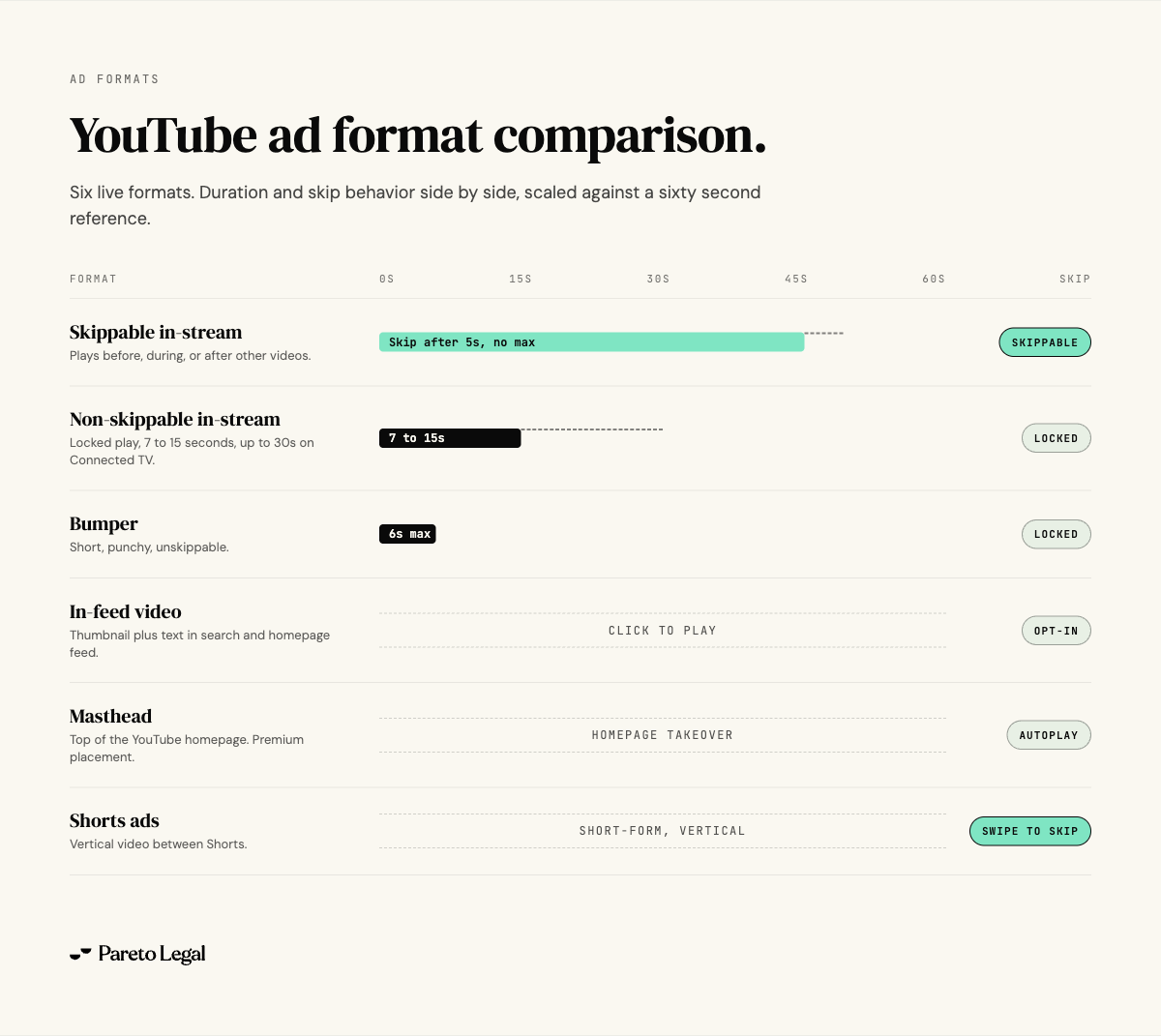
Google’s current video ad lineup has six formats. Older guides sometimes list “overlay ads” or “sponsored cards.” Those are retired terms and do not reflect what Google Ads currently sells.
The formats below are Google’s own, current list.
| Format | Length | Skippable | Where It Runs |
|---|---|---|---|
| Skippable in-stream | No fixed limit | Yes, after 5 seconds | Before, during, or after another video |
| Non-skippable in-stream | 7 to 15 seconds (up to 30 on Connected TV) | No | Before, during, or after another video |
| Bumper | 6 seconds or shorter | No | Before, during, or after another video |
| In-feed video | Varies (thumbnail-based) | N/A (user opts in by clicking) | Search results, watch-next, home feed |
| Masthead | Varies | N/A (autoplay, muted) | Top of the YouTube home feed (reserved placement) |
| Shorts ads | Short-form, vertical | Yes, immediately (viewer swipes past) | Between videos in the Shorts feed |
Sources: Google Ads Help, About video ad formats and Non-skippable in-stream ads.
Skippable in-stream ads are the most common starting point for a law firm. They are billed on a cost-per-view basis, so a firm generally pays only when someone watches long enough to signal real interest, not just for an impression. Bumper ads exist for a different job entirely: pure reach and name recognition in six seconds, not a pitch.
How to Target the Right Audience on YouTube
Google restricts what a legal advertiser can build an audience around, and the restriction is stricter than most firms expect. Google’s ad policies classify health conditions, medical treatments, and traumatic personal experiences as sensitive categories.
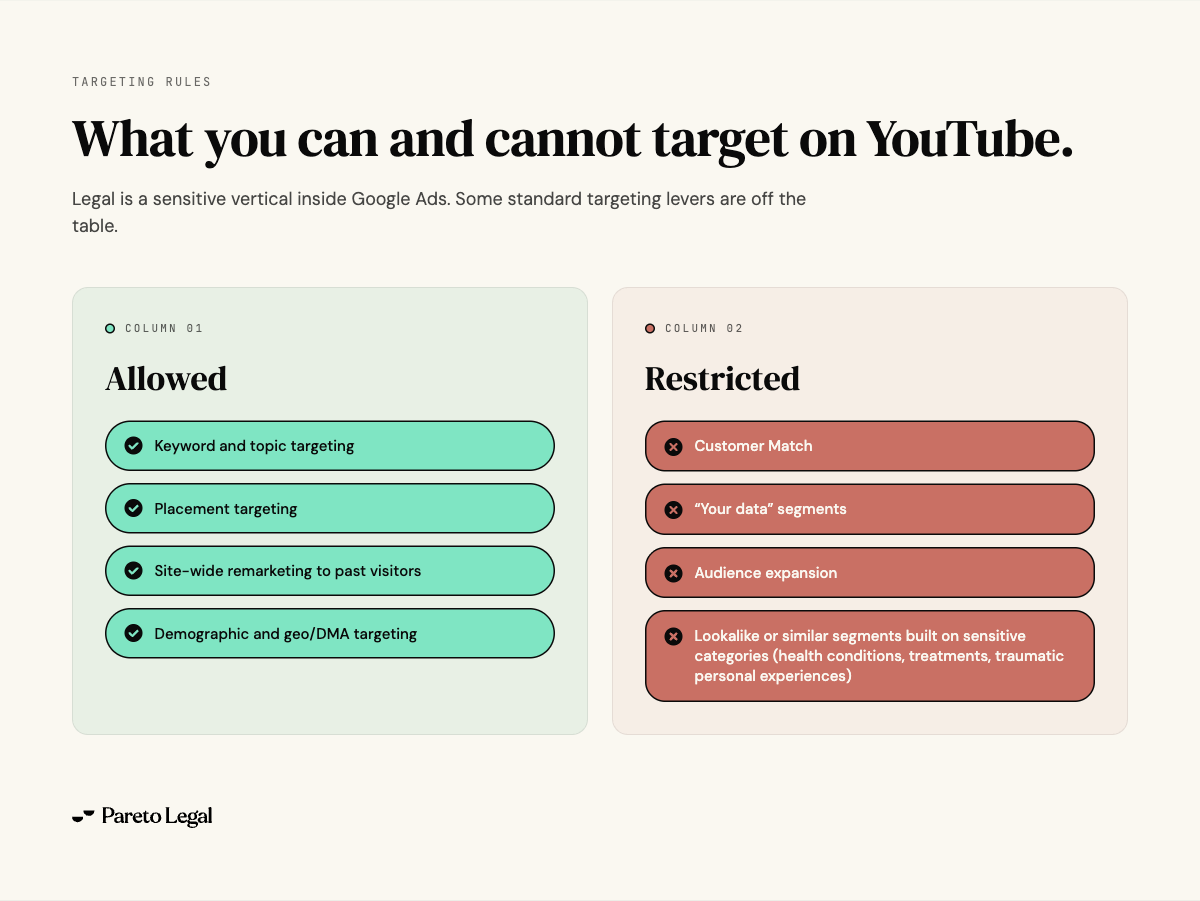
Google’s own policy language states that advertiser-curated audiences (Customer Match, “your data” segments, audience expansion, and lookalike segments) “cannot be used if promoting in sensitive interest categories, because they may inadvertently contain sensitive user signals.”
For a personal injury, workers’ comp, or criminal defense firm, that rules out the shortcut most agencies reach for first: build a list of people who look like past clients and target them directly. That list is built on the exact category Google restricts.
What remains available, and what actually does the work:
- Keyword and topic targeting. Reaching someone watching content about a specific topic, like a car accident explainer or a workers’ comp overview, without Google asserting it knows anything about that specific person’s history.
- Placement targeting. Choosing specific channels or videos where the firm’s ad should run.
- Site-wide remarketing. Reaching people who visited the firm’s site generally. This sits outside the restriction because it is not built from sensitive-category audience signals, unlike Customer Match or lookalike segments.
- Demographic and geo/DMA targeting. Age, household income range, and location down to the metro or zip level.
Geographic precision matters more for a law firm than most advertisers, since practice areas are local and state bar rules vary. The same location-based logic applies to using geofencing to attract more local clients, and it complements a YouTube campaign rather than replacing it.
What to Budget for YouTube Ads
There is no fixed daily figure that applies across firms and markets. Budget guidance that hands a law firm a flat dollar number without knowing the practice area or the market is guessing.
The model I usually suggest is an 80-20 split: roughly 80% of the budget going to direct response, and the other 20% going after cold traffic.
YouTube sits in that cold-traffic slice, alongside display.
I want to be clear that this isn’t a hard rule. The ratio also tends to shift as a firm grows, with more of the budget moving toward brand and awareness over time.
In practice, that means a smaller or newer firm typically starts with a modest YouTube slice while direct response carries most of the account. YouTube’s share tends to grow only once the direct-response channels are already performing.
The right number depends on the market, the practice area, and what the rest of the account is doing. It is not a template.
Common Mistakes Law Firms Make with YouTube Ads
Most of the waste on legal YouTube accounts traces back to a handful of repeat patterns.
- Judging YouTube by Search’s standards. Pareto sees this exact mistake on inherited Meta accounts, and the same logic applies to YouTube: “the biggest mistake is they treat Meta like they treat Google… they expect Meta to perform the same way that Google ads does.” YouTube is an awareness channel reaching people mid-video, not a channel competing for the same intent-driven click Search captures.
- Sending clicks to the homepage. A generic homepage forces a viewer who just watched a 15-second ad to re-orient and search the site for relevant information. A landing page built around the same topic as the ad keeps that momentum.
- Measuring success by views or clicks instead of signed cases. A campaign can post a strong view rate and still not be worth the spend if none of it converts to retained clients. Reporting that stops at views or clicks misses the number that actually matters.
- Targeting too broadly, too long. Without a frequency cap or a defined geography, budget gets spread across viewers well outside the firm’s practice area or service radius.
- Skipping the first five seconds. On a skippable format, an opening that does not establish who the ad is for in the first few seconds gets skipped before the message lands, regardless of how strong the rest of the video is.
Is YouTube Advertising Compliant with Bar Rules?
Running a YouTube ad is generally permitted everywhere. A pre-roll or in-feed ad is directed at the general public, which puts it under a state bar’s advertising rules rather than its stricter solicitation rules. The risk is almost never the format. It is the content and the disclosures inside it.
Every state has adopted some version of the ABA Model Rules on lawyer advertising. Three apply directly to a YouTube ad:
- Rule 7.1: nothing false or misleading, including a statement that is technically true but creates an impression the facts do not support.
- Rule 7.2: advertising is allowed, in any medium, provided the communication identifies at least one responsible lawyer or firm.
- Rule 7.3: solicitation has limits, but a video ad served to the general public is advertising, not the real-time personal contact this rule restricts.
Individual states layer on their own requirements beyond the model rules. Disclaimers, filing steps, and disclosure rules vary by jurisdiction.
This is general information, not legal advice. Confirm current requirements with your own state bar before a campaign goes live, and avoid any claim of a guaranteed or predictable case outcome in the ad itself.
How Pareto Approaches YouTube Ads
Google Search and YouTube do different jobs inside the same Google Ads account. Pareto’s law firm PPC service covers Search: capturing the person who has already decided to look for a lawyer. YouTube is upstream of that decision, reaching someone before they have typed anything.
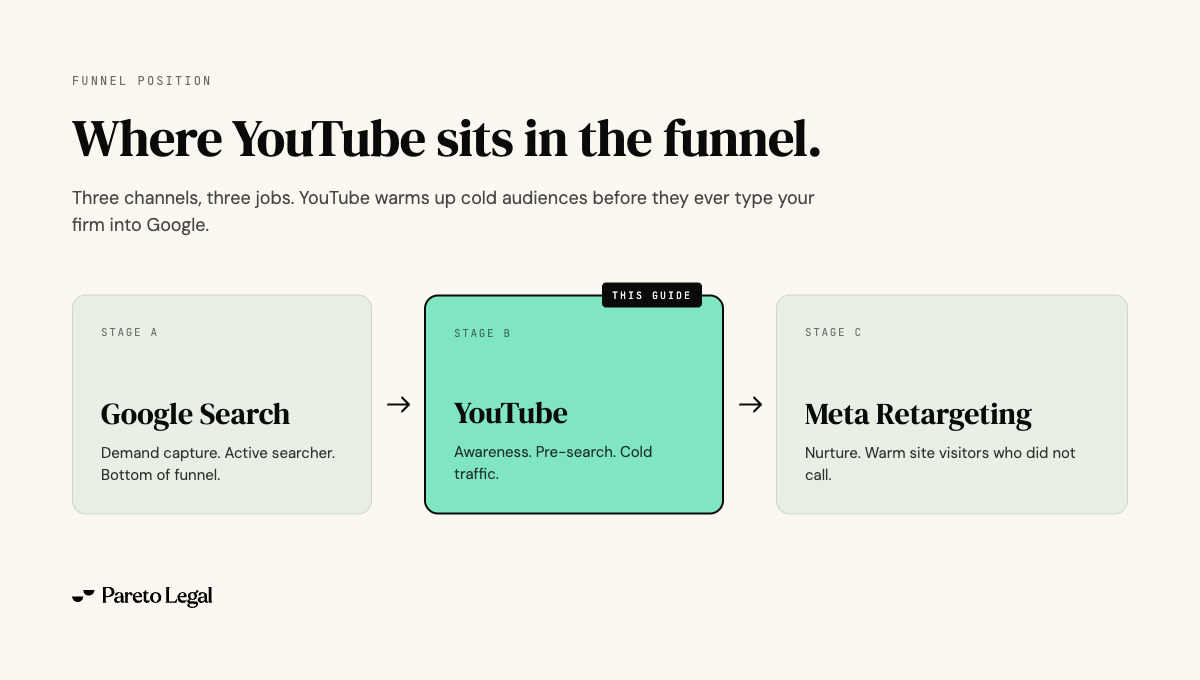
Treating YouTube as a second lead-volume engine bolted onto Search misreads the channel. Pareto positions it as part of the same awareness layer as programmatic, OTT, and Meta retargeting: channels built to warm an audience that Search and Local Service Ads capture later, not to compete with them for the same click.
Meta and the other social platforms play that same awareness role. It’s the layer our paid social services are built around. On the Meta side specifically, I’ve written guides on Meta ads for law firms and Meta ads for personal injury lawyers.
Whatever the channel, Pareto reports against signed cases, not platform metrics. A YouTube campaign with a strong view rate and no contribution to signed cases is not a channel worth keeping, regardless of what the platform’s own dashboard says.
That standard comes from managing more than 1,000 law firm ad accounts, over 600 of them personal injury, with a 95% client retention rate and an average client tenure of 2.5-plus years.
Roughly 70% of Pareto’s clients double their case volume within the first year of working together. Case results by firm, siloed by client, are documented at Pareto’s case studies.
Frequently Asked Questions
Are YouTube Ads Too Expensive for a Small or Solo Law Firm?
Not inherently. Skippable in-stream ads bill on a cost-per-view basis, so a firm generally pays only for engaged views, not raw impressions. The bigger cost driver is scope: a small firm running YouTube across a wide geography with no frequency cap will burn budget faster than one running a tight, local campaign.
What Type of Video Should a Firm’s First YouTube Ad Be?
A direct-to-camera video from an attorney or staff member, focused on one topic, performs better as a starting point than a polished but generic brand spot. Cover what to do after a specific type of accident, or what a specific practice area handles.
Clarity in the first five seconds matters more than production value.
How Do I Know if My YouTube Ads Are Working?
View rate and click-through rate tell you whether the creative and targeting are landing. They do not tell you whether the campaign is producing signed cases. That requires tracking a YouTube-sourced lead through intake to a retained matter, not stopping the measurement at the click.
Do I Need a Professional Video Production Team?
No. Authenticity typically outperforms production value on YouTube, especially for a direct-to-camera format. A clear message and a real attorney on screen matter more than studio lighting.
Can I Retarget People Who Visited My Site?
Yes, at the site-wide level. Google restricts audiences built on sensitive categories like inferred health or injury status. General site-visitor remarketing, reaching anyone who visited the site rather than a list built around a specific medical or legal situation, remains available.
How Does YouTube Advertising Differ from Google Search Ads for Lawyers?
Search reaches someone who has already decided to look for a lawyer and typed a query; it is demand capture. YouTube reaches someone earlier, while they are watching unrelated video content, before that search happens. That’s what our law firm PPC services are built around: catching that decision the moment it happens.
Is YouTube Advertising for Law Firms Compliant with Bar Advertising Rules?
Yes, structurally. A YouTube ad served to the general public counts as advertising, not solicitation, under the ABA Model Rules and most state versions of them. Compliance risk lives in the content: false or misleading claims, missing attorney identification, missing disclaimers. Confirm specific requirements with your state bar.
Get a Free YouTube Ads Audit
Pareto will show you where a YouTube campaign fits inside your account, what it should be measured against, and what a program built to reach signed cases looks like for your practice area and market.