
Here’s a pattern we see constantly. A personal injury firm is paying around $1,000 per lead on Google Ads for lawyers. They start running Facebook ads, and suddenly the leads come in at $10 apiece — dozens in a week.
The intake team is thrilled.
Until…
Within days, the phone stops getting answered. A chunk of the submissions are bots. Others can’t remember filling out a form. The managing partner pulls the budget and concludes, “Facebook doesn’t work for law firms.”
After managing over 1,000 law firm ad accounts, I can tell you: Meta ads for law firms work. But not the way most agencies set them up, and not the way most firms measure them.
And here’s the part that trips up even experienced marketers — the Meta of 2026 is not the Meta most playbooks were written for. Detailed interest targeting has been gutted. Advantage+ is the default.
Meta’s retrieval system now weighs your creative far more heavily in deciding who sees your ad, which means the ad itself is now the targeting layer. If you’re still building campaigns around carefully stacked audiences, you’re optimizing a lever the platform no longer responds to.
In this guide, I’ll show you how to generate signed cases from Meta — often at half what you’re paying for them on Google — using the way the platform actually works today.
Why Facebook Advertising Matters for Law Firms
Meta ads let you re-engage the website visitors who read your practice area page and left without calling. They let you reach prospects across every practice area at a fraction of what Google charges per click.
And with billions of users across Facebook, Instagram, Messenger, and Threads, Meta lets you build brand recognition at a cost traditional media can’t touch.
Meta does have its own rules for legal services — and they’ve tightened considerably. Interest categories tied to health, injury, and hardship have been stripped out of the platform.
Meta’s personal attributes policy prohibits ads that imply you know something about a person’s situation, and enforcement isn’t limited to the obvious “Were you injured?” opener — indirect phrasing risks the same rejection under the same policy.
Retargeting still works, but the signal driving it is weaker than it was three years ago.
None of that makes the channel unworkable. It makes it a channel with rules. Work inside them and Meta delivers a combination of awareness and lead volume that Google structurally cannot — because Google can only sell you the demand that already exists.
How Meta Ads Work (And Why They’re Not Google Ads)
Before we get into tactics, you need to understand the fundamental difference between how Google and Meta work for law firms. This is where the biggest mistakes happen.
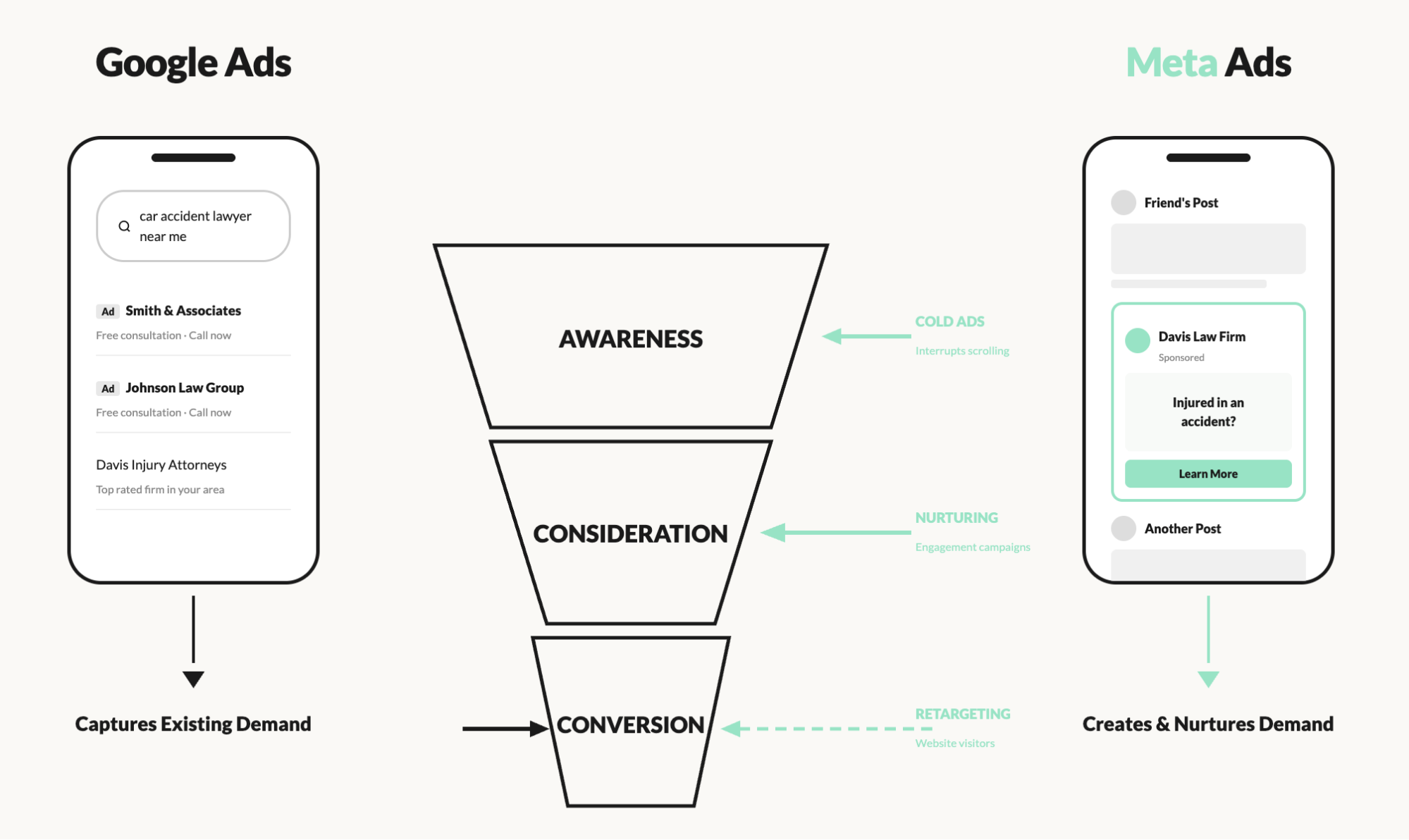
Google captures existing demand. Someone gets injured in a car accident.
Within 24–72 hours, they’re searching “personal injury lawyer near me.” Google Ads puts your firm in front of that active searcher.
They’re problem-aware, solution-aware, and ready to act. That’s bottom-of-funnel intent.
How I structure that search side for an injury firm is in google ads for personal injury lawyers.
Meta interrupts and creates demand. That same person, two weeks before their accident, is scrolling their feed, watching videos, commenting on friends’ posts, browsing Marketplace. Completely different headspace.
On Meta, you’re interrupting. You have to stop them mid-scroll and earn the attention before you can ask for anything.
The biggest mistake we see when we inherit a Meta account from a law firm is that the previous agency treated it like Google.
They expected the same lead quality, the same buyer intent, and the same measurement framework. When those didn’t materialize, they called the channel broken.
Different intent means the channel performs differently and has to be evaluated differently. Use Meta to replicate Google and you’ll fail.
Use it for what it’s actually good at: retargeting, brand awareness, and volume-based lead generation paired with strong post-lead qualification systems. Do that, and it becomes one of the most cost-effective channels in your legal marketing mix.
Here are the key differences at a glance.
| Factor | Google Ads | Meta Ads |
|---|---|---|
| User intent | Active: searching for legal help right now | Passive: scrolling, browsing, socializing |
| Funnel position | Bottom of funnel (capture demand) | Top/mid funnel (create demand + retarget) |
| Lead volume | Lower volume, higher intent | Higher volume that requires a qualification layer |
| Cost per lead | $500–$1,000+ for PI in major metros | As low as $10 (raw leads, before qualification) |
| What drives performance | Keywords and match types | Creative — the algorithm reads your ad to decide who sees it |
| Creative needs | Text ads (quick to produce) | Video, image, carousel: continuous production investment |
| Retargeting | Restricted for sensitive situations (injuries, health, hardship) | Available across practice areas, but signal is degraded by consent loss and creative must avoid implying you know the person’s situation |
| Attribution | Clear last-click attribution | Requires Pixel + Conversions API, plus self-reported attribution at intake |
Creative Is Your Targeting Now
If you take one thing from this guide, take this: on Meta in 2026, your creative is not the message you deliver to an audience you selected. Your creative is how the audience gets selected.
Meta rebuilt the front end of its ad system. Before an ad ever reaches the auction, a retrieval layer (Meta’s current system is called Andromeda) weighs the performance signals from your creative — the visuals, the hook, the tone, the subject matter — far more heavily in predicting who it should be shown to.
Your audience settings narrow the pool. The creative decides the match inside it.
Which means the old lever and the new lever have swapped places. The advertiser who wins is no longer the one who built the cleverest audience. It’s the one who produced the strongest and most varied creative.
Three consequences that matter for law firms:
- Variety beats polish. In practice, Meta clusters near-identical ads and treats them as effectively one ad. Ten versions of the same attorney video with different headlines is one ad in the system’s eyes. Ten genuinely different concepts — a client story, an explainer, an office walkthrough, a “what to do in the first 48 hours” piece — is ten shots at the auction.
- Fatigue arrives faster. A single concept now burns through its audience in weeks, not months. Firms that shot one video in January and ran it through June are the same firms that tell me the channel stopped working.
- Creative production is a line item, not a project. If you’re spending real money on Meta, you need a standing creative pipeline. This is the single biggest gap between the law firms that scale on Meta and the ones that quit.
What Works for Law Firm Ad Creative
Video outperforms everything else. Attorney explainers, client testimonials (anonymized where the case requires it), and educational content addressing a specific legal problem consistently generate the highest engagement.
Keep it short — 15 to 60 seconds — and put a real hook in the first three seconds.
Image and carousel ads still earn their place. A well-designed single image with sharp copy and a direct call to action will outperform a mediocre video every time.
But format and content have to be designed together. Carousel only works when the content is built for carousel — a swipeable narrative, a multi-step framework, a sequence of case results.
Single image works when one visual can carry the whole message. Video works when there’s something to reveal in the first three seconds.
Choosing the format first and retrofitting the content is how you end up with a carousel nobody swipes.
Pro tip: Shoot vertical (9:16). Most people are on mobile, and vertical takes up more of the screen. Always add captions — assume the sound is off.
Three Types of Facebook Ad Campaigns Your Law Firm Should Know
There are three distinct plays you can run on Meta, and understanding what each one is for determines whether your spend produces cases or evaporates.
1. Retargeting Campaigns
A prospective client visits your site. They read your personal injury page, maybe a blog post. Then they leave without calling, filling out a form, or starting a chat. Without retargeting, that person is gone.
You already know they’re more likely to hire you than a stranger — they came to your website. Retargeting serves ads to those visitors as they scroll their feed, reminding them your firm exists and giving them a reason to come back.
Every law firm running Google Ads should, at minimum, be running retargeting on Meta. It’s the highest-ROI starting point because you’re reaching people who already demonstrated interest.
Two things to know about how this works in 2026.
First, retargeting is not restricted by practice area — but the signal feeding it is weaker than it used to be, because a large share of users never consented to being tracked in the first place.
Uploading a customer list from your CRM as a Custom Audience is now a more durable input than relying on pixel-based website audiences alone.
Second, and more important: whatever your audience is built from, the creative still has to comply. An ad that says “Still dealing with your injury?” to someone who visited your car accident page is exactly the pattern Meta’s personal attributes policy is built to catch.
Retarget the person; don’t announce what you know about them.
2. Cold Audience Lead Generation Campaigns
Cold audience campaigns — typically run on Meta’s Leads or Sales objective — push ads to people who have never been to your website, with the goal of generating a lead.
This is where most law firms go wrong, because it demands a much more sophisticated setup than retargeting.
You’re interrupting someone in the middle of their day.
The creative has to stop them within three to five seconds.
The landing page has to pre-qualify them before they ever reach your intake team.
And the post-lead experience has to filter out the noise.
Cold audience lead gen on Meta is a volume play. You will generate far more leads at a far lower cost than Google, and the quality per lead will be lower. The system you build around those leads is what determines whether the economics work.
3. Brand Awareness Campaigns
Brand awareness campaigns reach a cold audience in your geographic area with the goal of making your firm memorable, not generating an immediate lead.
As your firm grows, Google search alone caps out. There are only so many people searching for an injury lawyer or a divorce attorney in your market each month, and once you’re competitive on all of them, there’s nowhere left to put the next dollar.
Building awareness on Meta puts your firm in front of people before they ever start searching, which expands the pool of cases you can compete for.
It also feeds your branded search volume — the cheapest, highest-converting traffic you’ll ever buy.
Where to start: Retargeting is the lowest-risk lever to pull as soon as you have enough traffic to build a meaningful audience.
Layer in cold audience lead generation once retargeting is profitable and your post-lead qualification system is in place. Awareness campaigns run alongside both — they’re not a phase three you have to unlock.
Audience Signals (Not Targeting): How to Reach the Right Clients in 2026
This is where 2026 Meta diverges most sharply from the playbook most firms are still running.
Meta has spent four years dismantling precision targeting. Sensitive interest categories — health conditions, hardship, and the like — started coming out in 2022.
Detailed targeting exclusions were removed in March 2025. And on January 15, 2026, ad sets still using the remaining deprecated interest options simply stopped delivering.
What replaced it is Advantage+ Audience, now the default on the Leads and Sales objectives. Under Advantage+, only two of your inputs are hard rules: location and minimum age.
Everything else — age range, gender, interests, custom audiences, lookalikes — functions as a suggestion. The algorithm treats them as a starting point and expands past them the moment it thinks it can do better.
So the question is no longer “how tightly can I define my audience?” It’s “what signals am I feeding the system, and is my creative good enough to do the sorting?”
Geographic Targeting
Location is one of the two settings Meta still honors as a hard constraint, so it’s worth getting right. Target where you’re licensed and where you can actually take the case.
One counterintuitive note: broader is often better on Meta, even geographically. Starting statewide or wider gives you a lower CPM and gets you through the learning phase considerably faster than a tight radius around your office.
If you practice across a whole state, don’t hand the algorithm a five-mile circle and then wonder why the CPMs are brutal.
Demographic and Interest Signals
Think about who your ideal client is — an estate planning firm skews older and higher-income; a workers’ comp firm skews toward physical trades — but understand what you’re doing when you enter it. You are giving the algorithm a hint, not drawing a boundary.
In practice, that means you don’t build a tight audience of “men 30–55 in Manhattan interested in motorcycles” for a PI campaign.
You give Meta a broad geographic and age range and let the algorithm find the conversion patterns from your creative and your pixel data — which it is now demonstrably better at than you are.
Narrow interest stacking doesn’t just underperform; it fragments the signal the algorithm needs to learn.
Custom Audiences and Lookalike Audiences
Custom Audiences let you reach people based on a specific interaction with your firm: website visitors, people who watched your video ads, or a client list uploaded from your CRM.
First-party data is the single highest-quality signal you can hand Meta, and it has become more valuable, not less, as everything else eroded.
Lookalike Audiences have lost most of their old power. Under Advantage+, a lookalike is a directional hint the algorithm uses as a prior and then abandons if it finds something better.
They’re still worth using when you’re entering a new market or seeding a campaign with thin conversion data.
They are not the cornerstone tactic they were two years ago, and if your agency is still building 1%/2%/5% lookalike ad sets and calling it strategy, that’s a tell.
Exclusions
Who you exclude still matters. Build exclusion audiences for people who already converted, people who submitted a lead and didn’t qualify, and existing clients. There’s no reason to keep paying to reach someone you’ve already signed.
How to Solve the Lead Quality Problem (And Make the Economics Work)
“I ran Facebook ads for my law firm, and the leads were terrible.” I’ve heard a version of this hundreds of times.
The firms that abandon Meta after that experience are leaving money on the table, because the lead quality problem is solvable once you understand what causes it.
Meta’s algorithm is a machine learning system. You give it a budget and a goal, and it accomplishes that goal as cheaply as it possibly can — with no opinion about quality.
If you’re running native lead form ads, where someone submits their name and phone number without ever leaving the feed, you are asking the algorithm to find you the cheapest form submissions on earth. It will.
That means bots, low-intent users, and people who click on everything.
And it compounds: the system learns that low-friction clickers are the fastest path to its goal, and the lead quality spirals downward.
The First Fix: Landing Pages Over Lead Forms
When you push traffic to a dedicated landing page instead of a native form, the user has to click the ad, wait for the page to load, and complete a longer form. Every step is a filter.
The leads that survive are better, because the friction screened out the people who were never going to sign.
You can run both concurrently — one ad set with lead forms, one driving to a landing page — but measure at the qualified lead level, not raw CPL.
Landing page campaigns almost always win on the metric that matters, and almost always lose on the one your agency likes to report.
The Advanced Fix: Train the Algorithm on What Qualified Looks Like
This is what separates the firms that make Meta work from everyone else.
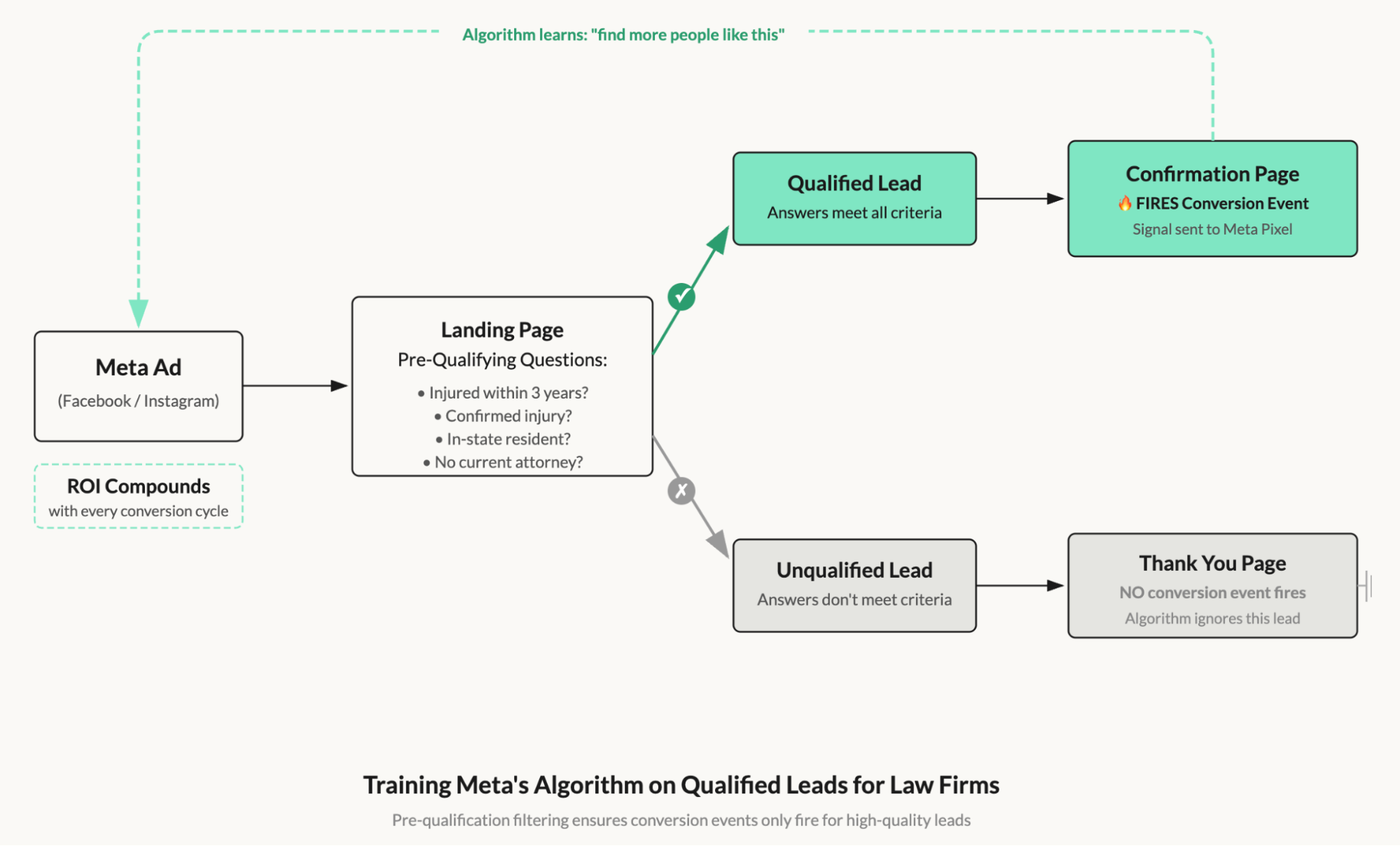
Instead of optimizing for a generic “form submit” event, you build landing pages with pre-qualifying questions specific to your practice area, then structure your conversion events so that only qualified answers fire a conversion back to Meta.
For a personal injury firm, those questions might be:
- Were you injured in the last three years?
- Do you have a confirmed bodily injury?
- Were you injured in a state where our firm practices?
- Are you already working with an attorney?
All yes/no, all on the landing page form. Someone who answers in a way that indicates they’re qualified lands on a confirmation page that fires the conversion event. Someone who doesn’t qualify lands on a different page that fires nothing.
You are telling Meta, in the only language it speaks: this was a good lead, find me more people like this. The algorithm keeps learning, the proportion of qualified leads climbs, and the ROI compounds.
Under the current system — where clean conversion signal is the fuel the whole retrieval engine runs on — this matters more than it ever has.
The Infrastructure Fix: Post-Lead Qualification
Even with pre-qualifying forms, Meta drives volume. Volume without a system overwhelms an intake team. You need to remove humans from the first filter so your team only talks to prospects worth their time.
When someone submits, trigger an automated sequence before a human ever picks up the phone: a text with additional qualification questions, an email pointing to a fuller form, or a scheduler that only books a consultation once the key criteria are confirmed.
Now run the math. A Google Ads personal injury lead in New York might cost $1,000. A Meta lead costs $10. If one in fifty Meta leads is qualified, your cost per qualified lead is $500 — half the Google price.
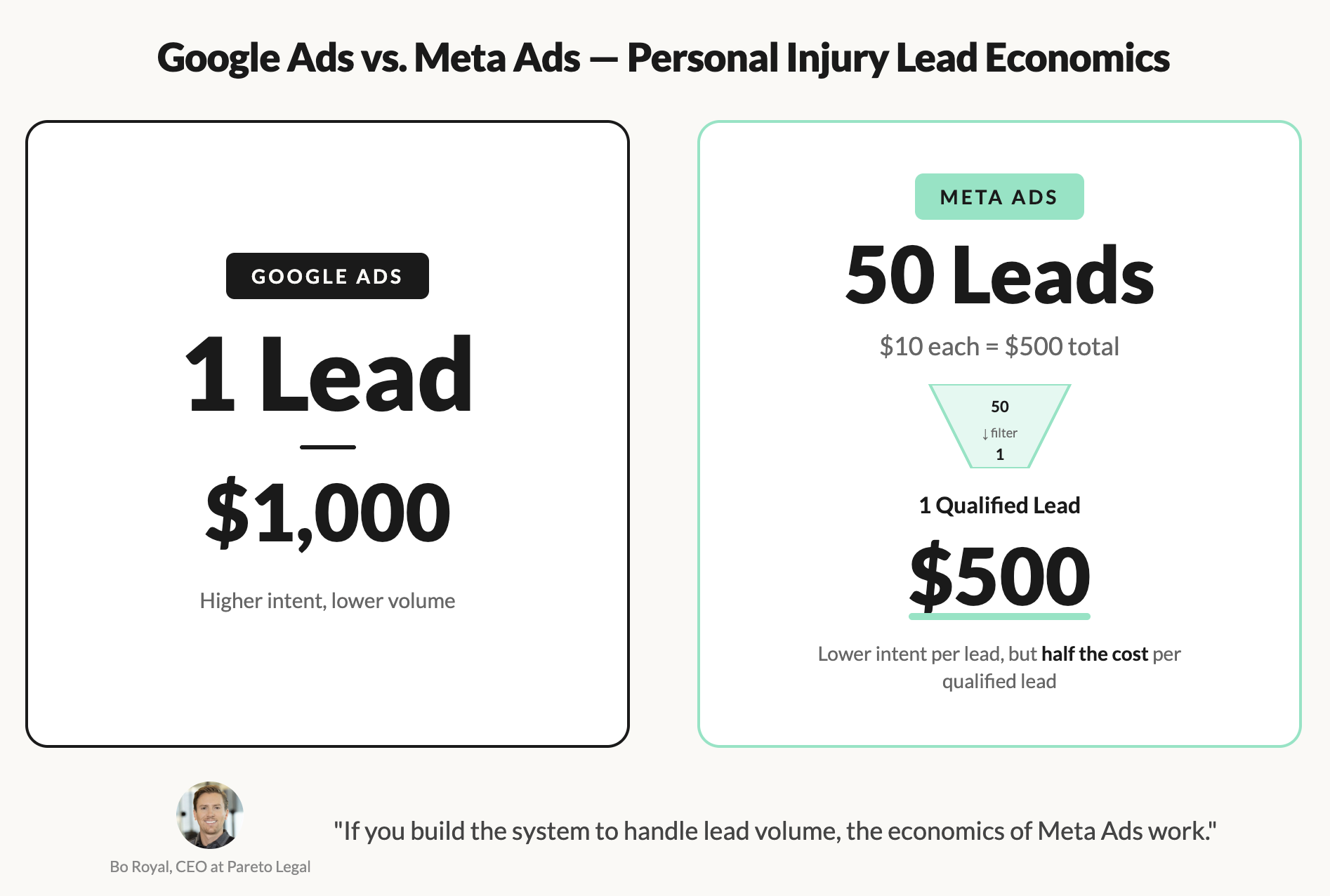
The economics work. They just require the landing page structure, the algorithm training, and the post-lead automation to hold them up.
Want to see how this would work for your firm?
Our Pareto Score assessment evaluates your strategy, marketing execution, intake systems, attribution infrastructure, and reputation. Our team will identify exactly where Meta ads fit (or don’t) in your growth plan.
Contact us to get your free Pareto Score assessment.
Practice Area Playbook: Where Meta Ads Work Best
Not all practice areas perform equally on Meta, and the difference comes down to one factor: the length of the decision window. The longer the window, the more value retargeting and awareness deliver.
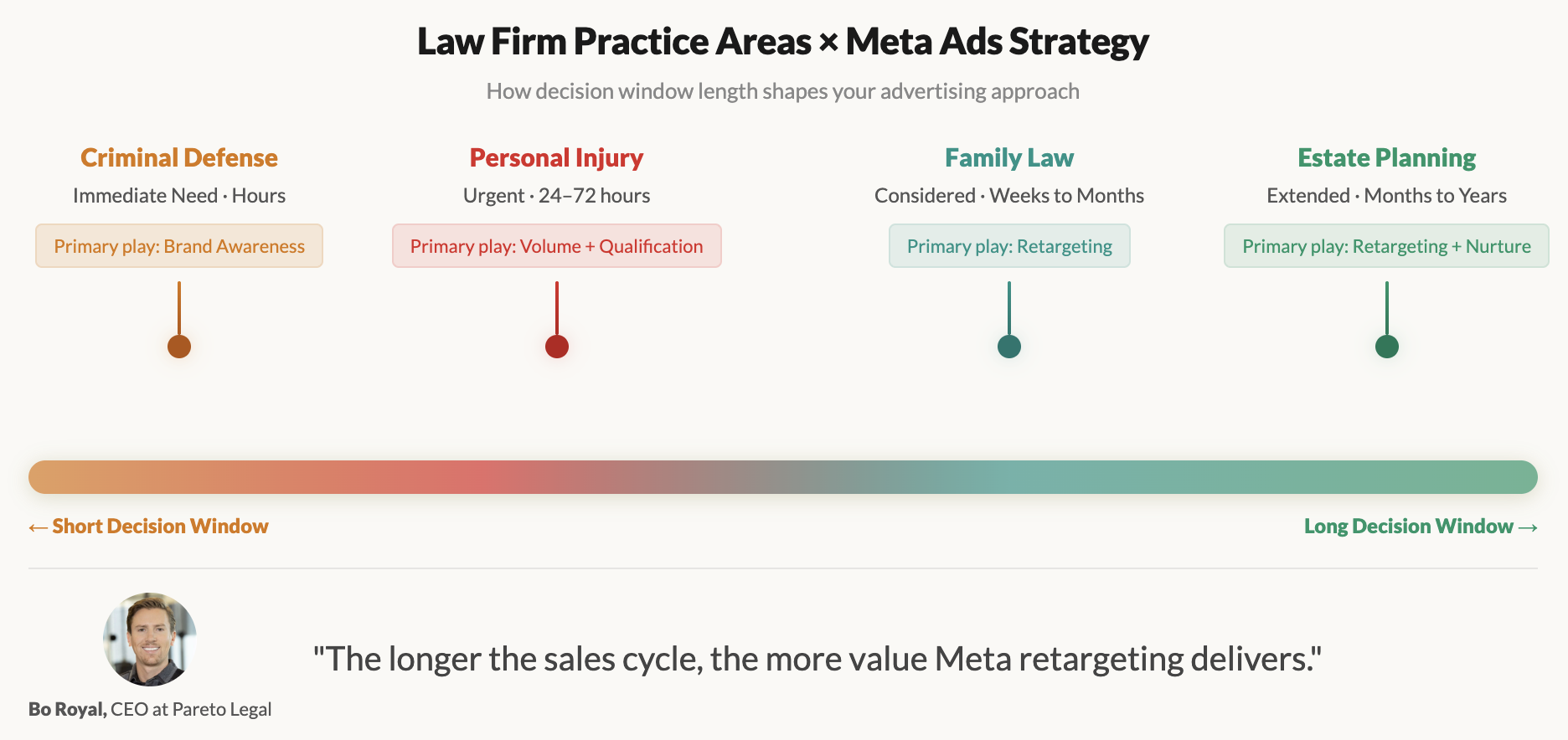
Personal Injury (Short Cycle: 24–72 Hours)
Someone who gets injured contacts a lawyer within days. Retargeting has a narrow window to work in. I wrote a separate playbook on Meta ads for personal injury lawyers that gets into that short window.
Meta’s primary value for PI is as a volume play with aggressive pre-qualification, plus a brand awareness engine so your firm is the one they recognize before the accident ever happens.
Family Law (Long Cycle: Weeks to Months)
Someone considering divorce may research for months before retaining anyone.
This is where Meta retargeting shines — you’re nurturing a prospect through an extended decision window that Google can only meet at the very end of. Retargeting ROI is typically much stronger here than in short-cycle areas.
Estate Planning (Extended Cycle: Months to Years)
Someone reads a blog post about setting up a trust and then doesn’t think about hiring a lawyer for six months. Meta keeps your firm in front of them across that entire consideration period. Google simply cannot cover that window.
Criminal Defense (Urgent: Immediate Need)
High urgency, very short window. Meta’s primary value here is brand awareness — being the firm someone recognizes when they, or a family member, suddenly need help with no time to comparison-shop.
Retargeting is less impactful; awareness builds the recognition that drives branded search.
The core principle: the longer the sales cycle, the more value Meta retargeting delivers.
For short-cycle areas, Meta shifts toward awareness and volume lead generation with robust qualification behind it. Either way, Meta is a complement to Google, not a replacement for it.
Budget Framework: How Much Should a Law Firm Spend on Facebook Ads?
What’s the right split between Google and Meta? We apply the 80/20 rule — the same Pareto methodology we bring to everything — to budget allocation.
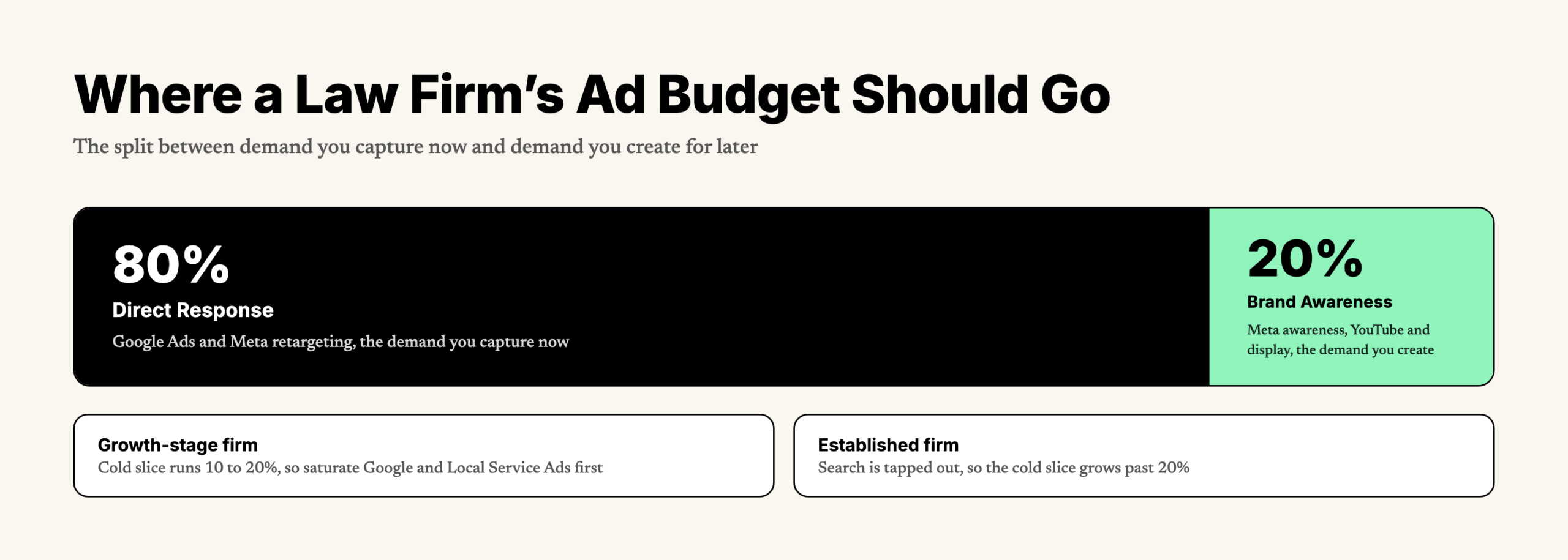
For growth-stage firms: if you need three to five more cases a month to hit the next level, saturate Google Ads and Local Service Ads first.
Then follow an 80/20 split — direct-response lead generation takes roughly 80% of spend, and the cold, brand-awareness slice sits around 10–20%.
On Meta specifically, weight toward retargeting (which behaves like bottom-of-funnel lead generation), with a smaller slice for cold audience campaigns. It isn’t a hard rule, but it’s where we start most growth-stage firms.
For established firms: once you’ve saturated the search volume in your market, the balance shifts. There are only so many people searching for an attorney in your area each month.
To keep growing, you have to invest in capturing people before their journey starts.
Meta becomes your primary awareness engine, and the cold, brand-awareness allocation grows well beyond that starting 10–20% — how far depends on how tapped-out your search channels already are.
Pro tip: Meta retargeting belongs in the 80% lead generation bucket, not the 20% cold bucket.
Retargeting reaches people who have already been to your website — that’s high-intent, bottom-of-funnel. The 20% is for people who have never interacted with your firm.
Getting this distinction wrong is how firms end up thinking Meta “doesn’t convert,” when what they actually measured was two very different campaign types averaged together.
Attribution: How to Know If Meta Ads Are Actually Working
Attribution on Meta has always been harder than Google, and Apple’s App Tracking Transparency framework made it harder still. Here’s what actually broke and what to do about it.
Before ATT, Meta could observe most of the journey from ad to conversion directly. After it, a large share of iOS users opted out of tracking, which meant Meta lost visibility into what happened after the click for a big chunk of its audience.
It didn’t stop measuring — it started modeling. Some of the conversions in your reporting are now statistical estimates rather than observed events, and reported conversions no longer reconcile cleanly against your CRM.
That gap is the thing most firms discover mid-argument with their agency.
The fix is not to accept the fog. It’s to feed the system better data.
Last-Click Attribution
The baseline. With the Meta Pixel properly installed and the Conversions API sending events server-side, you can see which campaign drove which lead.
Running Pixel and CAPI together is no longer optional — it’s the minimum viable setup, and it’s what recovers a meaningful share of what ATT took away.
Check your event match quality; if it’s low, the algorithm is learning from noise.
View-Through Attribution
Here’s the harder problem. Someone sees your ad in their feed and doesn’t click. Later they go to Google, search your firm by name, and call you.
In a last-click model, Google takes the credit. Meta gets nothing — even though Meta’s ad is the reason the search happened.
This is where self-reported attribution becomes essential.
Your intake team should be asking, every time: “How did you hear about us?” and “Have you seen any of our ads?” That creates a qualitative feedback loop that captures influence no tracking platform will ever show you.
And here’s the upside most people miss. If you can get your Meta campaigns profitable on a last-click basis alone, everything else is residual.
Thousands of people are seeing your ads every day, not clicking, and becoming aware of your firm anyway.
You’ve built a profitable awareness campaign with clean attribution attached. That’s the best-case scenario, and it’s achievable.
Facebook Ad Compliance and Ethics for Lawyers
There’s a fine line between being memorable, funny, and compelling — and being borderline obnoxious.
Every state has its own bar advertising rules, and your Facebook advertising has to stay inside them.
A good litmus test: if a judge pulled up your ad in court and displayed it on a screen in front of the entire courthouse, how would you feel? Embarrassed, or proud?
You have to maintain good standing with the judges you appear in front of, and your advertising reflects on your professional reputation.
You also have two separate rulebooks to satisfy — the bar’s and Meta’s — and they don’t always fail you in the same place. Here’s what to watch.
Don’t Overpromise on Outcomes
Specific dollar guarantees and “we’ll win your case” claims get rejected by Meta’s review system before they ever go live.
Even softer versions — “the maximum settlement you deserve” — create expectations that turn into one-star reviews and disappointed clients.
Frame your value around what you actually do: your process, your experience, the type of firm you are. Not the result.
Don’t Imply You Know Something About the Person
This is the rule that catches the most law firm ads, and most firms don’t know it exists.
Meta prohibits ads that assert or imply personal attributes of the viewer — including health conditions, physical characteristics, and financial hardship. “Injured in an accident?” is precisely the construction the policy targets.
Enforcement isn’t limited to that obvious opener — indirect framing like “for people recovering from a serious injury” risks the same rejection under the same policy.
The fix is a shift from “you” language to benefit language.
Instead of “Struggling after a car accident?”, write “How injury claims actually get valued in [State] — a free 10-minute guide.” Same audience, same intent, no assertion about the person reading it.
Have Your Creative Reviewed Before It Goes Live
The managing partner, or whoever owns marketing decisions at your firm, should review every ad — video, image, and copy — before publication.
When in Doubt, Consult an Ethics Attorney
If you’re on the fence about whether an ad crosses a line, bring in an ethics attorney rather than guessing. A review costs less than a bar complaint.
Include Required Disclaimers
Most states require specific disclosures in attorney advertising. Know your state’s rules and make sure every ad complies.
Final Thoughts
Meta ads for law firms aren’t complicated. But they are different from Google — and different from the Meta most agencies learned on. The firms signing cases from the platform are the ones that adapted to how it actually works now.
If you take nothing else from this guide, take these seven things:
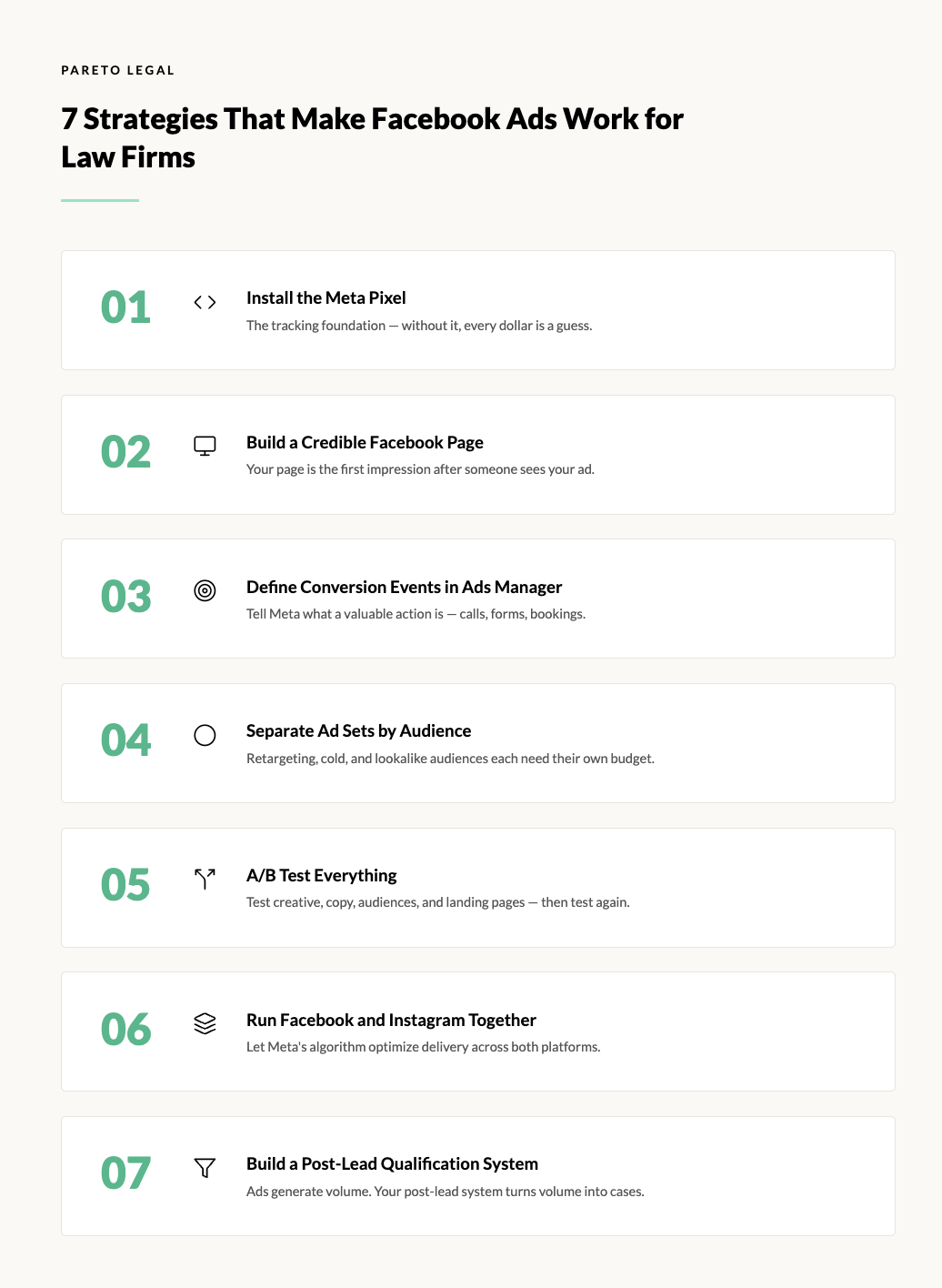
The firms that get these fundamentals right don’t complain about junk leads. They’re too busy scaling.
Stop guessing. Start with a diagnostic.
Our Pareto Score assessment evaluates your strategy, marketing execution, intake systems, attribution infrastructure, and reputation. We identify exactly where Meta ads fit in your growth plan.
Built for plaintiff-side law firms spending $40K+/month on digital advertising.
Contact us to get your free Pareto Score assessment.
Frequently Asked Questions About Meta Ads for Law Firms
Should every law firm run Meta ads?
Every firm running Google Ads should at least be running retargeting on Meta. Beyond that it depends on practice area and growth stage.
Retargeting on Meta is available across practice areas, though the tracking signal behind it is weaker than it used to be — which is why uploading a CRM list as a Custom Audience is worth doing alongside pixel-based audiences.
How much should a law firm budget for Facebook ads?
Start with 10–20% of total digital ad spend. For a firm at $40K/month, that’s $4K–$8K on Meta. Begin with retargeting; scale into cold campaigns once the qualification system works.
Why are my Meta leads low quality?
You’re almost certainly running native lead form ads, which optimize for the cheapest possible submission. Push traffic to landing pages with pre-qualifying questions, fire conversion events only on qualified answers, and build a post-lead automation sequence.
Can I run Meta and Google ads at the same time?
You should. They serve different parts of the funnel. Google captures people actively searching; Meta reaches them before they search, or re-engages people who already visited your site. Use the 80/20 framework.
Does attribution still work after ATT and iOS 14?
Yes, but it works differently. Pixel plus server-side Conversions API recovers most of the tracking gap, though some of what Meta reports is now modeled rather than observed.
The bigger challenge is view-through influence, which requires self-reported data at intake — “How did you hear about us?”
Why did my ad get rejected?
The most common cause for law firm ads is the personal attributes policy — copy that implies you know something about the viewer’s injury, health, or financial situation.
Rewrite from “you” language to benefit language and resubmit. The second most common cause is an implied outcome guarantee.
How long until I see results from Meta ads?
Retargeting: 2–4 weeks. Cold campaigns: 4–8 weeks of testing. The qualified-conversion training approach compounds over time, and most campaigns hit their stride at 60–90 days.
Budget for continuous creative production across that whole window — a single concept fatigues in weeks now, not months.
What about Instagram advertising for lawyers?
Instagram runs through the same Ads Manager. Most firms should run across both platforms simultaneously. Video performs especially well on Stories and Reels.
Is Meta advertising worth it if my firm already ranks well in SEO?
Yes. SEO captures existing search demand. Meta puts your firm in front of potential clients before they ever open Google — which is especially valuable for longer-cycle practice areas like estate planning and family law.