
“Meta leads are junk. Nobody answers the phone. The platform doesn’t work.”
I’ve read and heard a version of these complaints a LOT from injury attorneys.
And guess what? People are half right. Meta leads are lower quality than Google leads by design. But the injury firms calling Meta broken are usually the ones running it wrong.
When you understand how the platform actually works and build the right infrastructure around it, Meta can outperform Google on a cost-per-signed-case basis.
That comparison only holds if the search side is built properly too, which I covered in google ads for personal injury lawyers, and both sit inside the wider plan in personal injury marketing.
In this guide, I break down exactly how we approach Facebook advertising for personal injury law firms, including campaign architecture, audience strategy, ad creative, post-lead qualification, and the tracking stack. Let’s get started.
Why Most Injury Firms Say “Facebook Leads Are Junk”
Lisa Cunningham breaks down why most injury firms get low-quality submissions from Meta and what it takes to fix the funnel from ad to signed case.
Three things are usually going wrong simultaneously in such campaigns.
First, Meta’s algorithm optimizes for the cheapest conversions possible. It’s a machine learning system. You give it a budget and a goal, and it will achieve that goal as cheaply as it can, regardless of quality.
The algorithm doesn’t care whether a lead is qualified. It cares about cost efficiency. That means the onus is entirely on you to build quality control into your system.
Second, lead forms with zero friction attract junk. If you’re running Meta lead ads with in-platform forms, you’re letting people submit their name, email, and phone number without ever leaving their feed.
There’s no friction.
That opens the door to low-intent users, bot networks, and people who click on everything.
Worse, it creates a self-reinforcing cycle. Meta sees these easy conversions, learns that this is the type of person who converts, and sends you more of the same junk.
Third, firms have no post-lead qualification system. This is the biggest failure point. A law firm runs Meta ads, gets overwhelmed by the lead generation volume, and expects their intake team to manually call through every single lead. The intake team gets burned out calling dead numbers and unqualified prospects.
The platform isn’t broken. You need the right system to get it to work for you.
The Elephant in the Room: Meta’s April 2026 Ad Removals
In early April 2026, Meta pulled hundreds of law firm ads from Facebook, Instagram, Threads, and Messenger.
What they removed was narrow: mass tort recruitment ads for the Facebook/Instagram social media addiction MDL, following Meta’s back-to-back losses in the New Mexico ($375M) and California K.G.M. ($6M) bellwether trials.
Meta’s stance was they will not allow trial lawyers to profit from their platforms while suing them.
What Meta did not touch as of now: auto, slip and fall, workers’ comp, med mal, wrongful death. Standard PI lead gen is unaffected.
Auditing an Injury Firm’s Facebook Ads Account: The First Three Things to Check
If you already have a Facebook Ads account for your injury firm, here’s the set of basic foundational checks I recommend.
It’s our audit sequence when we inherit a new Meta account from a law firm, so you can directly use it.
1. Facebook Pixel installation. Is the pixel properly installed on every page of the website?
This is the foundation that fuels all of Meta’s targeting, audience modeling, and optimization capabilities. Without it, you’re flying blind.
2. Conversion event definitions. Are there clear, properly configured conversion events?
Not just “page view” or “lead”, but specific high-value actions like qualified form submissions, phone calls over 60 seconds, and consultation bookings. The conversion events you define determine what Meta’s algorithm optimizes toward.
3. Creative quality. Meta is powered by creative.
Unlike Google, where keyword strategy and bid management drive performance, Meta’s results are disproportionately influenced by the quality of your ad creative: video, images, ad copy, and offer. A mediocre Facebook ad campaign with exceptional creative will outperform a perfectly structured campaign with boring ads.
After these three, we review campaign structure (the Campaign → Ad Set → Ad hierarchy inside Facebook Ads Manager), ad set configuration, budget settings, and audience targeting. But those first three, pixel, conversions, and creative, are where most accounts break down.
State Bar Compliance
Every state bar has advertising rules rooted in ABA Model Rules 7.1–7.3.
Rule 7.1 is the one that matters most for Meta creative: no false or misleading statements. Testimonials and specific dollar figures trigger additional disclosure rules in most states, and Florida, Texas, and New York go meaningfully further than the ABA baseline.
I recommend that an attorney in your law firm review every ad before it runs.
Audience Targeting For Personal Injury Law Firms
The old Facebook Advertising model was tight interest categories, layered demographics, narrow audiences, and maximum precision. That’s not how Meta operates anymore.
Now it’s all about broad targeting paired with Advantage+ Audiences. Meta’s system finds your target audience using your creative as the primary signal. You’re not dictating who sees the ad but building a creative that tells Meta who the right person is.
For PI specifically, this changes where your energy goes. Obsessing over exact demographic parameters is largely wasted. Focus on your creatives and your landing pages.
What targeting still does matter
Geographic targeting still remains non-negotiable. You can target only the state(s) where your firm is licensed. Radius targeting around high-accident corridors, trauma centers, or major hospital systems is a reasonable secondary layer. You want to narrow your spending to areas where your potential clients actually are.
For adjacent practice areas, occupational signals are worth testing. Workers’ comp campaigns can layer in targeting toward construction, manufacturing, and logistics workers. Treat it as directional, not determinative.
What Meta’s sensitive-category restrictions actually look like
Meta classifies personal injury legal services as a sensitive category, which has real operational consequences. You cannot build retargeting audiences from someone visiting a specific PI practice-area page and retarget them with messaging tied to that situation. That triggers policy restrictions.
Certain demographic targeting options (including some health-related interest categories) are also unavailable or restricted in the legal/PI space. If your ad set is inexplicably underdelivering, sensitive-category restrictions are the first place to check.
What works: site-wide custom audiences built on aggregate website traffic, not page-specific URL paths. Someone who visited your site generally can be retargeted with general firm awareness creative.
On lookalike audiences from signed clients: Yep they’re worth seeding into Meta. But they are just a directional input, not a primary targeting strategy. Meta uses them as a starting point, not as a tight filter. Don’t build your campaign architecture around the assumption that a lookalike from your best signed clients will deliver those same clients at scale.
The Qualified Conversion Approach to Running Meta Ads
This is the most advanced—and most effective way to run Meta ads for personal injury. We’ve deployed this with multiple clients, and it consistently outperforms standard approaches.
I’ll share the four specific steps in the setup below.
But first, the broad concept (it is straightforward):
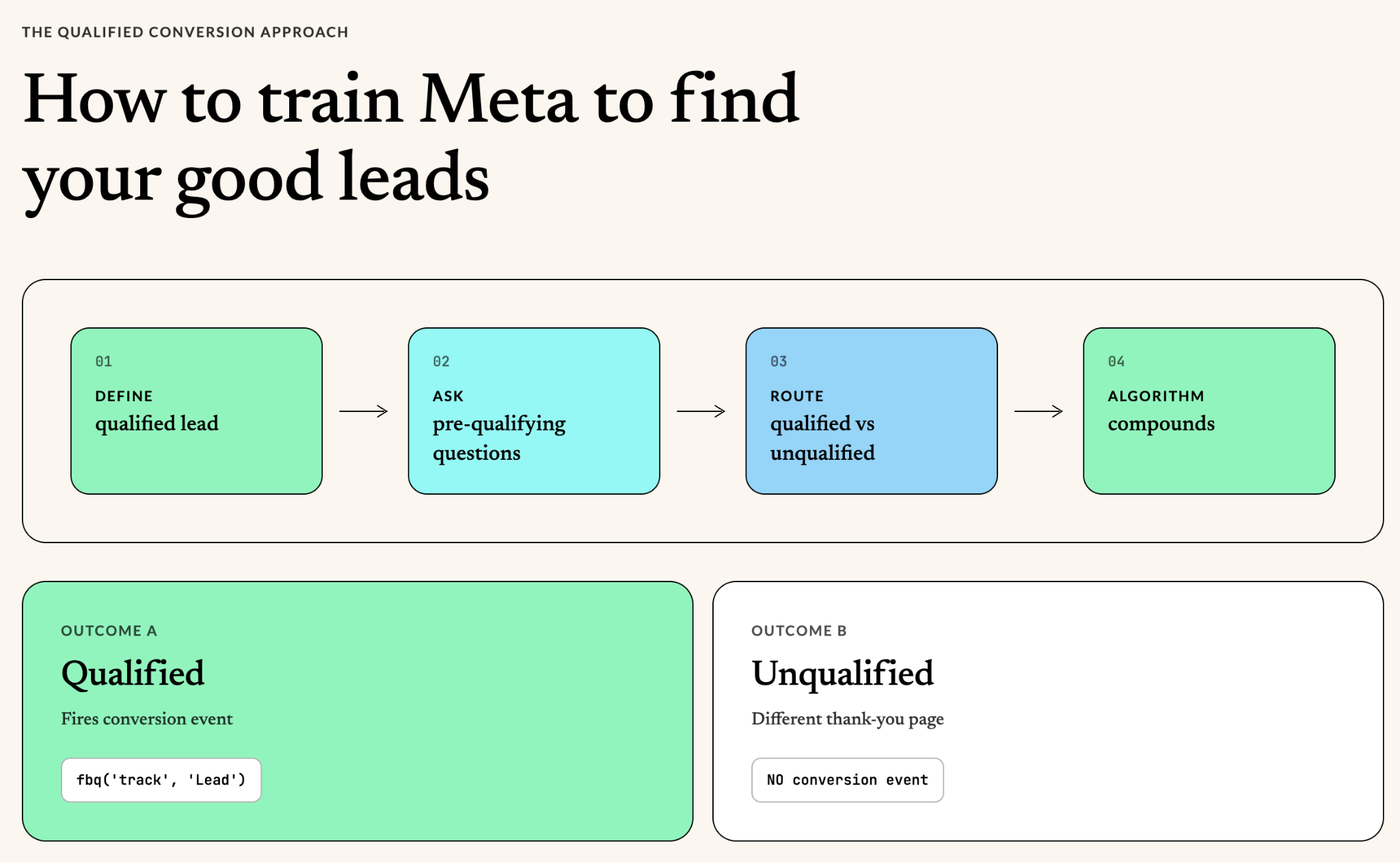
Instead of telling Meta “a conversion happened” every time someone fills out any form, you only fire the conversion event when the lead meets your qualification criteria. This trains Meta’s algorithm to find more people like your good leads, not just more people who fill out forms.
Here’s how to set it up:
Step 1: Define what a qualified PI lead actually is
For most personal injury firms, this means:
Injured within the statute of limitations: The range runs from 1 year (Louisiana, Tennessee, and Kentucky for most PI claims) to 6 years (Maine). Most states are 2 years.
Has a confirmed bodily injury
Was injured within a state where your firm is licensed
Is not already working with an attorney
A firm in Louisiana asking, “were you injured in the last 3 years?” will accept time-barred cases and burn its intake team. Set the qualifying window to your jurisdiction’s actual deadline, not a generic range.
These are all yes/no questions.
Step 2: Build these questions into your landing page form
Instead of just collecting name, email, and phone number, your form asks the qualifying questions first. Such as:
Were you injured in the last three years?
Do you have a physical injury?
Did the injury occur in [your state]?
Are you currently working with an attorney?
Step 3: Route qualified and unqualified submissions differently
If the answers indicate a qualified lead, the form submission fires your conversion event. The signal that tells Meta, “this was a good lead, find me more leads like this.” If the answers indicate an unqualified lead, they land on a different thank you page that does not fire the conversion event.
Step 4: Let the algorithm compound
Because Meta is a machine learning system, it gets smarter over time. The longer the campaign runs with this setup, the greater the proportion of qualified leads your intake team receives. Your ROI improves and compounds.
This works across practice areas with different qualification criteria. You essentially want to train Meta on what a good lead for your specific practice area and business looks like.
The Post-Lead Experience
Even with a qualified conversion setup I shared in the last section, you’ll need a post-lead qualification system.
Because Meta will always generate some volume of leads that look qualified on paper. You need further vetting before your intake team picks up the phone.
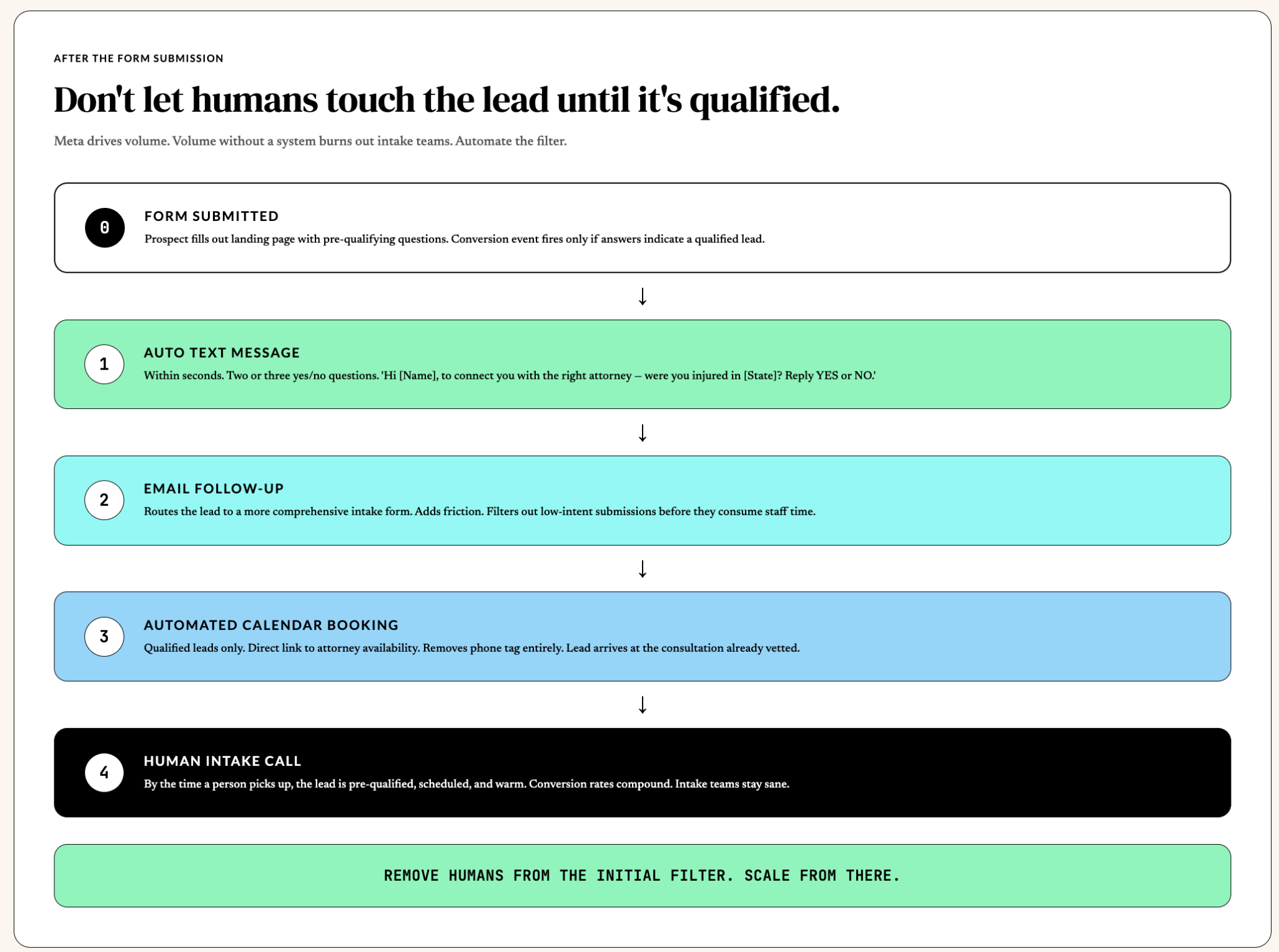
You need to remove humans from the initial qualification step wherever possible.
Here’s how:
Automated text message: Immediately after form submission, send a text with two or three quick qualifying questions. “Hi [Name], thanks for reaching out to [Firm Name]. To connect you with the right attorney, can you confirm: were you injured in [State]? Reply YES or NO.”
Email follow-up: Send an email that pushes the lead to a more comprehensive intake form. This adds another layer of friction that filters out low-intent submissions.
Automated scheduling: For leads that pass qualification, offer an automated calendar link to book a consultation. This removes the phone tag problem entirely.
The firms that fail with Meta are the ones that open the floodgates and expect their intake team to manually process everything. If you want to win, automate the qualification layer and only route genuinely qualified leads to humans.
Facebook Ads Budget Allocation: The 80/20 Rule
Here’s a good rule of thumb for budget allocation across your advertising channels:
80% of your total ad budget goes to direct response. This includes Google Ads (search campaigns), Local Service Ads, and Meta retargeting. These are your highest-converting, most efficient tactics.
20% goes to cold traffic and brand awareness campaigns. This includes Facebook prospecting (cold audiences), YouTube ads, and display campaigns. These build your pipeline for the future. Essentially brand awareness is what makes your firm the one people recognize when they (or a family member) suddenly need a personal injury attorney.
As your firm grows and you start to exhaust the available Google search volume in your market, this ratio shifts.
Large firms spending $100K+ per month often move to 60/40 or even 50/50 because there’s only so much search demand to capture. The incremental growth has to come from creating demand through awareness channels.
The key is always tracking back your spend to signed cases (not CPL). You don’t just want cheap leads. You want a channel that generates expensive leads that consistently sign cases. That’s the one you scale.
How This Translates into Numbers
CPL benchmarks I see on Meta in 2026: auto and car accident $150–$250, slip and fall $200–$300, med mal $250–$400, wrongful death $300–$500. Add 20–40% in LA, NYC, Miami, and Houston.
For context, cost per click on competing Google PI keywords in those same markets can run $200–$500 and above. Facebook lead costs are a fraction of that, but the quality bar lives elsewhere.
Minimum viable budget: Plan for $7,500 to $10,000/month once you’re optimizing for QualifiedLead at PI CPLs. Meta’s learning phase needs roughly 50 optimization events per week to stabilize. At $150–$300 per qualified lead, anything below that range starves the algorithm and produces noisy results.
Lower budgets only work if you optimize for a lower-funnel proxy event (FormSubmitted) for the first 30 days, then switch the optimization target to QualifiedLead once you’ve built enough signal.
Why PI Firms Can’t Rely on Retargeting Alone
Retargeting is the highest-ROI tactic on Meta, but for PI, it can’t carry the whole channel. The decision window is compressed. Someone who was just injured in a car accident contacts an attorney within days, not weeks, which means your retargeting audience has a much narrower window of intent than family law or estate planning.
To fill the volume gap, PI firms need a Leads campaign aimed at cold prospects running in parallel with retargeting. The Qualified Conversion Approach is what makes those cold campaigns viable. Without it, you’re back to the lead-form trap.
Essentially you need campaigns that generate new qualified leads at scale, not just recapture existing website traffic.
Also Read:Personal Injury PPC →Covers the Google Ads search-campaign half of the 80/20 budget allocation aboveAd Creative That Works for PI
Meta is an interruption based platform. Your ad has to stop the scroll. For personal injury, that means:
Video of the attorney speaking directly to the camera. 15–60 seconds in an empathetic tone. Address the viewer’s pain, whether it is medical bills, an insurance company runaround, or confusion about what to do next. This isn’t the place for “aggressive lawyer” positioning. It’s the place for “I understand what you’re going through.”
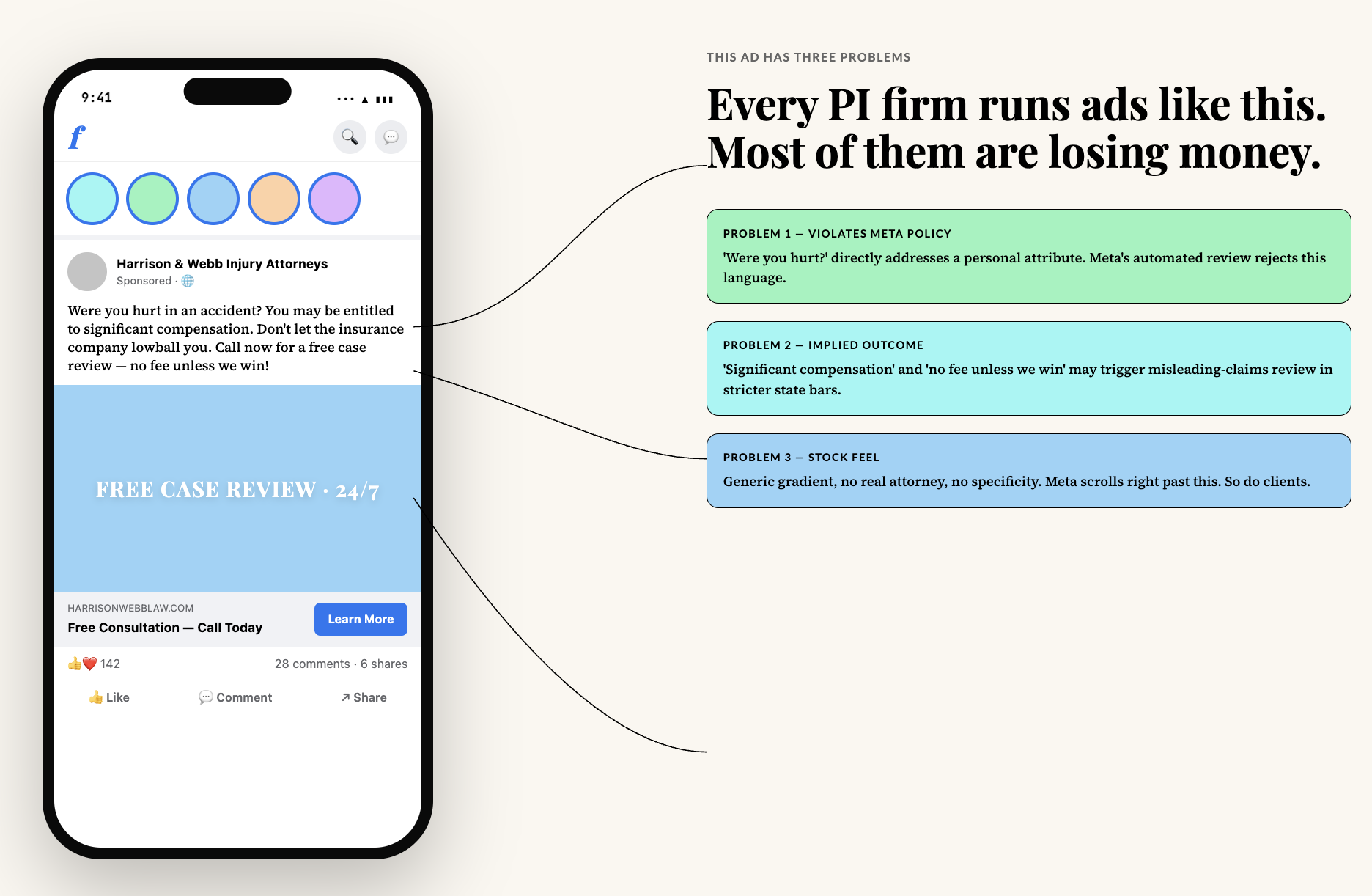
Real photos of your team and office. Never stock imagery. Meta users are sophisticated enough to spot stock photos, and it destroys trust immediately.
Testimonials and case results as social proof. Client stories (with appropriate permissions and disclaimers) are some of the highest-performing PI ad creatives. Google reviews and Avvo ratings can also be repurposed as ad assets. Pull a 5-star quote, name the case type, and you have a static image ad that builds credibility before the call to action.
Clear, specific CTAs. Not “Learn More.” Instead: “Get Your Free Case Review” or “Find Out What Your Case Is Worth.” The more specific and benefit-oriented, the better.
Also avoid graphic imagery of accidents or injuries. Beyond being distasteful, Meta’s policies prohibit shocking or disturbing content and will reject your ads. PI ads already receive extra scrutiny in Meta’s review process, so don’t give them a reason to flag you.
Which ad formats actually work for PI?
Single video ads (15–60 seconds, captions burned in) are the majority of ads that work well.
Static image ads with strong text overlay are your retargeting workhorse.
Carousel ads work when the content is built natively for the format. Each card advances a sequence that cannot be told in a single frame. “What to do in the first 24 hours after a car accident” works as a carousel precisely because it has five discrete sequential steps. Don’t adapt a single-image concept into a carousel. Design the carousel concept first.
You can skip everything else, such as Instant Experience, slideshow, boosted posts, and Stories-only. In-platform lead forms only if you’ve actually built the post-lead qualification stack I shared earlier in this article. Otherwise they will poison the algorithm.
Writing ad copy that passes Meta’s review and converts
Creative quality for PI has a constraint: you have to write copy that’s empathy-led and policy-compliant before you can even think about conversion rates.
Here’s how we structure PI ad copy.
Primary text (body copy above the image or video): Lead with a scenario, not an accusation. The personal attributes policy means you can’t address “you” as an injured person. What you can do is describe a situation the viewer might recognize.
Good: “If you were in a car accident in Houston in the last two years, most people don’t realize the insurance company’s first offer is almost never their best one.”
Bad: “Were you hurt in an accident? You may be entitled to compensation.” (Flagged as implying personal circumstances.)
The best primary text is 3–5 sentences. State the scenario, name the problem, surface the consequence (most people leave money on the table; most people don’t know what documentation they need), and invite the next step.
Headline (the bold line under the creative): Under 40 characters. Specific call to action (CTA) only. “Free Case Review. No Fee Unless We Win” outperforms anything vague.
“Find Out What Your Case May Be Worth.” Here, the word “may” is doing structural work by avoiding representing a guaranteed outcome while still surfacing the value.
Description line: Use it for a secondary trust signal. Bar association membership, years in practice, and number of cases handled. “500+ injury cases handled” belongs here, not in the headline.
Here are two example variants:
Auto accident. Static image ad:
Primary text: “If you’ve been dealing with insurance adjusters after a car accident in Georgia, here’s something most people don’t know: you typically have 2 years to file a claim, but the documentation window closes much faster. We offer free case reviews for anyone in this situation.”
Headline: “Free Case Review. No Obligation”
Description: “20+ years handling Georgia injury cases.”
Slip and fall. Video ad (burn-in captions required):
Hook frame (first 3 sec, on screen): “What to do if you slipped and fell on someone else’s property”
Primary text: “Property owners have a duty to maintain safe conditions. If you were injured in a slip and fall in [City] in the last two years, the process for determining liability is more complex than most people expect. We break it down for free.”
Headline: “Get a Free Case Evaluation”
Description: “No fee unless you win.”
Note on burn-in captions: They are non-negotiable for video. Over 80% of videos are watched without sound in feed placements. If your captions aren’t burned into the video file itself (not relying on auto-generated closed captions), you’re losing most of your video audience.
Test creative before you scale
On Google, bid strategy and keyword selection compensate for mediocre copy. On Facebook, there are no keyword levers. Your creative is the campaign.
So test before you scale: run two or three hook variations against each other with identical creative. Otherwise, $30–$50/day per variant, minimum seven days. Measure click-through rate and 3-second video views first (hook retention), not cost per lead.
You can’t diagnose CPL until you’ve confirmed the hook works. Refresh creative every 2–3 weeks on cold prospecting campaigns and monthly on retargeting. The firms that plateau are the ones that found one ad that worked.
What if your ad gets flagged? The appeals process…
PI ads get extra scrutiny in Meta’s automated review.
So expect to get disapprovals and file appeals.
Appeals are handled through Meta Business Suite. For PI accounts, request a human review rather than relying on automated reconsideration. The automated system usually upholds the original disapproval. A human reviewer who understands PI legal advertising as a category will often reach a different conclusion.
Document your appeal: state the policy cited, explain specifically why your ad does not violate it, and reference the disputed element.
Build appeals into your workflow expectation, not as an exception. PI campaigns will generate disapprovals. The firms that get derailed are the ones without a workflow to handle them without disrupting campaign continuity.
Your Facebook Ads Tracking Stack
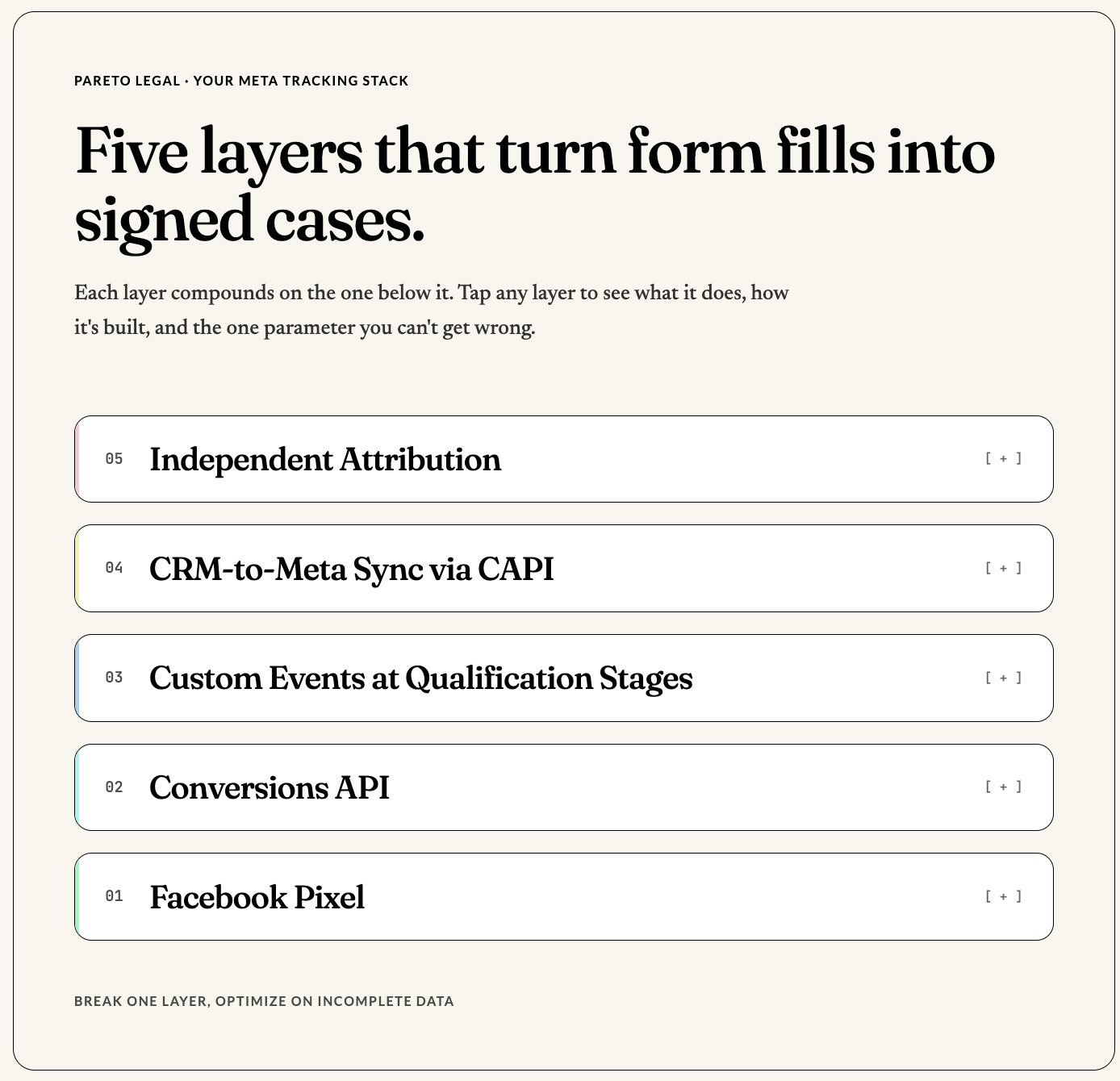
The real attribution challenge though is not tracking events on Meta but measuring multi-touch attribution.
Let me explain: Someone sees your Meta ad on Tuesday, and they don’t click. On Thursday, they Google your firm name and call from the organic listing. In Meta’s reporting, that’s zero conversions. In reality, Meta influenced that case.
This is why you need to ensure that every Meta lead is properly ported into your CRM with full source attribution. You want to track which Meta campaigns ultimately produce signed personal injury cases in the CRM.
Here are the five layers you need:
(1) Facebook Pixel firing on every page, verified with Pixel Helper.
(2) Conversions API server-side: CAPI Gateway or server-side GTM for most firms, deduplicated with the Pixel via event_id.
(3) Custom events at each qualification stage (FormSubmitted, QualifiedLead, ConsultBooked, Retained) with QualifiedLead as the optimization target.
(4) CRM-to-Meta sync via the Conversions API on a weekly cadence: You need to set action_source to system_generated for CRM-originated events. After Meta sunset its offline Conversions API in May 2025, offline events route through the standard CAPI. Your goal here is to teach Meta which campaigns produce signed cases vs. just form fills.
(5) GA4 plus direct UTM-to-CRM tracking is sufficient for most PI firms. Third-party platforms like Hyros, Triple Whale, or Northbeam become worth their cost above roughly $50K/month in Meta spend. Meta’s own numbers tend to overclaim, so an independent check matters regardless of which tool you choose.
Frequently Asked Questions About Facebook Ads For Personal Injury Law Firms
When should a PI firm start running Meta ads? At a minimum, you should have retargeting active from day one of any digital advertising effort. For cold prospecting campaigns, wait until your Google Ads and intake systems are stable and performing. Then layer in Meta as your awareness and volume channel.
Also Read:Local Service Ads for Law Firms →Sit on the Google-side of the same stack and are usually live before Meta layers inWhat budget do I need for Meta? Start with 20% of your total monthly ad spend allocated to Meta. If you’re spending $10,000/month total, that’s $2,000 to Meta. Split it between retargeting and a small prospecting test. Then scale from there, based on cost-per-signed-case data.
How long until I see results? Retargeting campaigns produce results almost immediately because you’re reaching people who already know your firm. Cold prospecting campaigns need 30–60 days of a learning phase before Meta’s algorithm stabilizes and lead quality improves.
Can I run lead forms and landing page campaigns at the same time? Yes, you can run them as separate campaigns with separate budgets. The lead form campaign is your volume play, and the landing page campaign is your quality play. Compare the cost-per-signed-case between the two and allocate accordingly.
What happens if Meta flags or removes my PI ads? PI ads get extra review scrutiny. You should expect occasional disapprovals as a normal operating cost. So maintain backup ad sets so a flagged campaign doesn’t stop spending while you appeal. For human review (which often reverses automated disapprovals), submit the appeal through Meta Business Suite with a specific argument against the cited policy.
If your account accumulates repeated disapprovals, future ads will enter a slower manual review queue. So backup ad sets and policy-compliant copy frameworks matter more on Meta than they do on Google.
Final Thoughts
Under $20K/month in digital ad spend, a generalist can probably handle ads for personal injury lawyers. Once you cross roughly $250K/year in total digital ad spend, it makes sense to hand it to a specialist.
Pareto Legal specializes in helping those kinds of injury firms. The way we set up conversion actions and train Meta’s algorithm on qualified-lead data is an approach I don’t see many other agencies running. Most agencies optimize for form fills. But we optimize for fills that actually become signed cases.
If you’re ready to hire a professional to handle your injury firm’s Meta Ads, contact us.