
PPC for personal injury lawyers is cutthroat. Picking the right keywords, writing good ad copy, building a landing page, and tracking your conversion rate are at table stakes. Most personal injury PPC campaigns fail because they fundamentally misunderstand what success looks like.
Injury PPC can’t be limited to generating leads. When your case volume grows and cost per case decreases simultaneously, that’s actually when you know your campaign is working.
I have personally overseen hundreds of injury law firm accounts and turned around their campaigns. That work became our law firm PPC services, built to buy signed cases rather than clicks.
For instance, I helped an injury firm in the mid-Atlantic transition their $40,000 to $50,000 a month budget for TV, billboards, and radio toward Google Ads, applying the same fundamentals I lay out for Google Ads for lawyers. In a couple of months, we increased their PI case volume from 5-10 (via traditional channels) to 25-30 (via PPC + LSA).
And mind you, they had started without any digital marketing presence.
If you want to start advertising DIY, here’s how to turn your personal injury PPC into a predictable case acquisition engine for your firm.
Why Most Personal Injury PPC Campaigns Fail
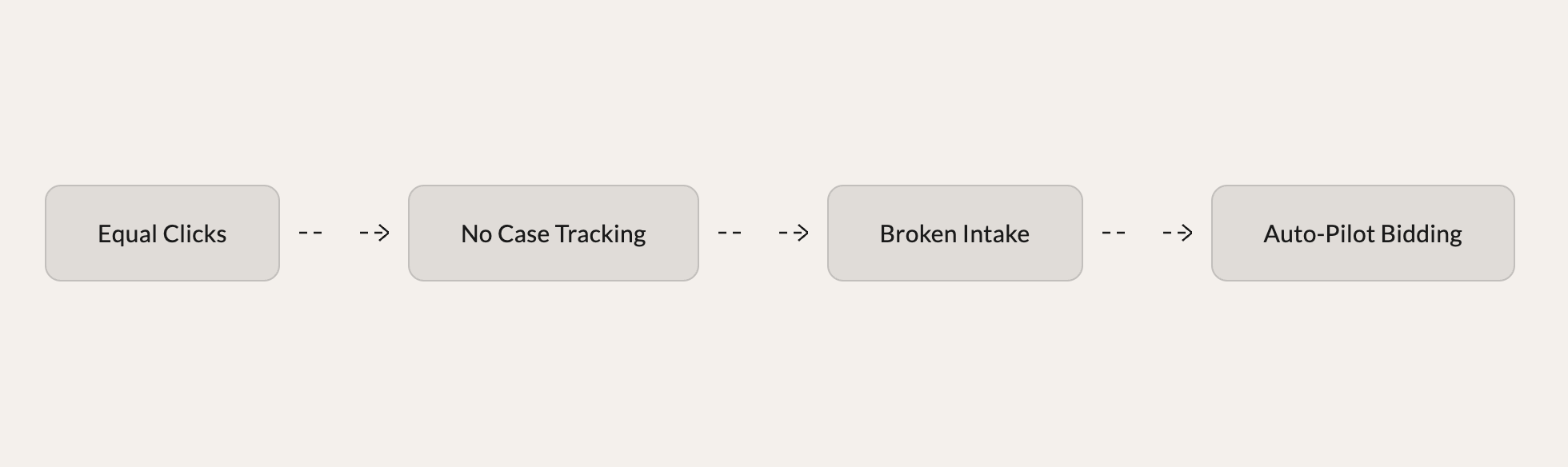
After auditing hundreds of PI firm accounts, I can attest to the following repetitive patterns that lead campaigns to fail.
Treating every click as equal: Most personal injury firms build one campaign, bid on broad keywords, and send all traffic to a single landing page.
But someone searching “what to do after a car accident” is in a completely different mindset than someone typing “car accident attorney near me.”
Treating those clicks the same, putting the same budget behind them and using the same PPC landing pages for them means you’re either:
overspending on low-intent traffic or
under-investing in potential clients ready to hire an attorney.
No connection between campaigns and signed cases: I suspect this is one of the most expensive mistakes in personal injury marketing. Most firms track leads but have no mechanism to determine which leads became qualified consultations and signed cases.
If you don’t know which PPC campaigns are driving the right outcomes, you’re optimizing for lead volume instead of value. This is where wasted ad spend compounds.
Ignoring intake: Your PPC campaign is only as good as the system that processes the leads it generates. I’ve seen personal injury firms spending over $10,000 a month on ads while losing the majority of leads to slow response times and broken follow-up. Fixing intake often delivers better results than increasing your PPC budget.
Running ad campaigns on autopilot: Don’t get me wrong. Google’s automated bid strategies are powerful. But only when they have enough conversion data to optimize.
If you launch with Max Conversions bidding and have no historical data, broad match keywords are a recipe for wasted spend.
How to Structure PPC Campaigns by Funnel Stage
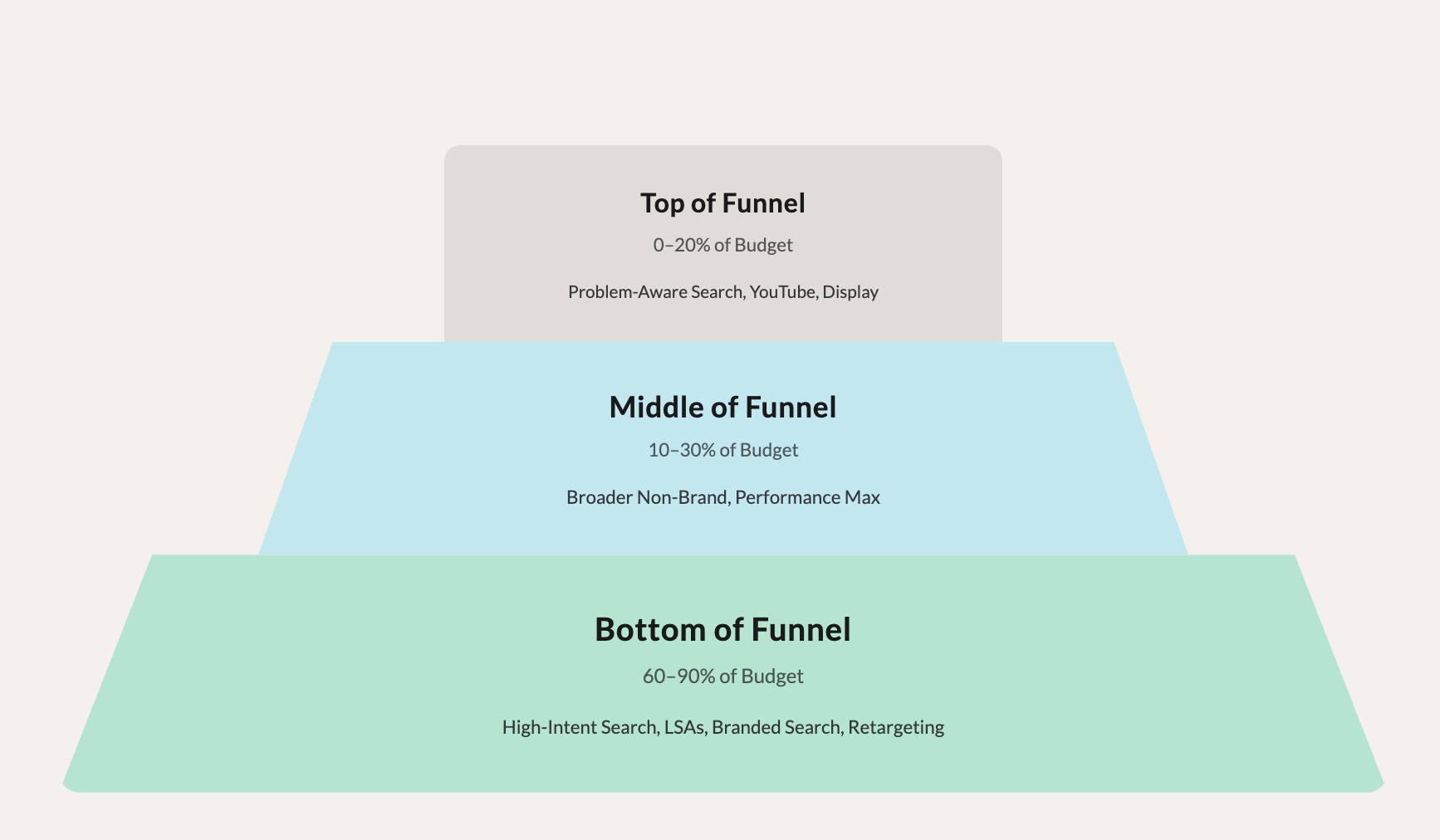
Most personal injury firms spread their budget evenly across the funnel, which starves the campaigns that actually produce cases. We never run a personal injury account as one monolithic campaign. We segment by funnel stage, intent, and conversion goal.
Let me break it down:
Bottom of funnel (60–90% of budget): These campaigns target people actively searching for an injury lawyer.
High-intent non-brand search terms like “car accident attorney [city]” get exact and phrase match, aggressive bids, and dedicated PPC landing pages per practice area and geography.
Local Service Ads for Law Firms operate alongside these on a pay-per-lead basis. They appear above standard Google Ads and for many personal injury firms, they’re table stakes.
Branded search campaigns protect your firm’s name with a target of 90%+ impression share.
Retargeting re-engages visitors from the past 30–180 days at the lowest cost per case in your account.
Middle of funnel (10–30% of budget): Broader non-brand search terms like “injury lawyer near me” that signal solution-awareness but lower certainty.
These are tested with controlled bids and only graduate to higher budgets when the data proves they generate quality leads. Performance Max campaigns can work here, segmented by practice area with separate campaigns for calls vs. forms vs. chats.
Top of funnel (0–20% of budget): Problem-aware searches like “what to do after a car accident” that lead to educational content. Think blog posts, guides, and FAQs. The goal here isn’t conversion. It’s pixeling visitors for retargeting and building your remarketing audience at a fraction of the CPC. YouTube and display prospecting fill this layer.
The key principle: Never allocate more than 20% to top-of-funnel until your bottom-of-funnel PPC campaigns are fully funded and consistently profitable.
Once you’ve a mental model of how to budget for different campaigns, next comes the keyword strategy.
The 80/20 Keyword Strategy for Personal Injury PPC
20% of your keywords drive 80% of your results. The other 80% quietly drain your budget. I emphasize that you try to identify your 20% from day one of starting your injury PPC campaign.
Here’s where the 80/20 mindset becomes actionable: find the heroes, fund them, and cut the villains.
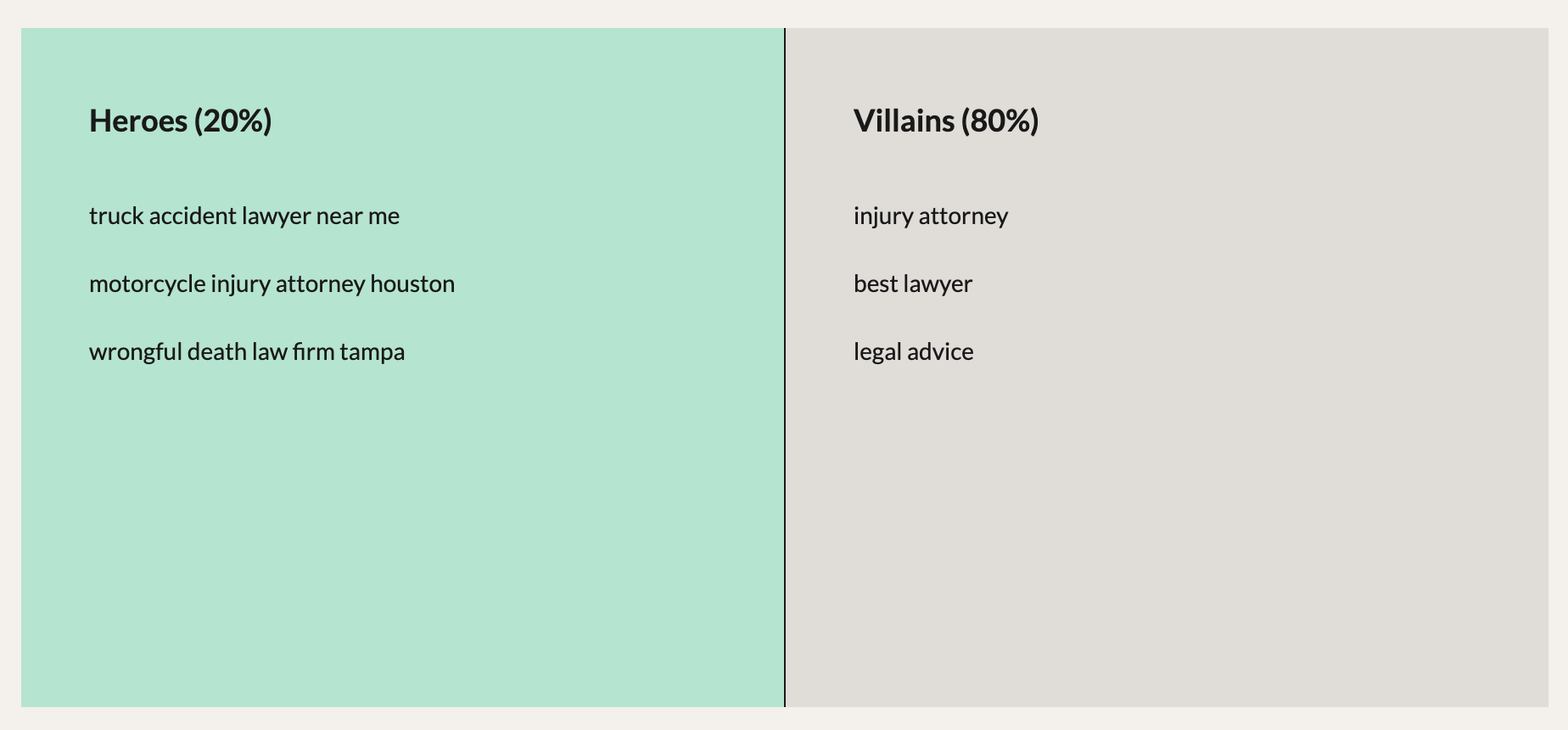
Find your “heroes”: Every account has them. They are keywords that reliably produce signed cases at an acceptable CPC.
And find’em “villains”: They look productive on a click basis but never convert downstream.
The only way to tell them apart is to close the loop between your ad platform and your CRM.
Let me explain:
Most law firm PPC advertising starts with Google’s keyword suggestions. You use broad terms like “injury attorney” or “best lawyer.”
But I recommend you start in the opposite direction. Reverse-engineer your keyword strategy from actual signed case data in your CRM.
Here’s how:
The personal injury keywords driving revenue are almost never the high-volume head terms. They’re specific and intent-rich: “truck accident lawyer near me” outperforms “injury attorney.” “Motorcycle injury attorney Houston” outperforms “best PI lawyer.”
You need to mine call transcripts, intake notes, and CRM source data to identify the actual search terms that precede retained cases.
On match types: exact and phrase match should dominate your non-brand campaigns. Indeed at Pareto, we limit broad match aggressively and maintain negative keywords weekly.
Our team has audited personal injury law firm accounts where 30 to 40 percent of the budget went to searches for jobs at law firms, legal advice for the opposing side, or completely unrelated case types.
That’s money a smarter keyword strategy would have saved from day one.
PPC Landing Pages That Convert Injury Clients Into Signed Cases
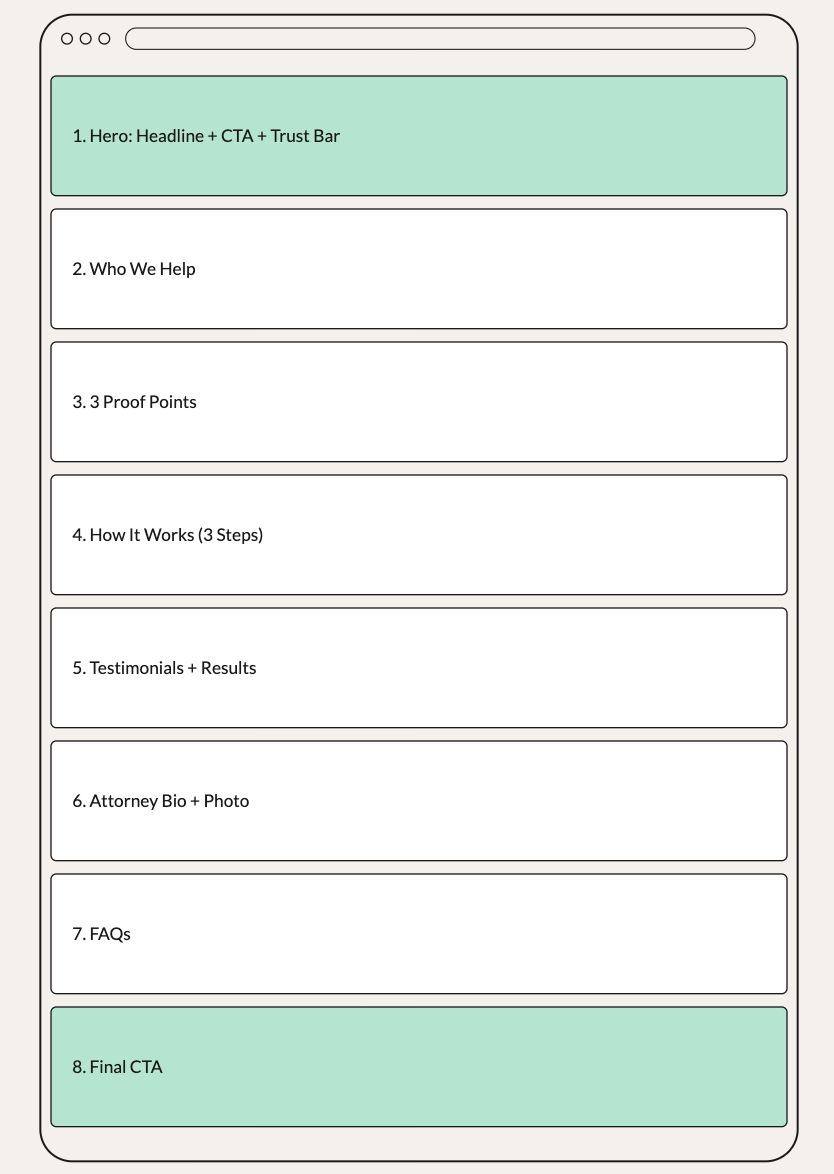
The specific landing page is where most personal injury PPC campaigns quietly bleed money. I’ve overseen hundreds of them, and the anatomy that consistently converts has some necessary ingredients.
Let me talk about them a bit:
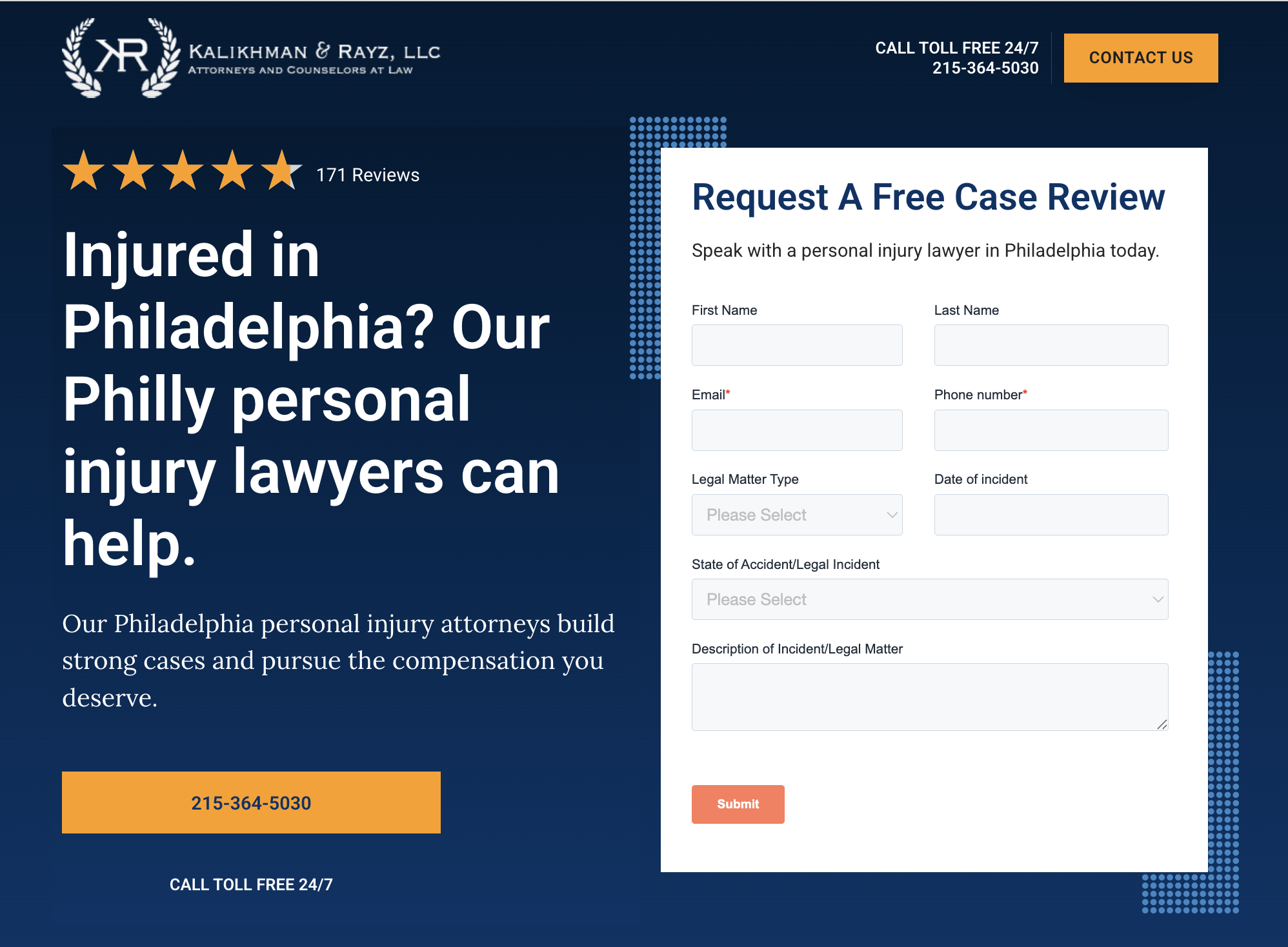
The hero section needs a plain-English headline that matches the PPC ad. For example, if the ad says “Truck Accident Lawyer in Phoenix,” the page must open with that phrase.
A risk-reducing subhead like “No Fee Unless We Win,”
A visible CTA, and
A trust bar with review stars and case results,
Below that, you want a focused section on who you help (matching the ad’s practice area). Don’t mention everything your firm does.
Share three concrete proof points,
A simple “how it works” process,
Specific testimonials with settlement amounts,
Real attorney photo with a brief bio,
FAQs addressing cost, timeline, and contingency fees.
Here’s an example injury landing page’s hero:
Now, next come the rules that matter most: one page, one goal. Strip global navigation and remove outbound links.
Message match is non-negotiable across ad headline, page headline, and CTA text.
Four form fields maximum with call, text, and chat alternatives nearby.
Mobile-first design with sticky call bars and page loads under 2.5 seconds.
And separate pages by practice area, geography, and language. A car accident page for Miami is not a truck accident page for Orlando.
Attribution: Connecting Ad Spend to ROI

Attribution means answering one question: which campaigns, ad groups, and keywords produced signed cases, and at what cost per case?
Let me tell you that this is the single biggest differentiator between personal injury firms that scale with PPC vs. firms that treat it as a black box.
The minimum stack is something like this:
Google Tag Manager for all tracking,
GA4 for event collection,
call tracking with Dynamic Number Insertion (with a 60-second minimum to filter junk),
a CRM with source fields mapped to every lead,
and offline conversion import that pushes signed case data from your CRM back into Google Ads (this is critical!)
The data flow: ad click → landing page (UTMs and gclid captured) → GTM fires events → GA4 and call tracking receive events → CRM creates lead with full source data → intake qualifies and signs → signed case imported back to Google Ads as an offline conversion.
Break any link in that chain, and you’re optimizing on incomplete data. We’ve worked with personal injury law firms that tripled their practice volume not by changing their PPC strategy but by fixing their attribution so they could finally see which campaigns actually produced return on investment.
PPC vs. SEO: Where Should Personal Injury Firms Invest?
PPC captures high-intent consumer demand immediately. SEO builds long-term organic search equity. The strongest personal injury firms invest in both.
My recommendation: fund bottom-of-funnel PPC and LSAs first. These capture the demand that exists right now. Layer in SEO as a 6–12 month play for sustainable growth. Add Meta and programmatic channels only after your core search campaigns are profitable (and your attribution proves it).
The firms that generate effective results build a system where every channel has a defined role, a clear budget, and measurable accountability for signed cases.
Also Read:Meta Ads for Personal Injury Lawyers →The awareness-layer side of the paid stackHow Much Does Personal Injury PPC Cost?
Before committing to a budget, see what the spend actually produced for a firm that scaled to 3X its case volume.
Personal injury is among the most expensive PPC verticals. The cost per click ranges from $70 to $300+, depending on your market and keyword. A broad term like “personal injury lawyer” in a major metro can exceed $250 per click. Long-tail personal injury keywords in mid-size markets might run $80–$120 CPC.
The raw cost numbers are meaningless without downstream context.
Cost per lead typically falls between $150 and $800 (though this depends heavily on how you define a “lead” and your landing page conversion rate).
Monthly ad spend ranges from $5,000–$15,000 for smaller markets to $30,000–$100,000+ for aggressive injury firms in competitive metros.
I want to take a step back here and say that the only metric that truly matters is cost per signed case. For well-run personal injury PPC campaigns, this ranges from $1,500 to $5,000+, depending on case type and market.
The only thing is that your injury firm needs to have attribution in place to connect ad spend to revenue.
Top PPC Keywords For Injury Lawyers
Based on Google Keyword Planner’s 2026 data, here are some of the most expensive keywords for injury lawyers. Note that the actual CPCs may exceed displayed ranges in competitive auctions.
| Keyword | Avg. Monthly Searches | Avg. CPC (Top of Page) | CPC Range |
|---|---|---|---|
| oilfield injury attorneys | 1,300 | $810 | $620–$1,000 |
| bus accident law firms | 390 | $665 | $330–$1,000 |
| top motorcycle accident lawyer | 720 | $665 | $330–$1,000 |
| best motorcycle accident law firm | 210 | $581 | $162–$1,000 |
| best lawyers for truck accidents | 12,100 | $581 | $162–$1,000 |
| truck injury lawyer | 5,400 | $575 | $150–$1,000 |
| truck accident lawyers near me | 90,500 | $569 | $137–$1,000 |
| [city] injury attorney | 18,100 | $558 | $119–$997 |
| 18 wheeler injury attorney | 8,100 | $558 | $115–$1,000 |
| construction site injury lawyer | 2,400 | $549 | $139–$960 |
| lawyer for truck accident | 165,000 | $541 | $82–$1,000 |
| personal injury lawyer [city] | 4,400 | $532 | $64–$1,000 |
| offshore injury lawyer | 720 | $530 | $59–$1,000 |
| boat accident lawyers | 1,900 | $520 | $79–$960 |
| car accident claim lawyers | 590 | $470 | $205–$735 |
| best car accident injury lawyers | 170 | $426 | $220–$631 |
| slip and fall injury lawyers near me | 720 | $388 | $111–$665 |
| industrial accident lawyer | 320 | $386 | $22–$750 |
| truck accident law firm | 3,600 | $383 | $86–$681 |
| personal injury [city] | 320 | $383 | $16–$750 |
| pedestrian accident law firm | 210 | $337 | $176–$498 |
| auto accident attorney | 74,000 | $326 | $119–$534 |
| motorcycle accident lawyers near me | 60,500 | $320 | $100–$539 |
| dog bite accident attorney | 880 | $314 | $50–$579 |
| motorcycle accident lawyer | 60,500 | $308 | $95–$522 |
| car accident attorney near me | 110,000 | $308 | $102–$514 |
| [city] injury lawyer | 1,600 | $296 | $99–$493 |
| bicycle accident attorney near me | 2,900 | $289 | $77–$500 |
| car accident lawyer near me | 201,000 | $276 | $96–$455 |
| bus accident lawyer | 6,600 | $260 | $82–$438 |
| slip and fall attorney near me | 22,200 | $248 | $71–$426 |
| premises injury attorney | 170 | $251 | $58–$445 |
| [city] injury attorney | 14,800 | $251 | $55–$447 |
| pedestrian injury lawyer | 1,900 | $245 | $84–$406 |
| burn injury attorneys | 1,300 | $226 | $52–$400 |
| personal injury lawyer near me | 450,000 | $220 | $65–$375 |
| best personal injury law firm | 18,100 | $204 | $47–$360 |
| slip and fall injury lawyers | 22,200 | $203 | $65–$341 |
| brain injury lawyers near me | 1,900 | $166 | $31–$300 |
| [state] injury attorneys | 6,600 | $158 | $35–$280 |
| premises liability attorney near me | 8,100 | $146 | $31–$261 |
| premises liability attorneys | 22,200 | $124 | $44–$203 |
| catastrophic injury lawyer | 5,400 | $100 | $31–$169 |
| workplace injury law | 1,900 | $89 | $19–$160 |
| nursing home injury attorney | 720 | $68 | $23–$113 |
As you can see, PPC can get expensive really fast for injury firms. A few clicks and you’ve already spent thousands of dollars. So inevitably, many injury attorneys question us:
Is PPC for Personal Injury Lawyers Worth It?
With a cost per click running up to or over $500 a click, personal injury PPC is cutthroat. You need a budget of at least $10k a month in most competitive metros. Before you commit that spend, our PPC budget calculator projects how many signed cases it can produce. Yet the most common PPC budgeting error isn’t spending too little. It’s spreading it too thin across too many campaigns and geographies at once.
A firm with $15,000 of monthly budget will almost always get better results concentrating on one or two case types in its strongest local area before expanding.
To put injury PPC advertising cost in context, I would call a $3,000 acquisition cost on a case that settles for $75,000 as an exceptional return on investment.
How about you?
Final Thoughts
Your Google Ads campaign may have generated 200 leads last month. But do you know how many of them became signed cases? If you can’t answer that question and tie it back to a specific campaign, ad group, and keyword, I am sorry to tell you: you’re flying blind. You’re almost certainly wasting the majority of your ad spend.
Hopefully this guide helped you get in the right mindset and set your PPC campaign for success.
If you’re spending $20,000+ per month on personal injury PPC and you can’t tell which campaigns produce signed cases, you have a solvable problem.
We evaluate your personal injury PPC program across five pillars: Strategy, Execution, Intake, Attribution, and Reputation, and identify the changes that will have the highest impact on your signed case volume. Contact us to get a Pareto Score™ Assessment.