

Ads arrived inside ChatGPT this year, and the pitches followed. Several agencies are now selling ChatGPT ads to law firms on the promise of cheap clicks and getting in early.
Before you buy that pitch, read OpenAI’s own ad policy. It does not permit what is being sold.
Legal Services Are Excluded From the Ad Content Policy
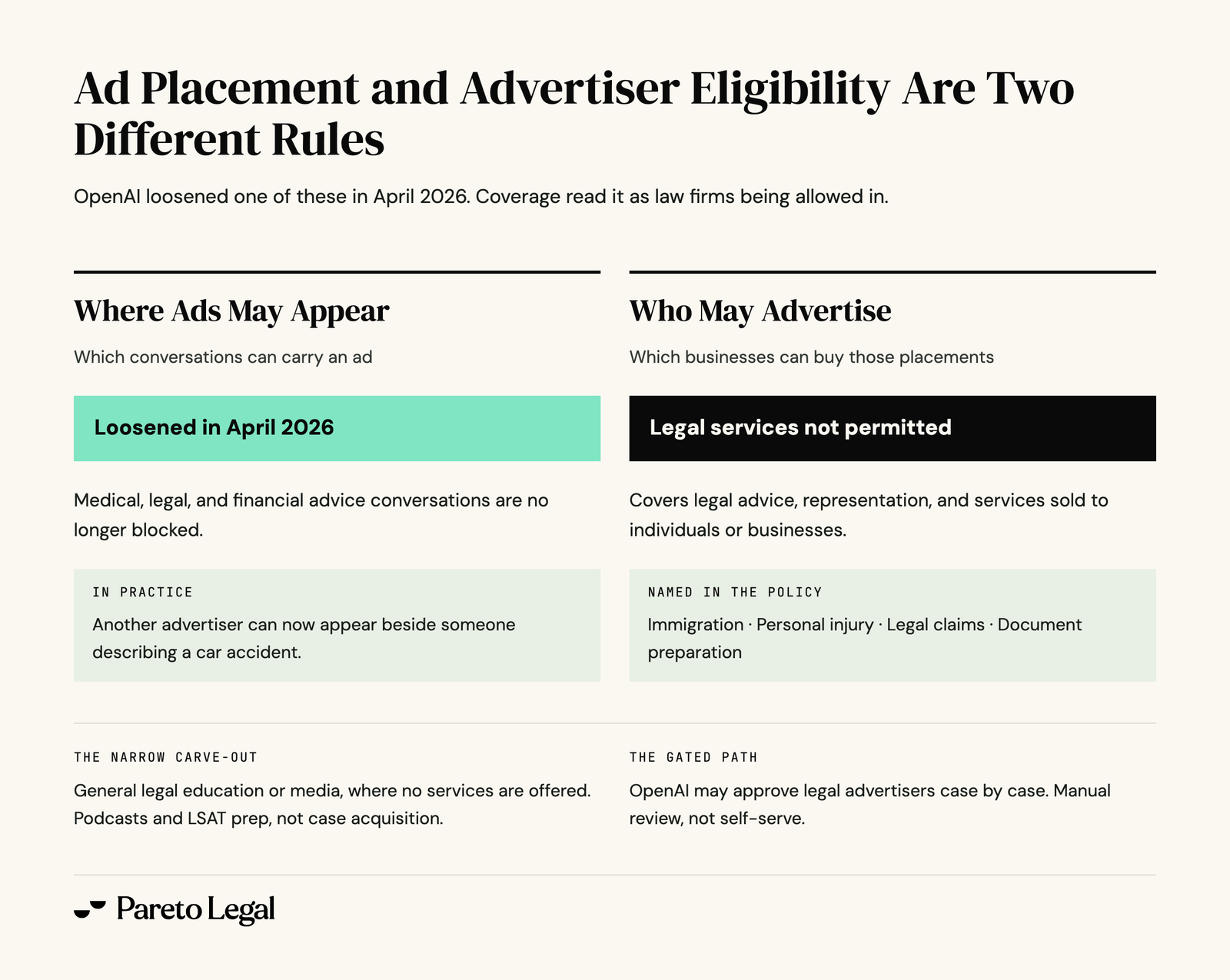
The policy is direct. Ads for legal advice, representation, or legal services are not permitted, whether offered to individuals or to businesses.
It names the examples: immigration, personal injury, legal claims, and document preparation. That covers most of the plaintiff-side practice list.
Immigration is excluded twice over. The policy separately bars advertising that meaningfully references sensitive social issues, and lists immigration among them.
The one carve-out is narrow. General legal education or media may be allowed where no legal services are offered, illustrated with legal-themed podcasts and LSAT prep. That is not case acquisition.
Where Ads May Appear and Who May Buy Them Are Separate Rules
This is the part the pitches get wrong. OpenAI did relax something involving legal in April 2026, and a lot of the coverage read it as the gate opening.
It was not. Placement governs which conversations can carry an ad at all, and that rule loosened: medical, legal, and financial advice conversations are no longer categorically blocked.
Content governs who may advertise, and that layer still excludes legal services. Other advertisers can now appear beside someone describing a car accident to ChatGPT. Your firm cannot.
The Approval Path Runs Through Manual Review
OpenAI left a path open, and it is worth reading precisely. It may approve ads from approved advertisers in the financial services, healthcare and medicine, and legal services categories.
Those categories are being rolled out gradually, with approvals reviewed manually. So this is not a permanent ban. It is also not something you can switch on yourself in an ads manager this afternoon.
A few agencies report running live law firm campaigns. That is consistent with case-by-case approval, and equally consistent with accounts nobody has reviewed yet.
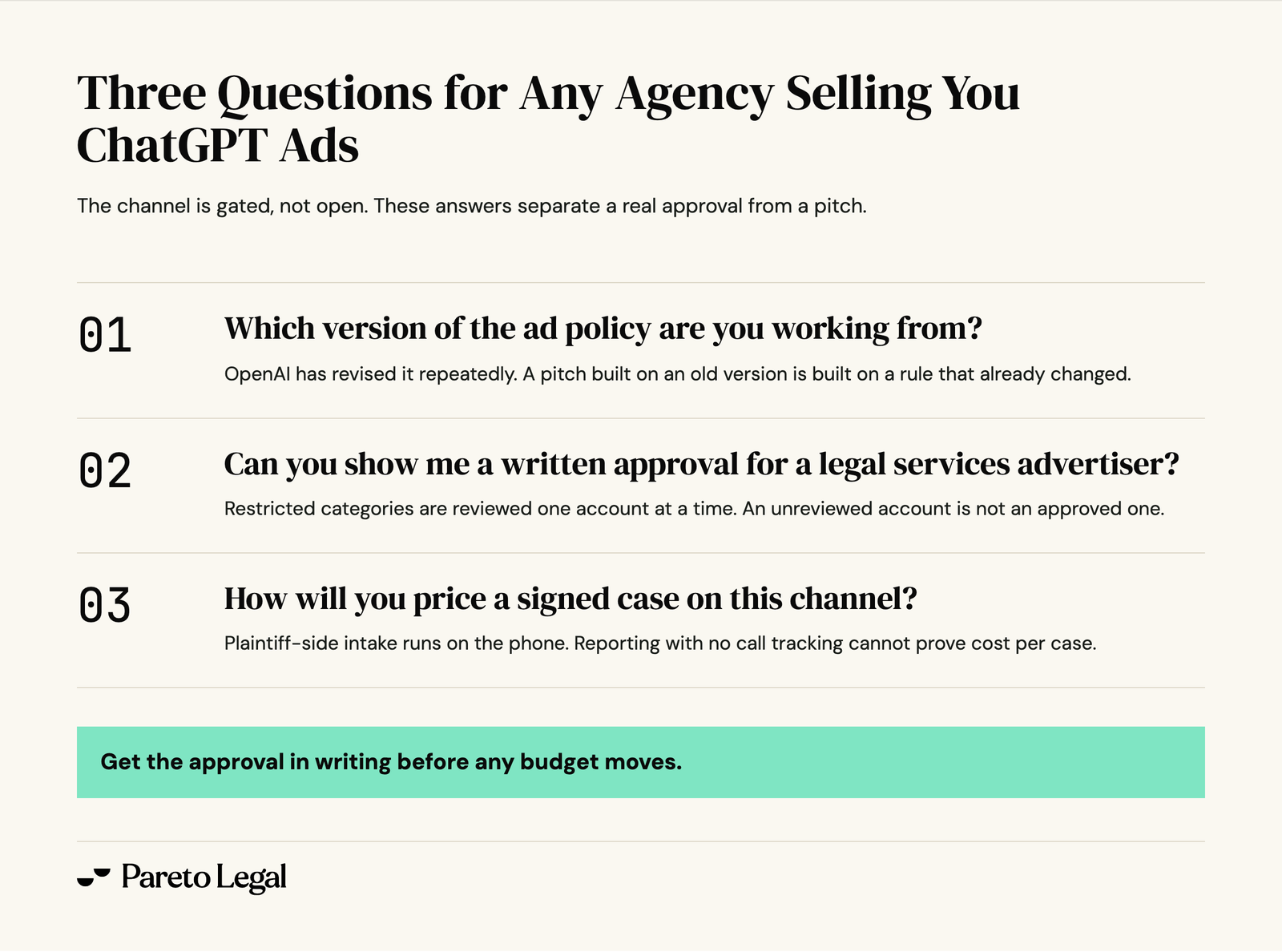
I would want to see the approval in writing before trusting a pitch built on it.
Where to Put Your Advertising Budget in the Meantime
Keep it in the channels producing signed cases. Our law firm PPC services stay pointed at Google Ads and local service ads, because that is still where plaintiff-side case volume comes from, and nothing here changes that this quarter.
For an injury firm that budget mostly goes into google ads for personal injury lawyers first, with the rest of the channel mix sequenced behind it.
One thing is worth doing now. Watch OpenAI’s policy changelog rather than the marketing around it, because the document is already on its fourth version since March 2026.
Measurement is the next question when legal does open. Reporting so far is aggregate, with no prompt-level detail and no native call tracking of the kind pay-per-click campaigns for law firms rely on.
Plaintiff-side intake runs on the phone. Cost per signed case will be hard to prove early, and lead generation on its own has never been the point. Test carefully when the time comes rather than writing the channel off.
Contact us for your law firm advertising needs.