

AI is completely changing the way your legal clients use digital media platforms. Law firms are also increasingly trying to integrate AI into their workflows (with some caveats). Which legal marketing tactics stay effective this year? Are AI platforms like ChatGPT and Claude a major source of getting new legal clients?
Let’s look at some key legal marketing statistics around how law firm owners and marketers are making decisions for their marketing.
Statistics Around Legal Marketing Channels
First up let’s look at where and how your potential clients find you online. And identify the channels that make sense to target for your firm’s marketing efforts.
- Law firm websites remain among the most important digital assets for attorneys. According to the ABA 2024 Websites and Marketing TechReport:
- 90% of respondents reported having a website, down from 94% in 2022
- Solo practitioners increased their website presence from 61% in 2022 to 70% (which possibly represents how important a website remains to a law firm)
- Meanwhile, 100% of firms with 100+ attorneys maintain websites
- Social media marketing is surprisingly in decline. The usage of social media as a marketing tool dropped to 80% in the 2024 survey, down from 89% in 2022.
Increased competition makes organic social media traffic scarce now. But some social media platforms offer better value to attorneys than others:- LinkedIn is the primary platform at 76%
- Facebook comes in at the second spot at 53%
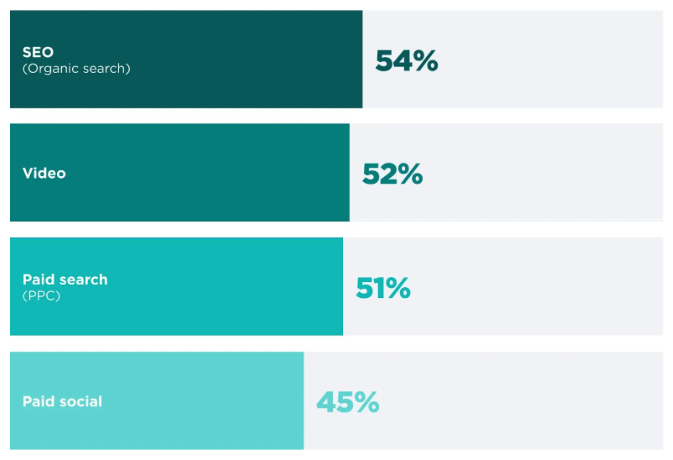
- According to the CallRail 2026 Legal Marketing Trends Report, search engine optimization (SEO) leads at 54%, followed by video marketing at 52%, paid search (PPC) at 51%, and paid social at 45%. For larger firms, paid search is even more dominant—63% of larger firms name it as a top acquisition channel.
- 92.4% of legal consumers research their legal issue online before contacting an attorney, according to the Martindale-Avvo Legal Consumer Report 2024. And 93.3% of consumers want to do further research into attorneys found via search engines before hiring: rising to 96.3% among those who actually hired an attorney.
- Indeed 51% of consumers don’t make it past the 5th search result, according to Scorpion’s 2025 Legal Consumer Research. If your firm isn’t showing up near the top, you’re invisible to over half of potential clients before they even see your name.
Now that we have an idea of the key online marketing strategies, let’s look at the fundamental tenet of your online visibility that your prospective clients will always consider.
Online Reviews and Reputation Statistics
Your online reputation directly influences whether prospects pick up the phone to call you. But how critical are reviews to attract potential clients? Let’s find out.
- 68.2% of consumers name online reviews and testimonials as the most helpful element when looking for an attorney, according to Martindale-Avvo’s Legal Consumer Report 2024.
- 53% of consumers won’t even consider firms rated below 4 stars—up from 42% in 2024, according to Scorpion’s 2025 Legal Consumer Research.
- So what matters most in your online reputation?
- 58.8% of consumers prioritize average review score/star rating,
- 54.3% look at the number of reviews,
- 40.8% consider the recency (newness) of reviews,
- 35.1% value endorsements by other attorneys,
- 29.4% check third-party ratings of expertise,
- and 26.0% look at awards or certifications.
- Why do consumers leave reviews?
- 79.8% do so to tell others about an attorney who did a good job,
- 65.0% want to warn others about an attorney who did a bad job,
- 45.9% want to tell the attorney how they helped,
- and 26.6% leave a review because the attorney asked for one.
- Referrals still get verified online. According to Martindale-Avvo, 61% of consumers who receive a referral still research the attorney’s reputation online. 54.6% look at the attorney’s website.
Only 4% of consumers said they did not look into a recommended attorney at all. Approximately 50% of consumers who were recommended an attorney hired that attorney! - Other decision factors consumers weigh:
- 61.6% consider pricing and fees,
- 58.0% look at responsiveness,
- 53.0% evaluate reputation among peers,
- 46.6% want to know about past cases and outcomes,
- and 45.0% value recommendations from friends or family,
- Awards come in at 10.9%!
Content Marketing Statistics
Content remains king, but not all content tactics deliver equal results. Here’s a look at what’s working.
- Written content development is the most effective marketing tactic. According to the Legal Marketing Association’s ATL CMO Survey 2025, 57% of law firm CMOs rate written content development as “very effective” (the highest rating of any marketing tactic surveyed).
- Branding and profile building come in second, with 62% of CMOs rating it “very effective.” This reinforces that consistent messaging and positioning matter more than one-off campaigns.
- In-person speaking engagements remain highly effective, with 57% rating them “very effective.” Despite the shift to digital, face-to-face thought leadership still converts.
- Directories and awards? Most CMOs say stop doing them. The LMA/ATL CMO Survey 2025 found that the majority of respondents rated directories and awards as their least effective tactics—a signal that these legacy plays aren’t moving the needle for growth-focused firms.
- Video is a top-3 channel for new business. According to CallRail, 52% of firms cite video as a primary driver of new business.
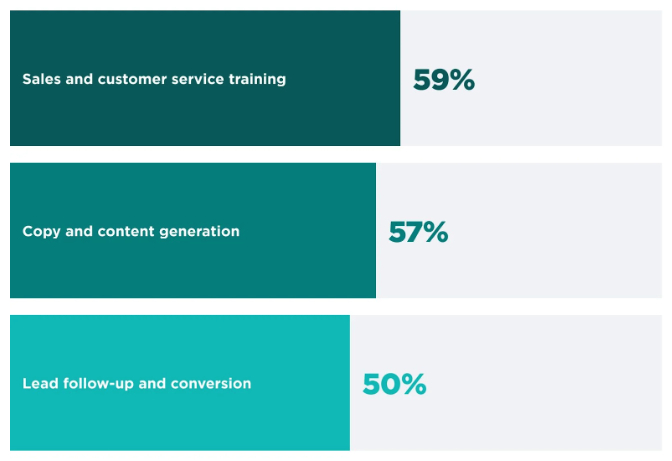
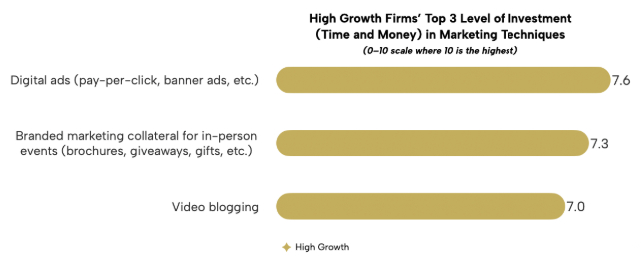
The Hinge Marketing 2025 High Growth Study confirms that video requires the third-highest level of investment for high-growth firms, reflecting the growing importance of visual communication in legal marketing. - Copy and content generation remain a major challenge. Despite content’s effectiveness, 57% of firms cite copy and content generation as a significant challenge according to CallRail’s 2026 report. The gap between knowing content works and actually producing it consistently is real.
Law Firm Marketing Budgets
The U.S. Small Business Administration recommends an average marketing budget of 7%-8% of your firm’s gross revenue. But law firms generally spend between 2% to 10% of their revenue. Let’s look at a few more stats around how law firms spend.
- 54% of law firms increased their marketing budgets (adjusted for inflation) according to the Legal Marketing Association’s ATL CMO Survey 2025. Only 14% reported budget decreases.
- Mid-sized firms are investing the most aggressively. 74% of firms with 51-100 attorneys report budget increases (the highest of any segment). This validates that growth-focused mid-market firms are putting serious money behind their marketing.
- Technology budgets remain consistent. According to the ABA 2024 TechReport:
- The average annual technology spend was $13,991, with solo respondents typically spending less than $3,000 annually, while firms of 2-9 attorneys reported spending between $10,000-$20,000.
- 65% of firms reported budgeting for technology in 2024, unchanged from 2022. However, this percentage increases dramatically with firm size (from 41% of solo practitioners to 90% of firms with 100+ attorneys).
- Marketing budget increases are expected across firm sizes. According to the Rankings.io 2025 State of Law Firm Marketing Report, 69% of smaller law firms (1-25 employees) agree their marketing budget will increase, while 79% of medium/large law firms (26+ employees) expect increases.
- Rankings.io also found that only 65% of firms agree that their current marketing budget is achieving their lead generation goals. This means over a third of firms feel their marketing spend isn’t hitting targets, creating urgency to find efficiencies in lead generation and conversion.
Statistics Around Paid Search Marketing (PPC)
For growth-oriented plaintiff-side firms investing $40K+ per month in digital advertising, paid search remains the most controllable and scalable channel. Here’s what the data shows:
- Paid search (PPC) is a top-3 channel for law firm lead generation. According to CallRail’s 2026 report, 51% of firms cite paid search as a primary driver of new business. For larger firms with bigger budgets, that number jumps to 63%.
- High-growth law firms invest heavily in digital ad campaigns. The Hinge Marketing 2025 High Growth Study found that, unlike other professional service sectors, the fastest-growing law firms are making significant investments in digital advertising campaigns.
- Smaller firms feel the pressure of competition more acutely.
When asked if they have greater marketing exposure than competitors, only 54% of smaller law firms (1-25 employees) agree compared to 69% of medium/large law firms (26+ employees).
This gap suggests that smaller firms need to be more strategic about where they allocate their paid media dollars.
Lead Response and Intake: The Hidden ROI Killer
You can run the best PPC campaigns in the world, but if your intake can’t convert those leads, you’re burning money. The data here is sobering.
- Response rates are improving, but 26% of firms still don’t respond at all. According to Hennessey Digital’s 2025 Lead Form Response Time Study, 74% of law firms now respond to online leads within seven days (up from just 59% in 2021).
But that still means over a quarter of firms are leaving money on the table with unanswered leads. - Speed is improving dramatically. 25% of law firms now respond to leads in under 5 minutes, compared to just 13% four years ago. The median response time is 13 minutes, a great improvement from lags that peaked at 25-33 minutes in recent years.
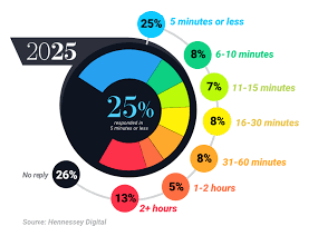
- But 39% still take too long or don’t respond. According to Hennessey, 39% of firms take more than 2 hours to respond or don’t respond at all to online leads. In a world where prospects are contacting multiple firms simultaneously, that’s a death sentence.
Consumer expectations are even higher than most firms realize. - According to Martindale-Avvo’s Legal Consumer Report 2024, 85% of consumers expect a response within 48 hours or less.
- 40% will wait less than 24 hours before contacting another attorney.
- 44% would wait 24-48 hours before moving on.
- 20.7% would wait only 1-8 hours, and 20.2% would wait just 9-23 hours.
Scorpion’s 2025 research found that 72% of consumers will move on if they don’t hear back within 24 hours up from 66% in 2024. Consumer patience is shrinking. And that’s why at Pareto, we help our clients with intake optimization alongside legal marketing. - 81% of firms admit to losing business due to slow responses, according to CallRail 2026. 52% lose business specifically because of missed calls. And 35% of firms estimate they’ve lost 11-25% of their annual revenue simply because they couldn’t respond fast enough.
- Phone calls remain the #1 response method. Hennessey Digital’s study found that 87% of firms use phone calls when responding to online leads. 67% use email (automated or personalized).
Text messaging has seen slower growth than expected. Just 5% growth since 2021 (likely due to stricter A2P messaging regulations requiring explicit consent).
Intake is understaffed and under-tooled. - According to CallRail, 68% of firms still rely on attorneys or paralegals to handle intake alongside their existing caseloads. Only 52% use a CRM, only 22% use call tracking or call recording, and just 11% use virtual receptionists.
- Phone remains king for ongoing client communication. While phone and email tie at 69% for initial contact, ongoing communication heavily favors the phone at 58%, with email dropping to 20% and text at 11%.
Email is now the preferred initial contact method (surpassing phone calls), but consumers are receptive to live chat with a real person while being significantly less likely to engage with chatbots or AI (according to Martindale-Avvo).
The takeaway: Your digital advertising is only as good as your intake system’s ability to answer the phone and convert leads quickly.
AI in Legal Marketing
Only 35% of law firms report regular or widespread artificial intelligence use. According to the LMA/ATL CMO Survey 2025, most firms are still in the early stages of AI adoption. Notably, 100% of firms with widespread AI adoption have 100+ attorneys. The smallest firms are lagging behind. Here are some more stats around AI legal marketing:
- AI is already affecting positioning and differentiation. 38% of CMOs say AI has affected their firm’s positioning and differentiation (the highest impact area reported in the ATL survey).
The AI adoption across the legal industry isn’t uniform. Solo and small firms are falling behind. - According to Clio’s 2025 Solo and Small Law Firms Report, while solo and small firms are often thought of as leaders in law firm technology, they’re actually falling behind their larger counterparts when it comes to AI adoption.
- How firms are using AI in marketing according to CallRail 2026:
- personalizing campaigns or customer experiences (68%),
- lead scoring or qualification (55%),
- attribution or ROI measurement (53%),
- and generating content (52%)
- While 84% of PI firms use AI for personalization (versus 68% overall), only 36% use AI for attribution and ROI measurement (versus 53% overall).
Given the massive investments PI firms make in SEO, video, and paid search, this attribution gap represents a significant missed opportunity. - Marketing teams want “hard data, helpful metrics, and applicable tracking.” The ATL CMO Survey found that CMOs are increasingly using AI for KPI tracking and measurement, signaling a shift from AI as a content generator to AI as an analytics tool.
- 70% of CMOs are also taking on greater technology adoption responsibilities. Marketing is increasingly owning the tech stack from CRM to attribution to AI implementation.
AI and Search Behavior: The New Consumer Journey
AI is reshaping how consumers find and evaluate attorneys online. 1 in 5 Google searches now display AI summaries (as of March 2025). Here are some more stats that show how AI has percolated into the consumer’s legal research journey:
- AI Overviews can create 50-80% click-through rate declines in trust-sensitive categories. For legal services, this means your organic rankings may not translate to clicks the way they used to.
- Consumer journeys are now “non-linear”: bouncing between profiles, review sites, websites, and AI-powered results. The path from search to contact is no longer a straight line.
- 53% of profile-driven contacts happen off the profile, according to Martindale-Avvo. These contacts come via websites, Google Maps, saved numbers, and email (not through the profile itself).
- For every 10 tracked profile contacts, there are approximately 21 total contacts influenced by your online reputation. The True Contacts Multiplier is 2.1×.
This means last-touch attribution significantly underestimates your marketing’s actual impact.
Further the “Hidden Influence” problem is real. - 27% of contacts occurred after an intervening profile or website step that doesn’t get credited in last-touch attribution. Profiles influence 38% more contacts than last-touch attribution shows. From 9.5 million ad impressions analyzed: 942,571 engaged, 383,278 calls tracked, and 103,586 contacts occurred via indirect paths.
Revenue Outlook: Law Firms Are Bullish
Despite competitive pressures on legal services, law firms remain optimistic.
- 88% of firms agree their revenue will improve over the next 12 months, according to Rankings.io survey, with a uniform optimistic rating of 4.2 out of 5 across all firm sizes.
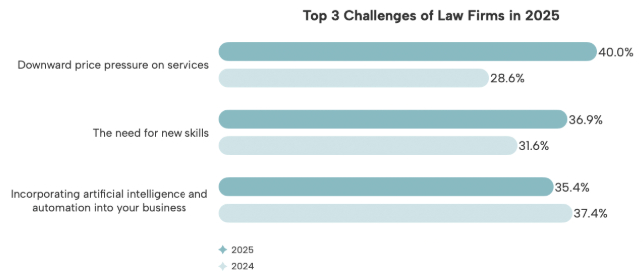
- But according to Hinge Marketing, pressure to reduce fees now dominates the list of concerns, with four out of ten participants citing it as their top worry. This development is particularly noteworthy given the recent rise in legal fees.
The firms that will win in this environment aren’t necessarily the ones spending the most. They’re the ones spending most efficiently, with tight attribution and intake systems that convert marketing investment into signed cases.
The Bottom Line
Here’s what these statistics for law firms actually tell us: Firms spending serious money on PPC and SEO but ignoring intake, reviews, and attribution are lighting money on fire.
The ones winning aren’t outspending everyone—they’re out-executing on the fundamentals that convert clicks to signed cases. When 72% of consumers move on within 24 hours and 53% won’t even look at you below 4 stars, the margin for error is razor thin.
So what separates the firms growing 40% year-over-year from everyone else? They track everything. They answer the phone fast. They treat their online reputation like the revenue driver it is. None of this is complicated. It’s just disciplined.
The real question isn’t whether you should invest in better tracking and faster response times–it’s whether you can afford not to. That’s the work we do at Pareto Legal: connecting ad spend to signed cases and fixing the intake bottlenecks that kill ROI. Contact us to schedule your PPC audit.