For years, many firms followed a simple rule: if you want more clients, just bid higher on keywords. But in 2026, simply buying clicks is no longer enough to grow a profitable practice. Competition has reached an all-time high, and the way potential clients find and choose a lawyer has changed.
Today’s consumers are looking for instant trust signals like “Google Screened” badges and 5-star reviews right at the top of their search results. If your firm isn’t adapting to these new behaviors, you may be spending more on leads that don’t convert into cases.
Let’s take a look at the most critical local PPC statistics from 2025 and 2026 and how the most successful firms are using this data to help turn their marketing spend into high-value signed cases.
Also Read:Legal Marketing Statistics 2026 →
Local Business Statistics
Consumers are adapting to newer search methods to look for businesses online, but are also looking at a business’s legitimacy and reputation before they make a decision.
How People Find Businesses
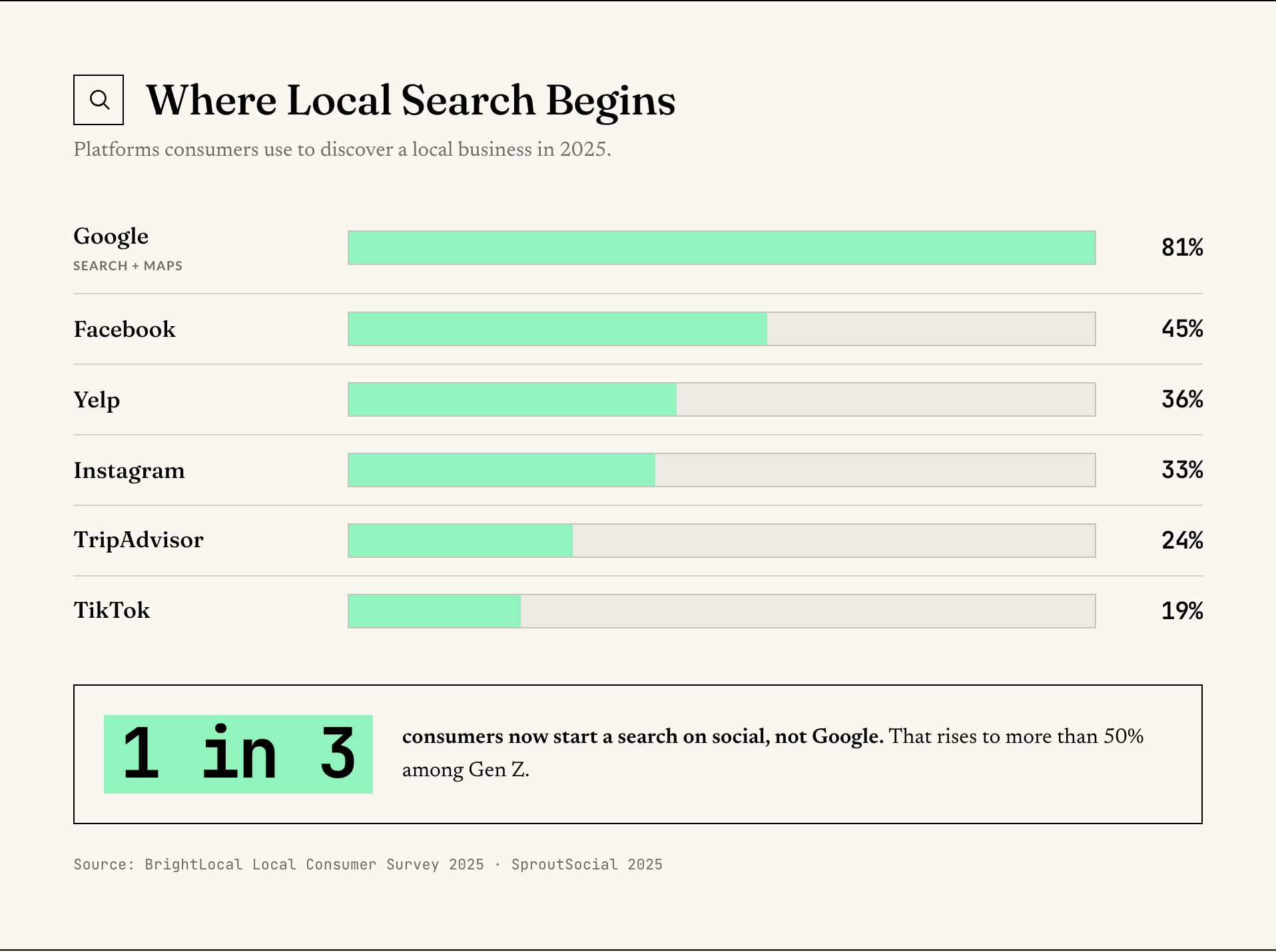
Businesses need to identify the specific digital gateways their audience prefers. Here is a breakdown of where the search journey begins:
1. 81% of consumers effectively use Google products (Google Search and Google Maps) as their default for discovery, according to BrightLocal’s Local Consumer Survey in 2025. In the same research, other platforms rank as follows:
- Facebook: 45%
- Yelp: 36%
- Instagram: 33%
- TripAdvisor: 24%
- TikTok: 19%
2. SproutSocial’s 2025 Impact of Social Media Report shows that nearly 1 in 3 consumers now skip Google entirely and start their search on social networks like TikTok, Instagram, or YouTube. This number rises to more than 50% for Gen Z consumers.
3. GatherUp’s research also reveals interesting stats on how consumers begin their search for local businesses:
- 58% start by using search engines like Google or Bing
- 14% start by typing a query into map apps like Google or Apple
- 11% start by using voice assistants like Siri or Alexa
- 7% start by asking friends or family
- 1% start by searching on social media
4. The Rio SEO 2025 Local Search Consumer Behaviour Study found that 31% of consumers use Apple Maps frequently to find a local business.
Another reason local search is important to a business is the frequency and volume of these searches every single day.
80% of U.S. consumers search for a local business at least once a week, and 32% do so every single day, as reported in the Soci 2025 Consumer Behavior Index research.
How People Trust Businesses
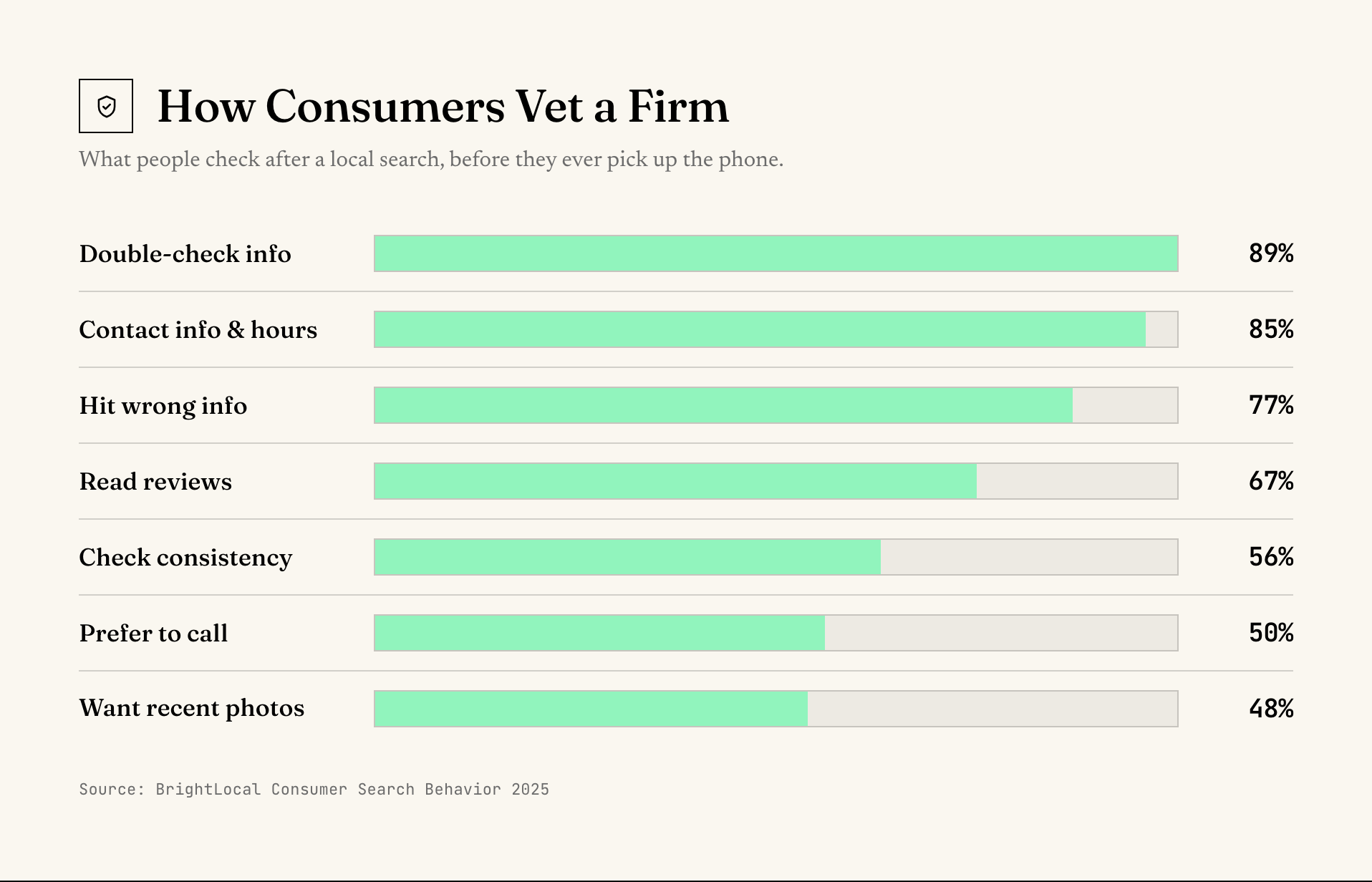
Based on the BrightLocal Consumer Search Behavior 2025 report, here is the breakdown of how consumers verify and trust local businesses through search:
- 89% of consumers double-check a business’s information online (such as verifying it on multiple platforms) before they ever decide to visit in person.
- 85% of consumers state that the presence of contact information and accurate opening hours is a primary factor in their research and trust process.
- 77% of consumers have encountered incorrect business information online in the last year, which serves as a major red flag for brand credibility.
- 67% of consumers “often” or “always” look at business reviews specifically after conducting a local search to validate their choice.
- 56% of consumers “often” or “always” check that business information is consistent across different websites to ensure the business is legitimate.
- 50% of consumers prefer to call a local business directly to ask questions, showing that “click-to-call” is the most vital ad extension for local trust.
- 48% of consumers rank high-quality, recent photos as a “very important” factor in their decision to trust a business they found via search.
LSA Statistics
Here’s how consumers are actually interacting with Local Service Ads (LSAs).
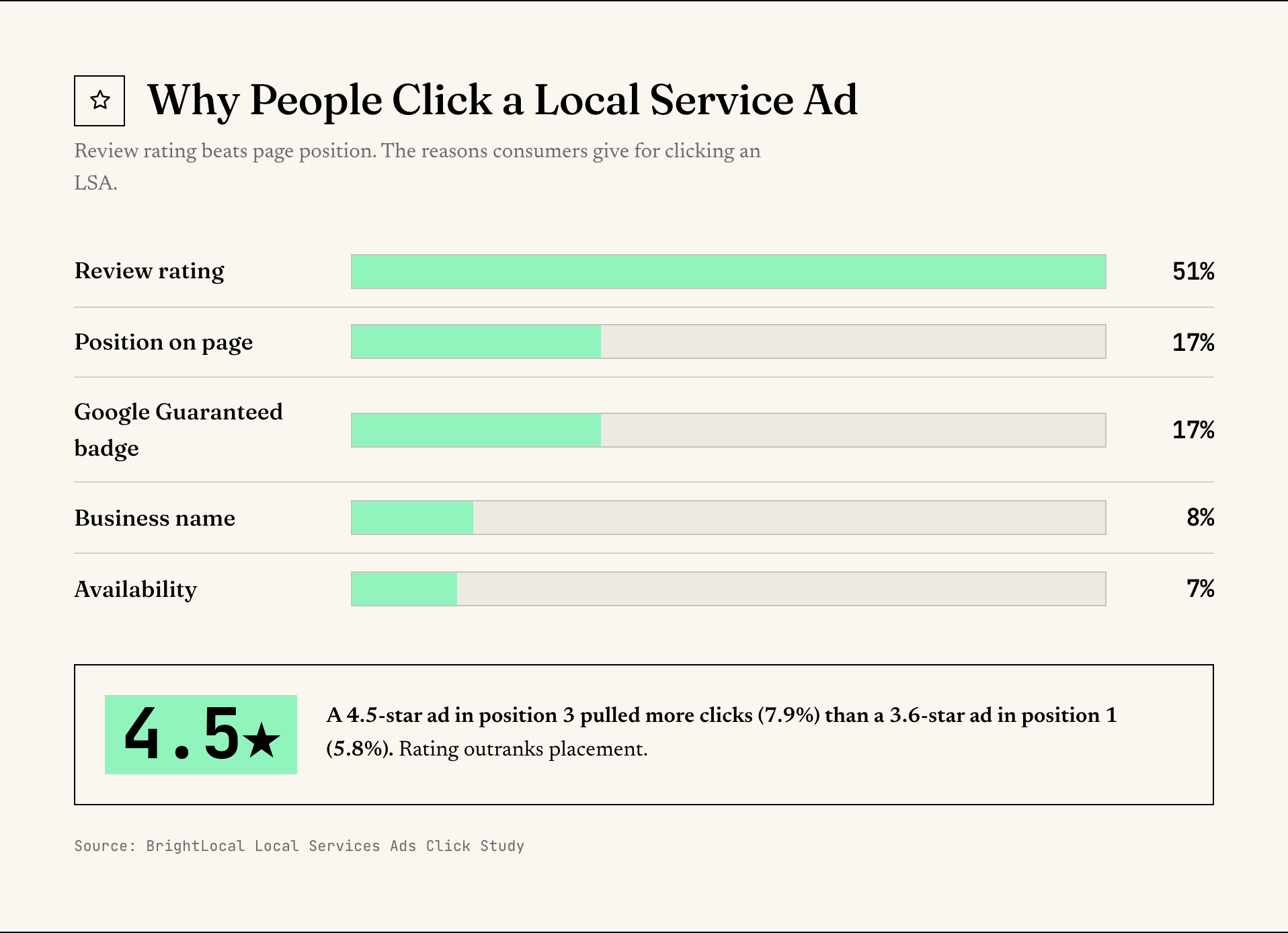
1. Review ratings matter. According to the BrightLocal Local Services Ads Click Study, consumers are willing to skip the top result to click a better-rated business, proving that Review Rating > Page Position for LSAs. Here are the numbers:
- The reasons for people clicking on LSAs are:
- Review rating: 51%
- Position on page: 17%
- Google Guaranteed badge: 17%
- Business name: 8%
- Availability: 7%
- 7.9% of all clicks went to an LSA in Position 3 because it had a high rating (4.5 stars).
- In contrast, only 5.8% of all clicks went to the LSA in Position 1 because it had a lower rating (3.6 stars).
2. According to Wordstream’s Google Ads Benchmarks 2025, the “Personal Services” category (a key LSA vertical) is seeing an average conversion rate of 9.74% in 2025, significantly higher than the Real Estate sector (3.28%) or Finance sector (2.55%).
Law Firm PPC Statistics
Our 2026 report on the state of law firm PPC, which analyzed $3.3 million in managed ad spend, highlights several critical performance benchmarks for legal marketing:
- Bankruptcy leads conversions at 10%, which is five times the rate of criminal defense leads (2%).
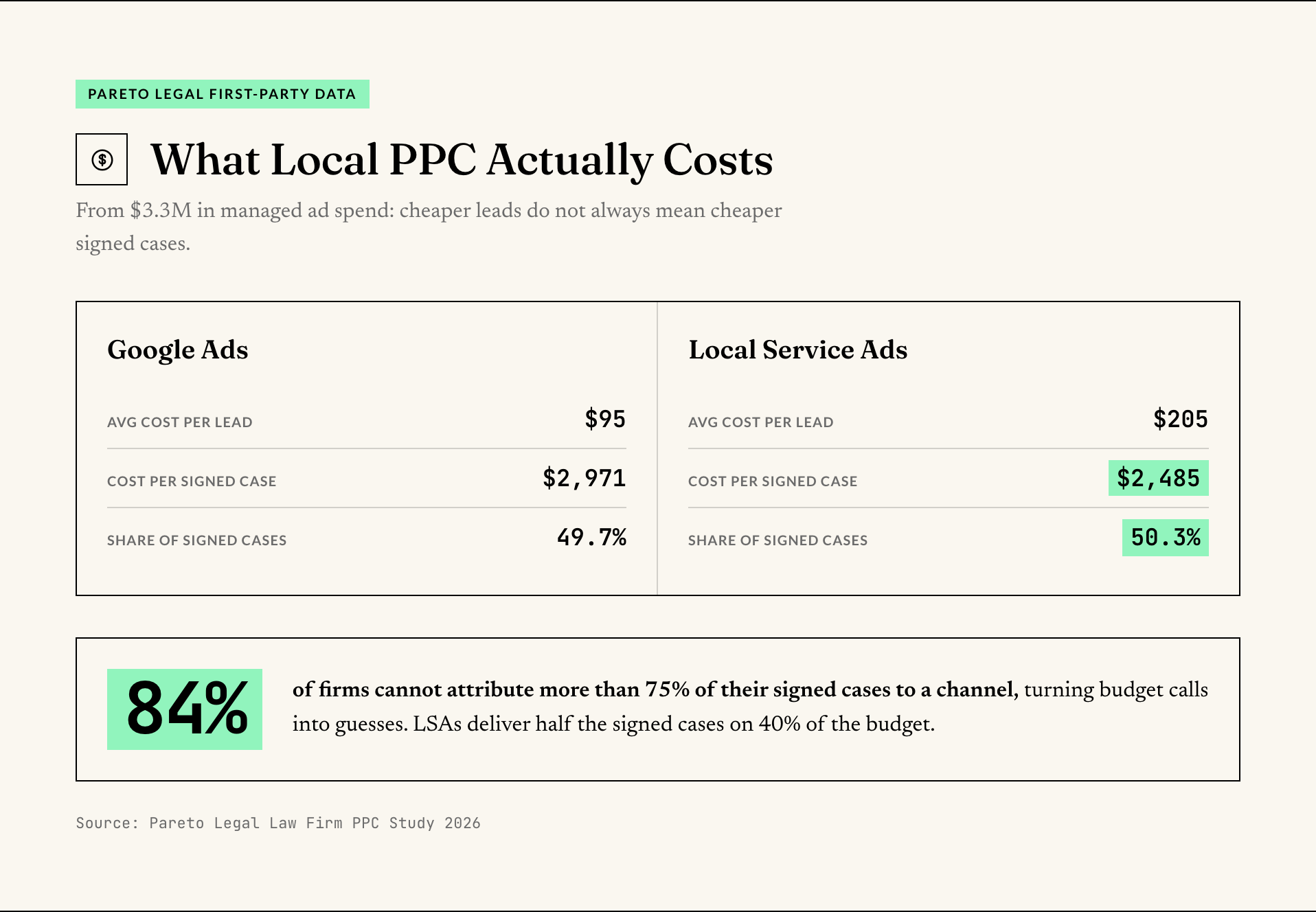
- LSAs are highly efficient, producing 50.3% of signed cases while utilizing only 40% of the total marketing budget.
- While Google Ads offers a lower average cost per lead ($95 vs. LSA’s $205), LSAs deliver a superior cost per signed case at $2,485 compared to $2,971 for Google Ads.
- A significant 84% of law firms struggle to attribute more than 75% of their signed cases to specific marketing channels, leading to “blind” budget decisions.
- For personal injury (MVA) firms, the average cost per signed case is $468, which typically represents a high ROI given that case values in this practice area often range from $15,000 to over $150,000.
Ad Copywriting Statistics
Writing ad copy is no longer just about catchy slogans. It’s now about meeting a searcher’s psychological expectations in milliseconds. The latest industry research suggests that the structure and specific phrasing of your text are the primary drivers of engagement in 2026.
An Unbounce Conversion Benchmark Report shows that:
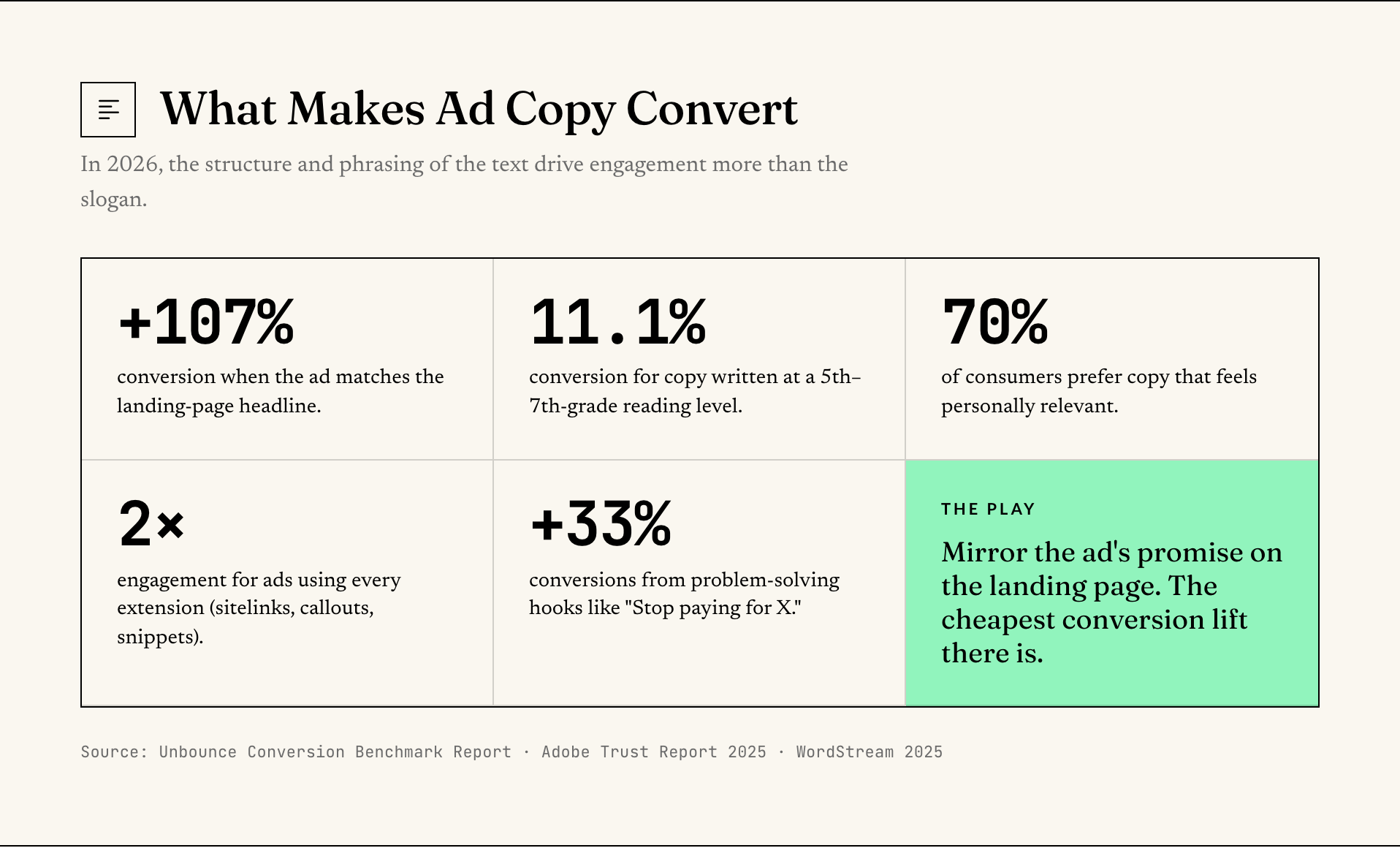
- 107% higher conversion rates are achieved when marketers align their ad copy exactly with the landing page headline
- 11.1% conversion rate is seen for landing pages and ads written at a 5th to 7th-grade reading level.
Furthermore, people are drawn to ad copy that speaks directly to them.
70% of consumers express a clear preference for ad copy that feels “personally relevant,” according to the Adobe Trust Report 2025. Using direct address, like “You” and “Your”, helps bridge the gap between a generic ad and a personal solution.
Having more text in ads appears to be an advantage. The WordStream 2025 Google Ads Benchmarks report found that 2x higher engagement is recorded for ads that use all ad extensions (sitelinks, callouts, and structured snippets). These extensions increase the ad’s physical size and provide more entry points for the user.
The same study found that problem-solving hooks like “Stop paying for insurance” generate 33% more conversions.
Landing Page Statistics
According to FirstPageSage’s 2026 Google Click-Through Rate Study, the value of your landing page is entirely dependent on its ability to rank in the top three spots.
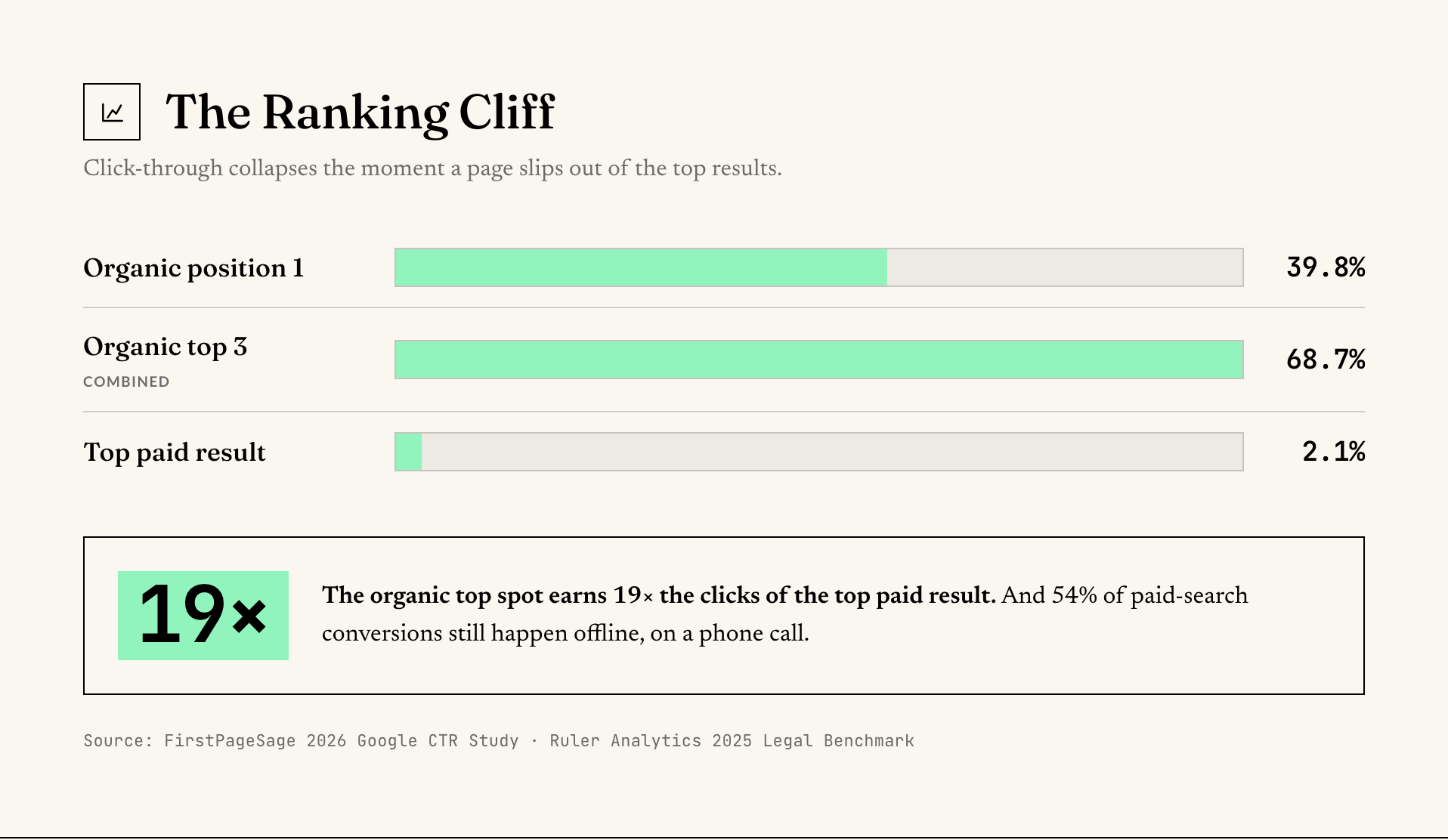
The data reveals a massive cliff in traffic for pages that slip even slightly in position, making SEO a critical component of landing page strategy.
1. The organic #1 position commands nearly 40% of all click-throughs, meaning the top result captures the lion’s share of high-intent traffic.
2. The top 3 organic results combined capture 68.7% of all clicks on the page. If your landing page ranks lower than #3, it is fighting for scraps.
3. The #1 organic result receives 19x more clicks than the top paid search result (which averages just 2.1% CTR).
The Ruler Analytics 2025 Legal Conversion Benchmark Report found a few more surprising facts on how landing pages convert (or don’t).
- 54% of all conversions from paid search happen offline with a phone call.
- Visitors from paid search convert at 4.3%, noticeably higher than organic search visitors at 3.%.
Stats on Ad Platforms
Based on current industry benchmarks from late 2025 and early 2026, here is how the primary paid ad platforms are performing.
1. Google Search
According to the WordStream 2025 Google Ads Benchmarks, Google remains the top channel for capturing active buyers, though rising competition has driven up costs across nearly every vertical.
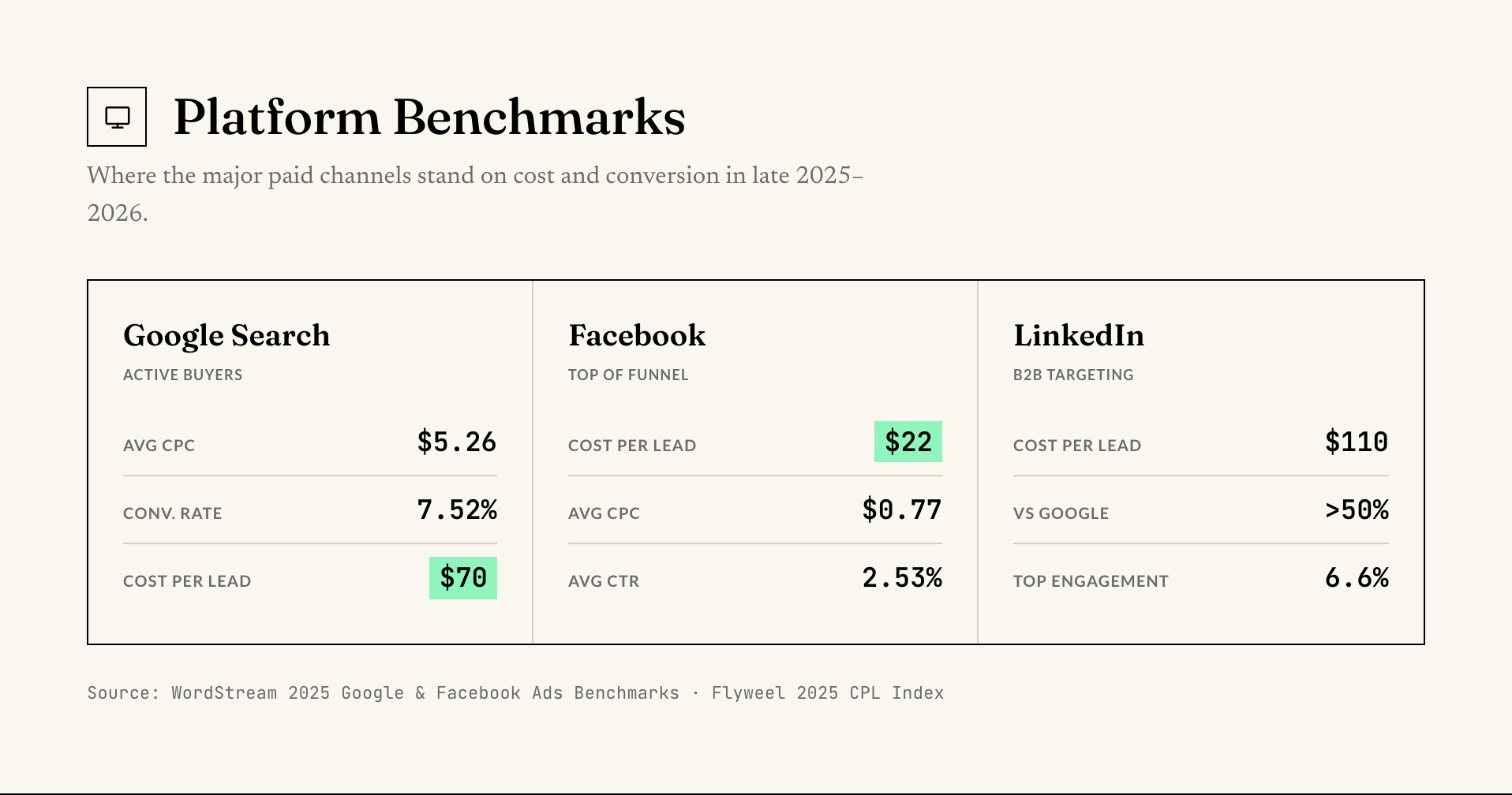
- Average CPC: $5.26 (a significant increase year-over-year).
- Average Conversion Rate: 7.52%.
- Average Cost Per Lead (CPL): $70.11.
Skai’s Q3 2025 Quarterly Digital Trends Report tracked billions in ad spend and shows how enterprise-level advertisers are shifting their budgets.The study found that:
- Paid search spend increased 9% year-over-year, matched by a 9% increase in Cost Per Click (CPC).
- Adoption of Performance Max (PMax) has stabilized at roughly 60% of all search accounts.
2. Facebook
The WordStream 2024-2025 Facebook Ads Benchmarks show that Meta remains the king of top-of-funnel awareness, with its lead generation ads continuing to show strong year-over-year improvement.
- The average Cost Per Lead for Facebook Lead Ads is $21.98.
- For standard traffic objectives, the average CPC is a budget-friendly $0.77.
- Average CTR across all industries for lead campaigns is 2.53%.
3. LinkedIn
According to the Flyweel 2025 CPL Benchmark Index, LinkedIn is the most expensive platform for advertising but offers unmatched targeting for professionals.
- The average CPL for B2B leads is $110, more than 50% higher than Google Search.
- SaaS and Software leads typically cost $100+, while Finance & Insurance leads range between $90 and $120.
- Multi-image posts are currently the most engaging format on the platform, with a 6.60% engagement rate.
AI Stats Around Local PPC
AI is changing how paid search works. For advertisers, showing up doesn’t guarantee a click anymore, and you aren’t just competing with other brands but Google itself.
PPC and AI Overviews
The biggest change right now is that Google is answering questions directly on the results page. When users get their answer instantly, they don’t need to click your ad or visit your site. This “skip effect” is real, and the numbers prove it.
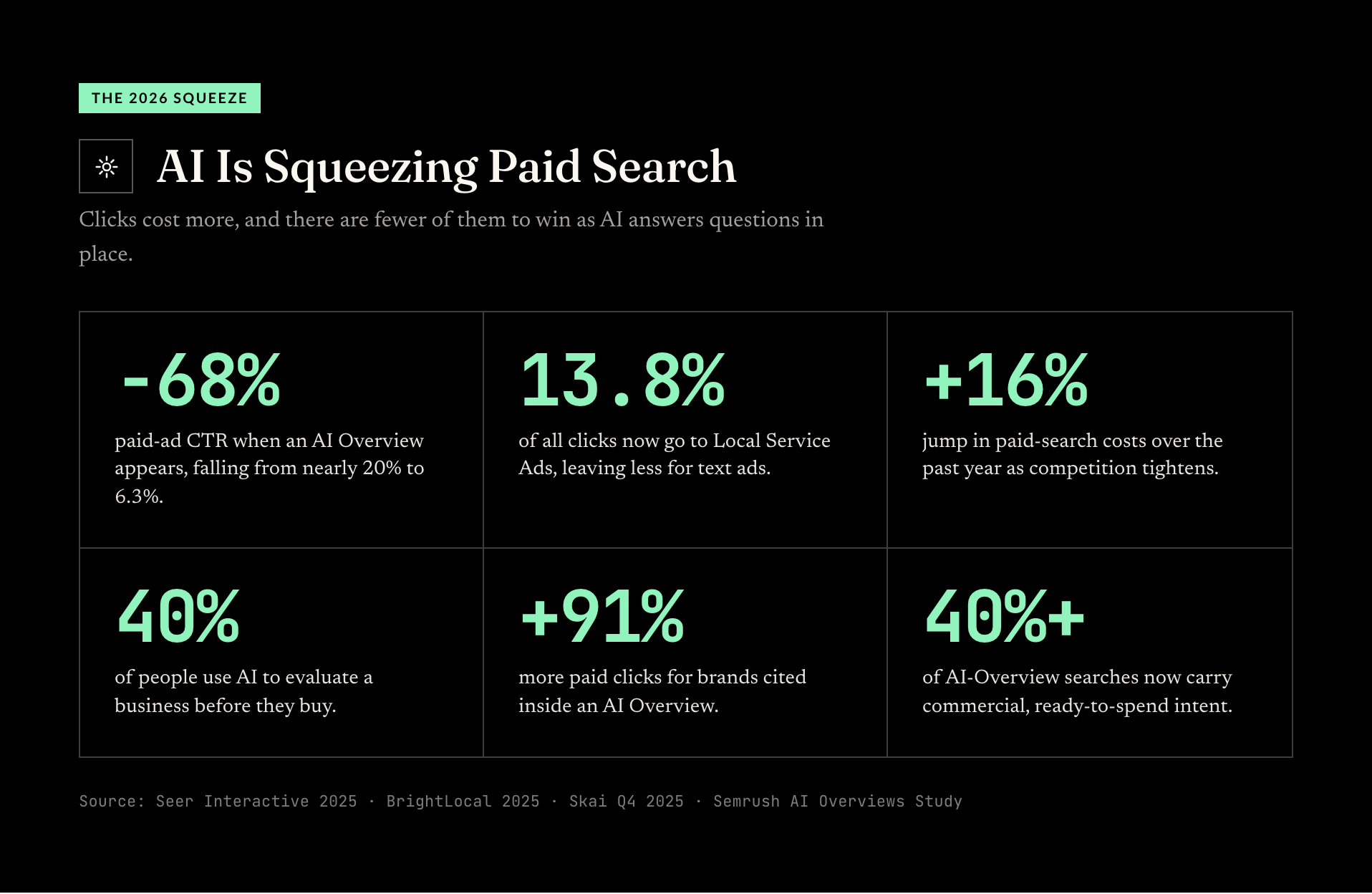
- When an AI Overview appears, the click-through rate for paid ads crashes by 68% (dropping from nearly 20% to just 6.3%), according to Seer Interactive.
- FirstPageSage notes that while the #1 organic spot is still valuable, attention is being fractured.
- BrightLocal found that LSAs are grabbing 13.8% of all clicks. Between AI summaries and LSAs, there is simply less traffic left over for traditional text ads.
The Cost Per Click Shift
You are likely feeling the double squeeze where clicks are costing more, but there are fewer of them to go around. As AI handles the easy questions, the remaining searches are more competitive and expensive.
- Paid search costs jumped 16% last year, according to Skai’s Q4 2025 Report.
- WordStream backs this up, showing the average Cost Per Click (CPC) has hit $5.26 across industries.
- The PPC Survey 2025 found that 49% of marketers say managing ads is harder now than it was two years ago, mostly because they feel like they’ve lost control over where their money goes.
AI and Consumer Trust
The goal was to rank #1. Now, the goal is to get cited. AI is changing how people trust information, and users are skipping Google Search entirely to ask AI chatbots for recommendations.
- GatherUp found that 31% of consumers have used AI tools (like ChatGPT) “many times” to find local businesses.
- BrightLocal adds that 40% of people use AI to evaluate a business before they buy.
If you can get mentioned in an AI overview, it pays off. Seer Interactive data shows that brands cited by AI get 91% more paid clicks than those that just appear on the page without a mention.
AI As a Shopping Tool
AI is now being used more in transactional and commercial search. People are using it to find products and hire services, which means you need to be fast to compete.
- Semrush reports that over 40% of searches triggering an AI overview now have commercial intent, which means the user is ready to spend money.
- To keep up, advertisers are handing the keys to the algorithm. BrightLocal found that 93% of marketers are using generative AI tools to help manage their work.
- While automation is necessary, it’s not magic. Unbounce notes that median conversion rates are hovering around 6.6%, so you still need a great landing page to close the deal.
Data-Driven Growth vs. Best-Guess Marketing
In a market where a single click costs nearly $10, there is no room for best-guess marketing.
Stop paying for clicks and start paying for clients. At Pareto Legal, we don’t just manage keywords. We optimize your entire funnel, from the first LSA click to the final signed retainer.
Our data-driven approach fixes the intake bottlenecks that kill ROI and ensures every dollar of your ad spend is working toward a signed case.
Contact us today for a comprehensive PPC audit for your law firm.