

A criminal defense Google Ads account is won or lost in its structure, not in its ad copy. Where the campaigns split, which match types run where, what the negative list blocks and when the schedule goes dark decide most of what a lead ends up costing you.
The economics that set the ceiling on all of it sit one level up, in criminal defense marketing. Everything below is the account itself.
What Is Criminal Defense PPC?
Criminal defense PPC is paid search advertising for a defense firm. You bid on charge-specific queries like “DUI lawyer near me” or “drug possession lawyer Houston” through Google Ads for lawyers, and you pay each time somebody clicks through to your site.
The unit you buy is a click. The unit you are actually paying for is a retained client, and closing that gap is the entire job of the account.
Two settings decide most of it before you write a single ad: what Google is allowed to match your keywords to, and when Google is allowed to spend. The figures behind the target itself, including what a retained criminal defense client costs, are worth having in front of you before you set a budget.
Campaign Structure for a Criminal Defense Google Ads Account
Split the account into one branded campaign and one campaign for each charge type you want to fund separately. Budget is set at the campaign level, so a charge sharing a campaign with another charge cannot have a budget of its own.
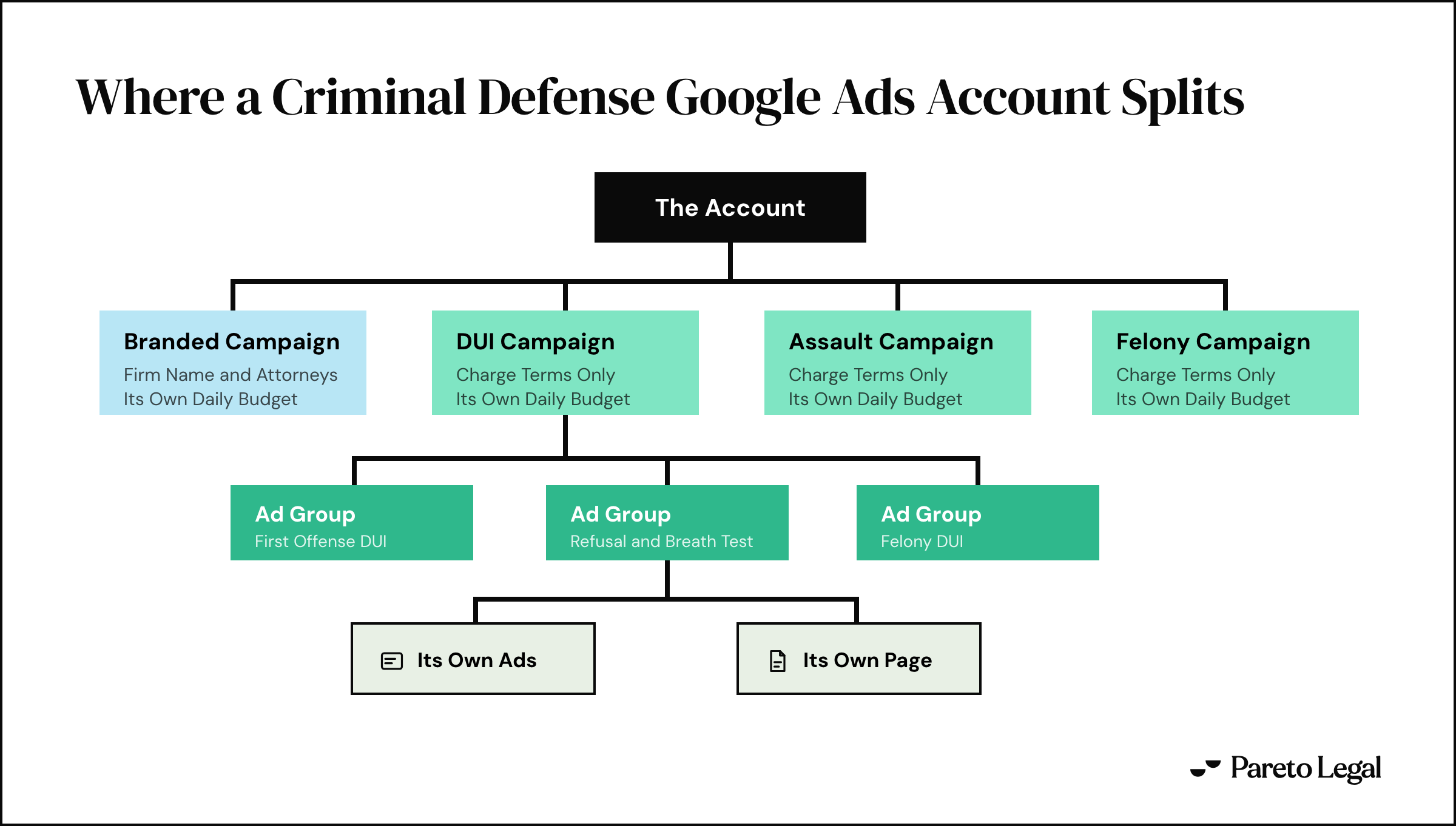
Start by separating your firm name and your attorneys’ names into their own campaign. Blend them with charge terms and the branded conversions, which are cheap and were coming to you anyway, will sit on top of the non-branded numbers and hide what new clients actually cost.
Then give each charge its own campaign wherever the economics differ. A DUI campaign and a felony campaign are not the same purchase, and holding both inside one campaign hands the split to Google rather than to you.
Underneath each campaign, one ad group holds one charge, one set of ads and one page. That is the level where the search, the ad and the page either match or leak.
Budgets behave in a way that catches most firms out on their first week of reporting. Google treats the figure you enter as an average, so it can spend up to two times your average daily budget on a single day and still hold the month to 30.4 times it. A Saturday that reads double is the system working, not a fault.
Match Types and Negative Keywords for Criminal Defense Campaigns
Run exact and phrase match on charge terms, and keep broad match out of a defense account unless you are on automated bidding with a negative list you maintain every week. Broad match without both of those is an instruction to spend your budget at random.
There is an asymmetry in how Google treats the two halves of your keyword set, and it is the single most expensive thing most defense accounts do not know.
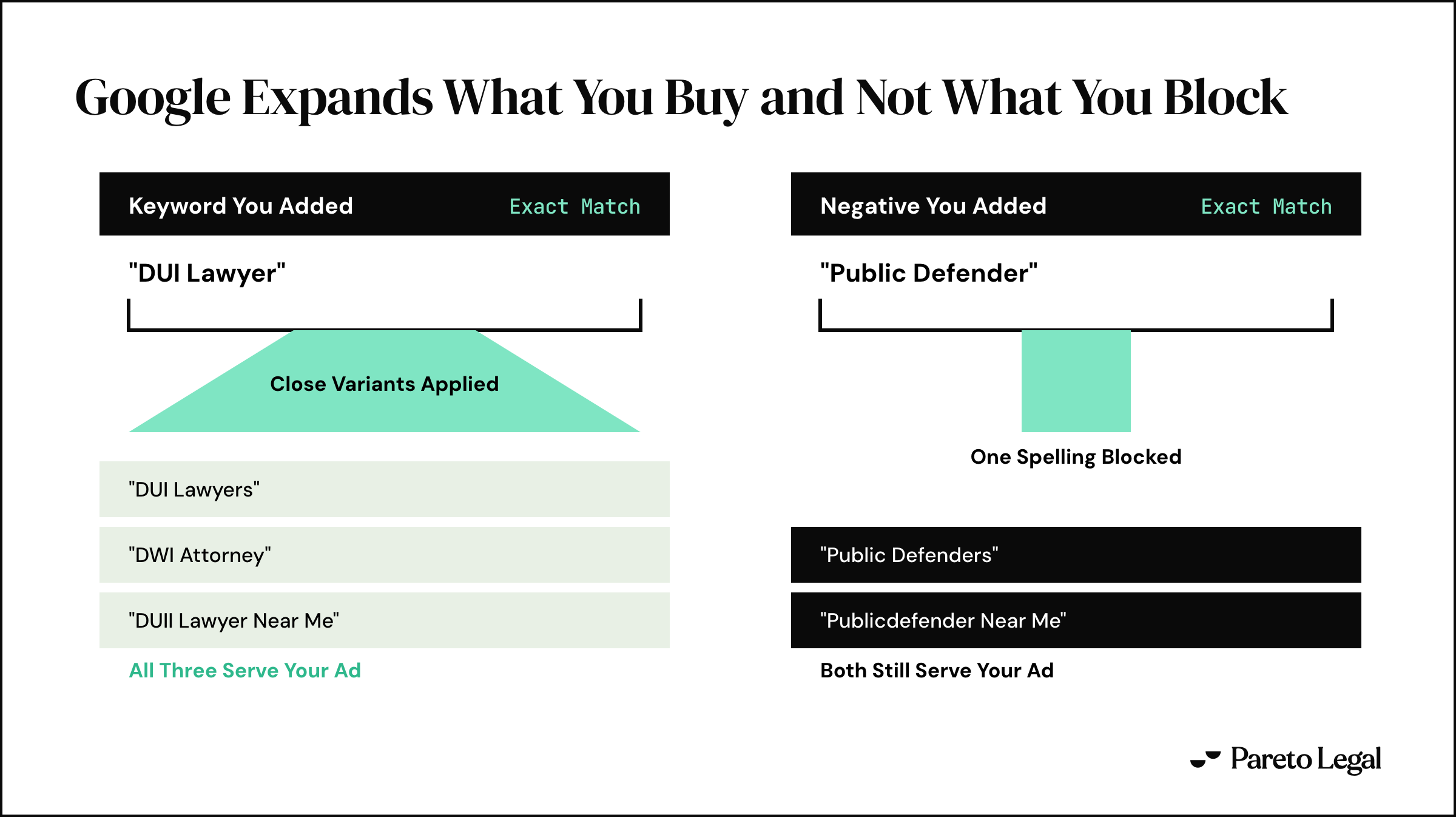
Google expands what you buy. It does not expand what you block. Its own documentation states that “negative keywords don’t match to close variants, so your ad might still show on searches or pages that contain close variations of your negative keyword terms,” which you can read in full in Google’s guidance on negative keyword match types.
So a negative on one spelling blocks that spelling only. Plurals, misspellings, run-together words and spaced-out words each need their own line. Add every variant you can think of at the moment you add the term, because the report will not remind you later.
Never set a negative to broad match. Exact and phrase are the only two safe choices, because a broad negative lets Google decide which searches to withhold your ad from.
Hold the list in three tiers rather than one. Account-wide negatives block the searches no charge campaign ever wants. Campaign-level negatives block the charges your firm does not take. Ad-group-level negatives block each charge from the others, so a DUI search cannot pull an assault ad and land on an assault page.
Keep the account-wide tier in a shared negative keyword list rather than typing it into each campaign. A list holds up to 5,000 negative keywords, and an account can hold 20 lists, applied across every campaign at once, so one addition covers the whole account instead of eight separate edits.
Build the first version of that list before the campaign goes live. Preemptive negatives cost nothing. Reactive ones cost whatever Google spent before you noticed.
How Often to Pull the Search Terms Report
Daily for the first two weeks of a new campaign, then every other week for the life of the account. Any longer than that and Google is spending against terms nobody has looked at.
Read it twice each time. First qualitatively: does the overall profile of who is clicking look like people who get charged and hire lawyers. Then quantitatively: how much budget went to terms that produced no lead. Those terms are your next negatives.
The report has a limit that changes how you should use it.
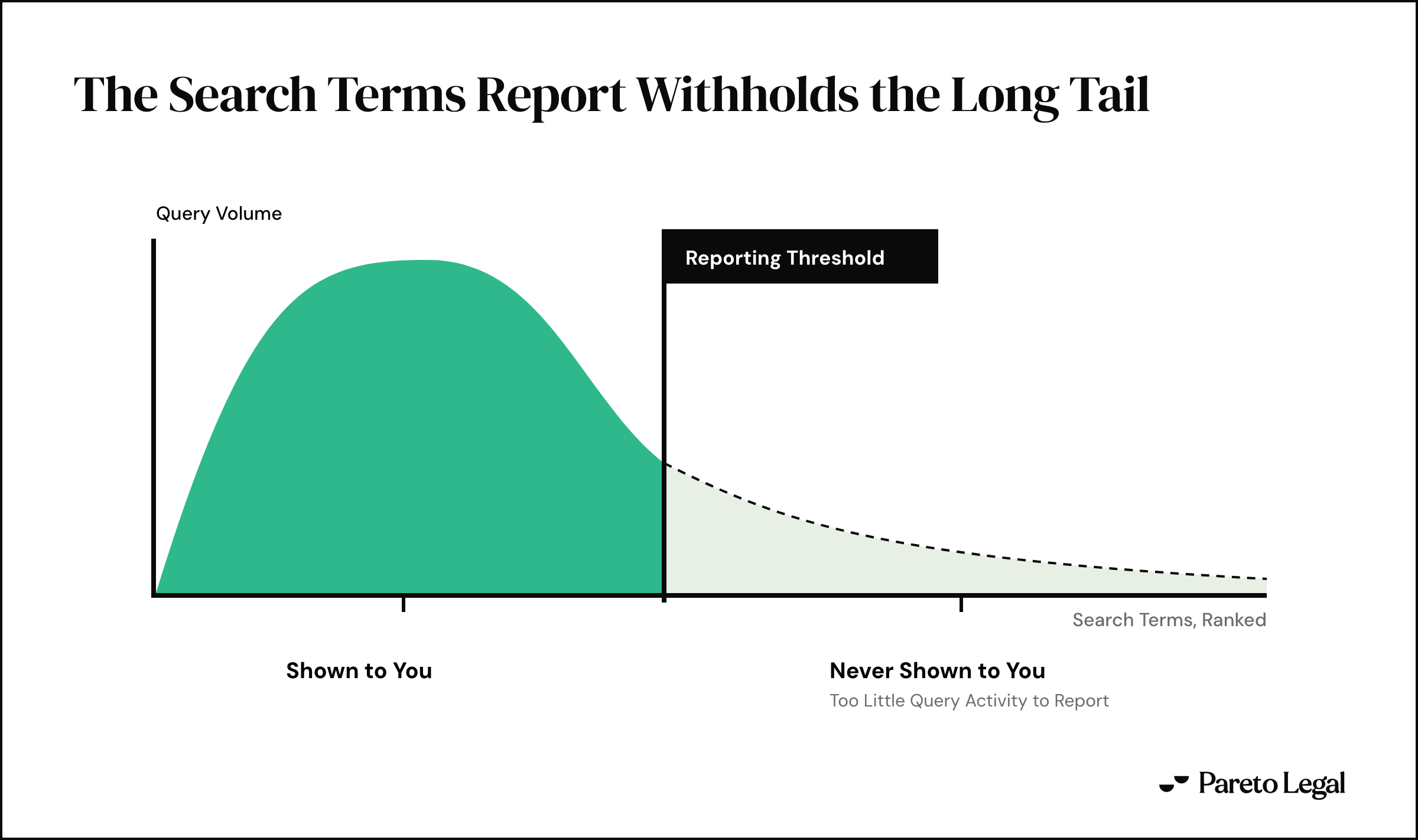
Google withholds the long tail. Terms “that don’t have enough query activity are omitted from the search terms report in order to keep with our standards on data privacy,” as Google’s own description of the report puts it. Rare searches are exactly where a defense account picks up the strangest matches, and those are the ones you will never be shown.
That is the argument for writing negatives ahead of the data rather than only in response to it. The report is a strong quality check on the traffic you can see, and it is silent about the rest.
Ad Scheduling and Bid Adjustments for Criminal Defense Campaigns
Set the schedule against your staffing roster, in your account’s time zone, and use bid adjustments to weight the hours you keep rather than to switch hours off. Google runs the ad schedule on the account’s time zone, not the searcher’s, so a firm licensed across two time zones on an Eastern-time account starts an hour late in the west every single day.
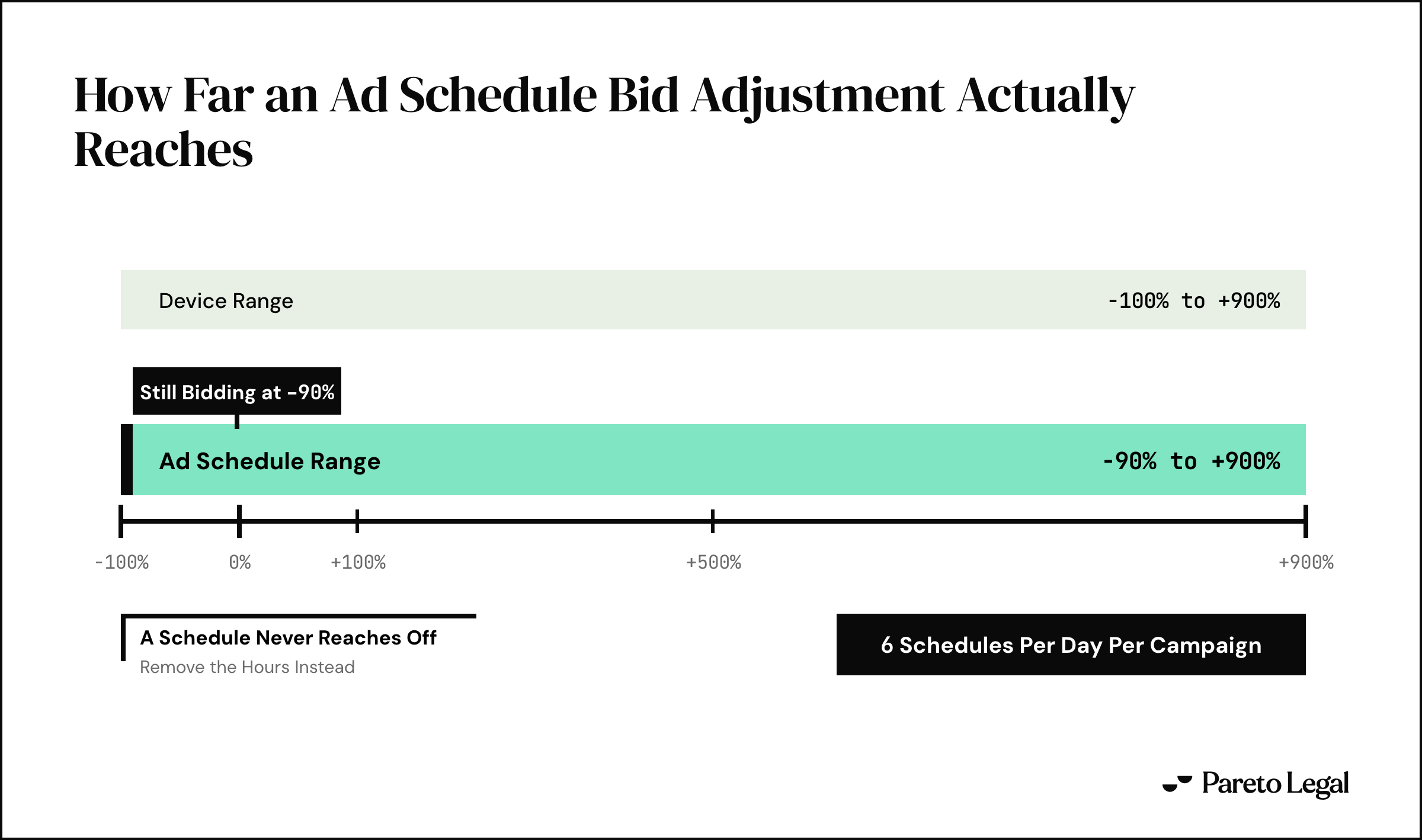
You get six slots. Google allows a maximum of six ad schedules per day for each campaign, which rules out hour-by-hour dayparting and pushes you toward blocks that match when your coverage actually changes: overnight, early morning, business hours, evening.
Inside those blocks, the adjustment range is asymmetric. An ad schedule bid adjustment runs from -90% to +900%, while a device adjustment reaches all the way to -100%. So you cannot turn an hour off with a bid adjustment on the schedule. At -90% the campaign is still in the auction, still buying the cheapest tail of it, and still sending calls to whoever is on duty. To go dark you remove the hours from the schedule.
Pull the day-and-hour segment before you adjust anything, and weight on conversions rather than clicks. Clicks peak wherever attention is cheap. Conversions peak wherever somebody answered.
Rebuild the schedule whenever coverage changes. Running ads when nobody is there to pick up the phone is one of the quickest ways to lose money in this practice area, and a schedule written once around business hours does exactly that.
Bid Strategy Sequence for a Criminal Defense Campaign
Start on manual CPC, move to Maximize Conversions once the campaign has produced 15 to 30 conversions, and move to Target CPA only once it is holding 30 to 50 conversions a month. Google’s own recommendation lands in the same place: measure the last 30 days, “including at least 30 conversions,” before you judge a Target CPA campaign.
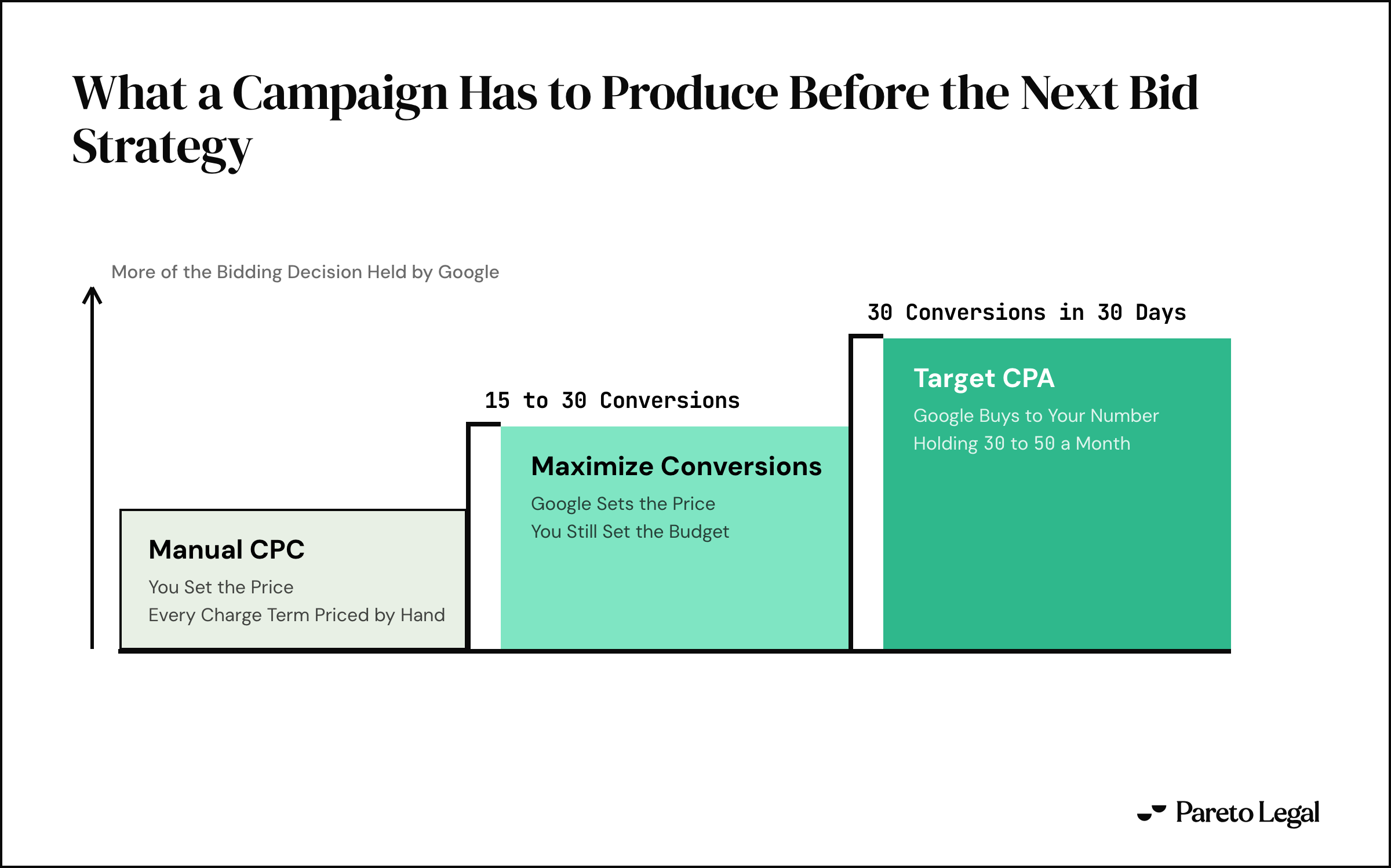
Manual is worth the tedium at the start because it is the only setting that tells you what a charge term is really worth to you rather than what Google thinks it can get. Skip it and every later decision rests on the algorithm’s guess.
Once you hand over, stop touching it. Changes monthly or quarterly at most, because each switch restarts the learning and a strategy that never finishes learning never optimises.
Impression share is the metric that tells you which constraint you are actually under. Google reports the shortfall two ways: “search lost IS (budget)” is the percentage of time your ads did not show “due to insufficient budget,” and “search lost IS (rank)” is the percentage lost “due to poor Ad Rank in the auction.” Both sit in the impression share columns.
Read them as two different instructions. Losing to budget means the traffic is available at the price you are already paying and you are simply out of money before the day ends, so funding the campaign buys volume at the same unit cost. Losing to rank means every extra impression costs more than the last, and the fix is a better ad, a better page, or a decision to pay the premium.
Fund until the loss moves from budget to rank. That is the point where you are buying everything available at your price.
None of it reads correctly if the conversion data underneath is wrong, which is the part firms skip.
Also Read:Google Analytics 4 for Law Firms →Setting up the measurement layer that connects each click to a signed caseWhat a Criminal Defense PPC Landing Page Needs
A conversion path above the fold, a headline that repeats the charge and the city from the search, and a page that finishes loading before the reader gives up. Each ad group’s page answers that ad group’s charge and nothing else.
Nobody should have to scroll to find out how to reach you. A visible phone number and a click-to-call button belong above the fold, because a phone call is the highest-value conversion a law firm gets and the only one a person in custody can complete quickly.
Write the headline to repeat the search. “Tampa DUI Attorney” tells somebody they are in the right place. “Experienced attorneys near you” makes them check. Nobody finds it repetitive to be handed exactly what they asked for.
Keep the form to five or six qualifying questions. If you genuinely need more, split it into a two-step form rather than running the questions down the page, because a long form reads as work before anybody has decided to trust you.
Put the trust signals where they answer the second question a reader has. Bar admissions, certifications, review count and star rating do more here than a firm history does, and they do it faster.
Then measure the page rather than admiring it. Google’s threshold for Largest Contentful Paint is 2.5 seconds or less at the 75th percentile of loads, measured separately on mobile and desktop, and you can test any page at pagespeed.web.dev. Compress the images, cut the scripts, and build for mobile first.
Two things to leave off. Stock photography of handshakes and gavels, which every competitor also has, and anything decorative that costs load time. Pretty pages lose money.
You can put a rough number on what a cleaner account would return before you rebuild anything using our legal PPC calculator.
What to Fix First in a Criminal Defense PPC Account
Pull the search terms report before you touch anything else. It is the only report that tells you what you are actually buying, and it usually reprices the account on its own.
After that the order is fixed by dependency. Negatives, then the campaign split, then the schedule, then bid strategy, then the pages. Each one is harder to judge while the one above it is still wrong.
The question of how much belongs in paid search at all, against Local Services Ads, paid social and the organic work underneath them, is a different decision and it sits in the criminal defense marketing budget.
If you are spending on criminal defense PPC and cannot say which campaigns produced retained clients last month, that is the problem worth solving first, and it is the work our law firm PPC management starts with. Contact us to get a Pareto Score™ Assessment.