

A law firm buys marketing in units that don’t compare to each other. Search charges per click. Local Services Ads charge per lead. Connected TV charges per thousand impressions. SEO and content charge for a slice of somebody’s month.
None of those units says what a signed case costs, so most firms end up comparing the numbers that are easy to see: cost per click, cost per lead, follower counts.
Digital marketing for lawyers covers search, Local Services Ads, Meta, YouTube, organic search, and the website and intake system behind all of them. Each one bills differently, and none of those units is a signed case.
Why Law Firms Need Digital Marketing
92.4% of legal consumers say they research their issue online before contacting an attorney, according to Martindale-Avvo’s State of the Legal Consumer 2026.
That number comes from what people report doing rather than something anyone measured them doing, and it still tells you where the decision starts: online, before the phone ever rings.
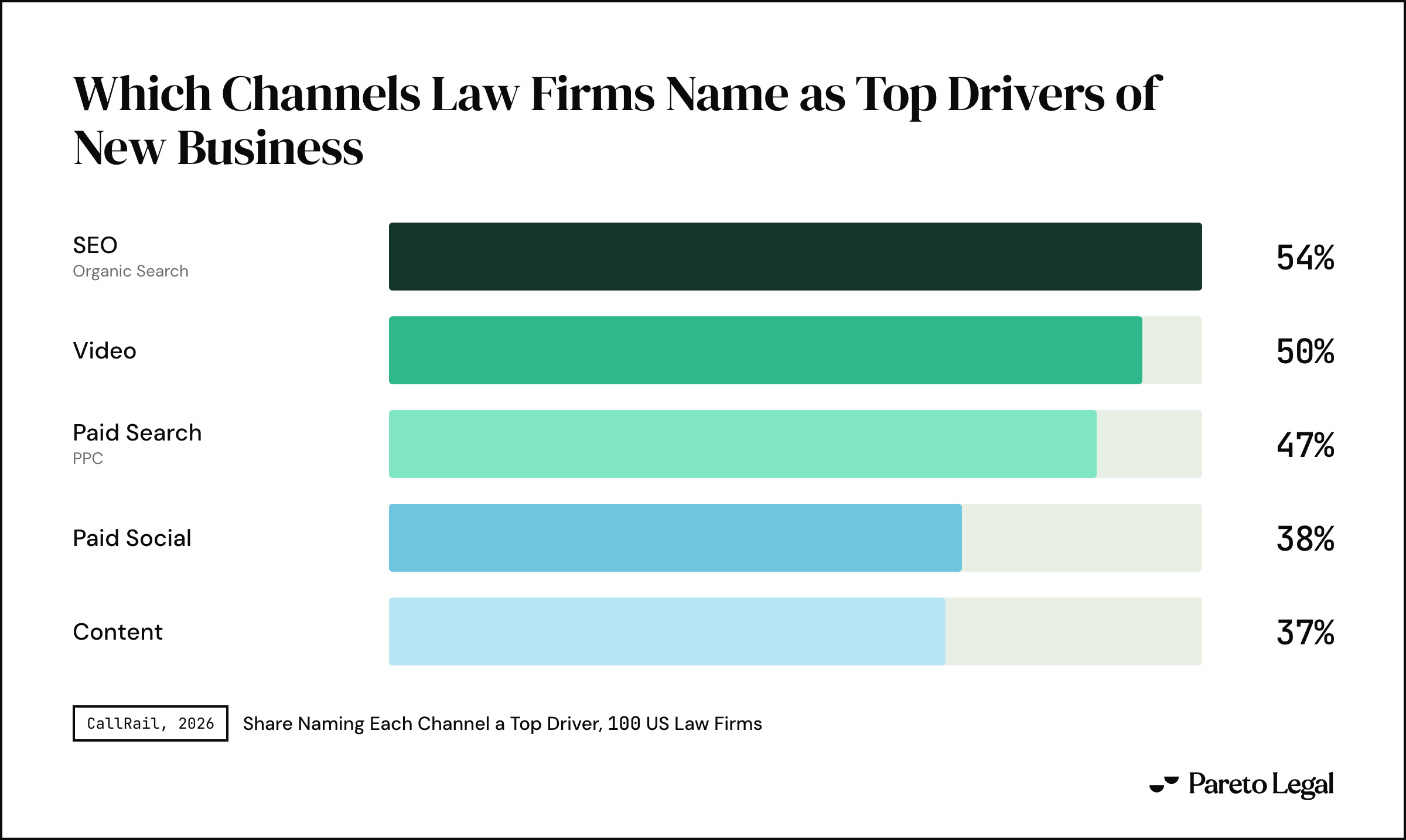
Law firms put the top five sources of their own new business all in digital. In CallRail’s 2026 survey of 100 US law firms, SEO led at 54%, video at 50%, paid search at 47%, paid social at 38% and content at 37%.
The mix moves by practice area. Personal injury firms name pay-per-click their top driver at 68%, and criminal defense firms name SEO at 56%.
Those are conversations, not cases. A conversation is someone reaching your firm, which is the start of the job rather than the end of it, and the three channels do not hand you the same person.
Someone who taps call on a map listing has already picked a firm and just needs the number. Someone arriving from an organic result is usually still comparing two or three other firms, so that call takes more follow-up before it becomes an appointment.
Which is why channel share is the wrong number to manage to. A signed case is the only figure that means the same thing on every channel, and it is the one most firms cannot produce.
Paid Advertising Channels for Law Firms
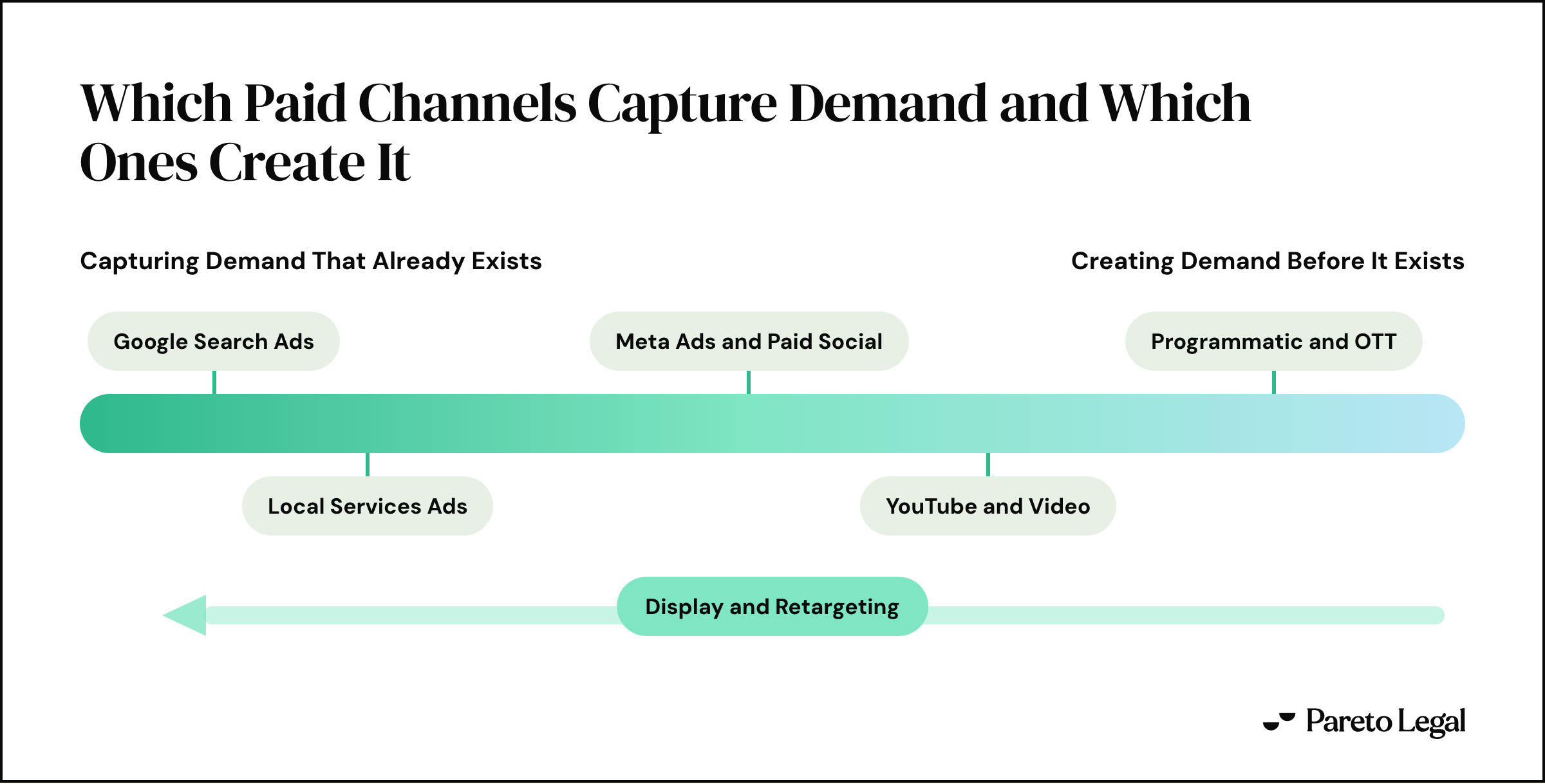
I fund paid advertising in this order: Google Search Ads, Local Services Ads, Meta and paid social, YouTube and video, programmatic and connected TV, then display and retargeting.
Legal is the most expensive vertical Google Ads tracks. Attorneys and legal services average a $9.87 cost per click and a $131.63 cost per lead, the highest cost per lead of the 23 industries in WordStream’s 2026 benchmarks, drawn from 13,474 US search campaigns.
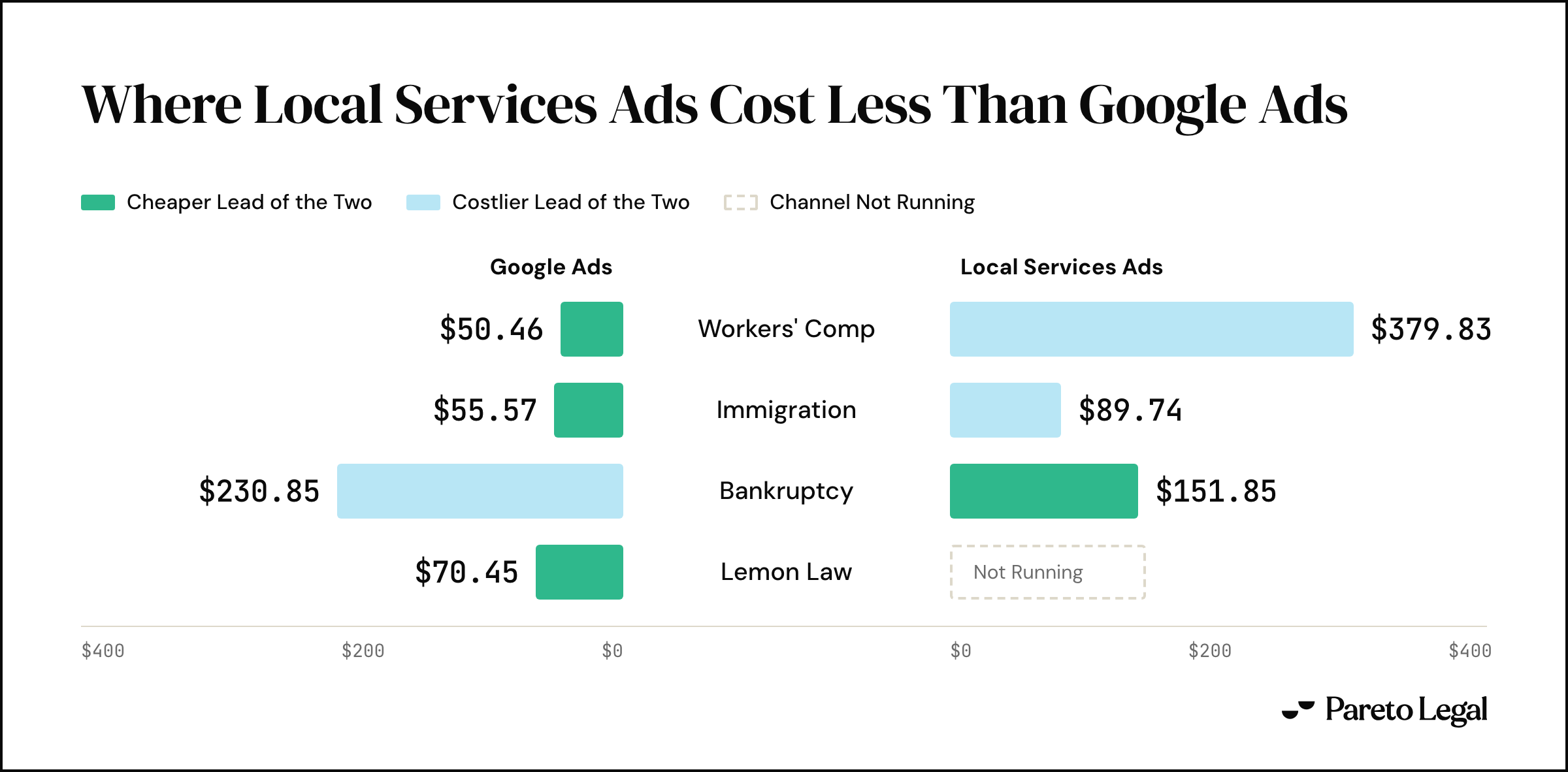
That average hides more than it shows, because the spread runs by practice area. On Google Ads a workers’ compensation lead runs about $50.46 and an immigration lead $55.57, while lemon law runs $70.45, bankruptcy $230.85 and personal injury $409.27.
Those figures count raw engine conversions: every form fill, call and contact that hit the tracking pixel before anyone on staff qualified it as a real case.
Google Search Ads
Search ads buy the person typing the query. Intent is highest here, so is the price, and so is the share of budget that leaves on searches you never meant to buy.
Quality Score is not an auction input, per Google’s own documentation. It is a diagnostic. Ad Rank runs on six factors and gets recalculated twice per auction, so there is no score to chase.
Broad match is the default on every new keyword you create, and close variants cannot be switched off on any match type, exact included, per Google’s match type documentation. The loosening is the default state, not something you opted into.
The search terms report withholds low-volume queries for privacy, by policy, which means you cannot audit every query that spent your money.
So negatives get built before launch rather than after, exact and phrase match only, never broad, because a broad negative hands Google the decision about which whole categories to exclude.
On one criminal defense account I audited, 40% of spend was going to pro bono searches, competitor names and practice areas the firm did not handle.
An average daily budget is not a daily cap. Google can spend up to twice it on a strong day, with the month capped at 30.4 times it.
Impression share tells you which constraint you are under: lost to budget means there is cheap volume sitting unclaimed, lost to rank means buying it back costs a premium.
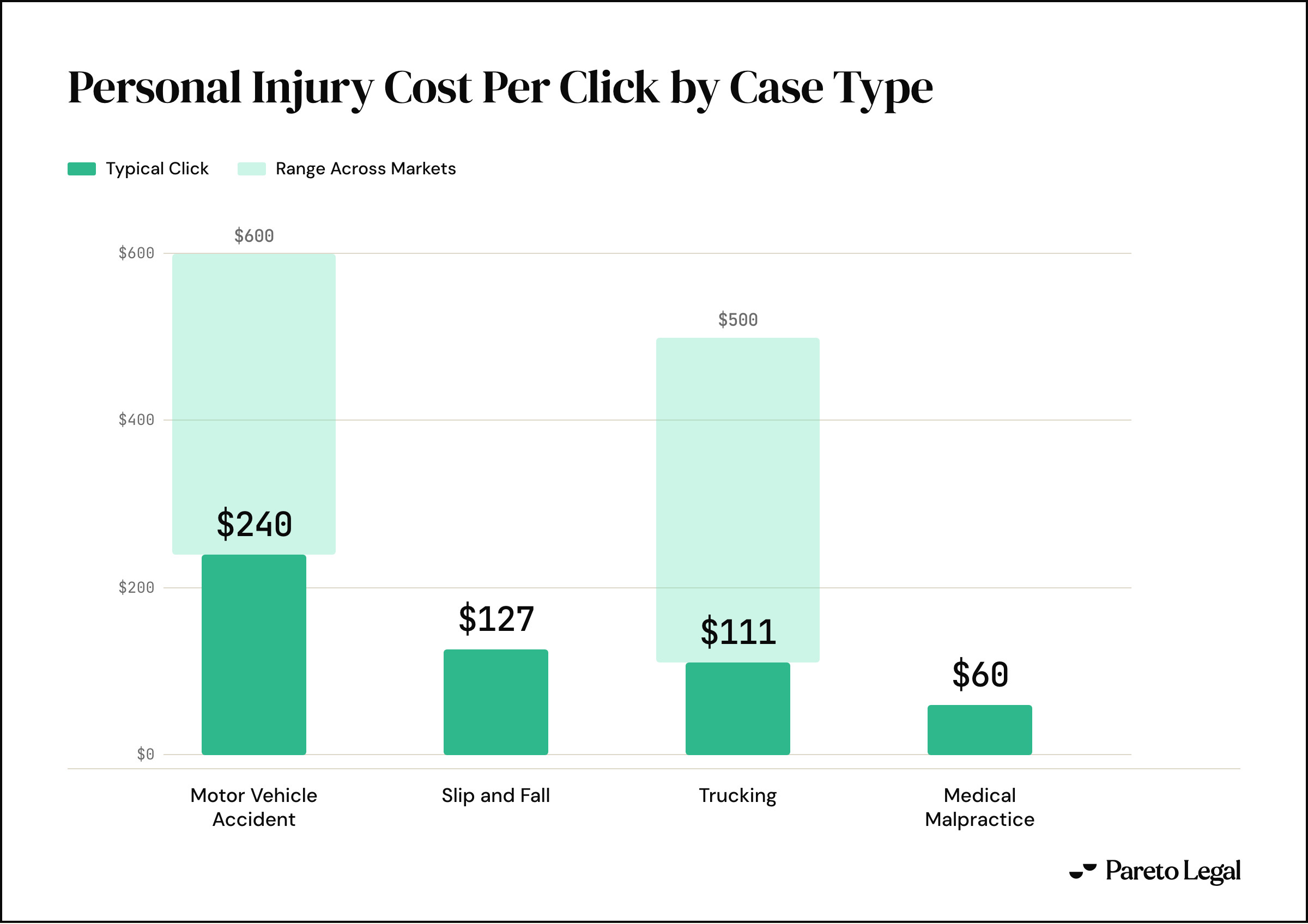
Inside personal injury the price splits again by case type. Motor vehicle runs about $240 a click in a $200 to $600 range, slip and fall $127, trucking $111 with some markets past $500, and medical malpractice $60.
From August 17, 2026, per Google’s notice, budget-limited Target CPA and Target ROAS campaigns get pushed toward the target you typed rather than left to quietly beat it. If you are on a capped budget getting cheap leads, retune the target before that date.
I went deeper on match types and negatives in how pay-per-click works for law firms.
Local Services Ads
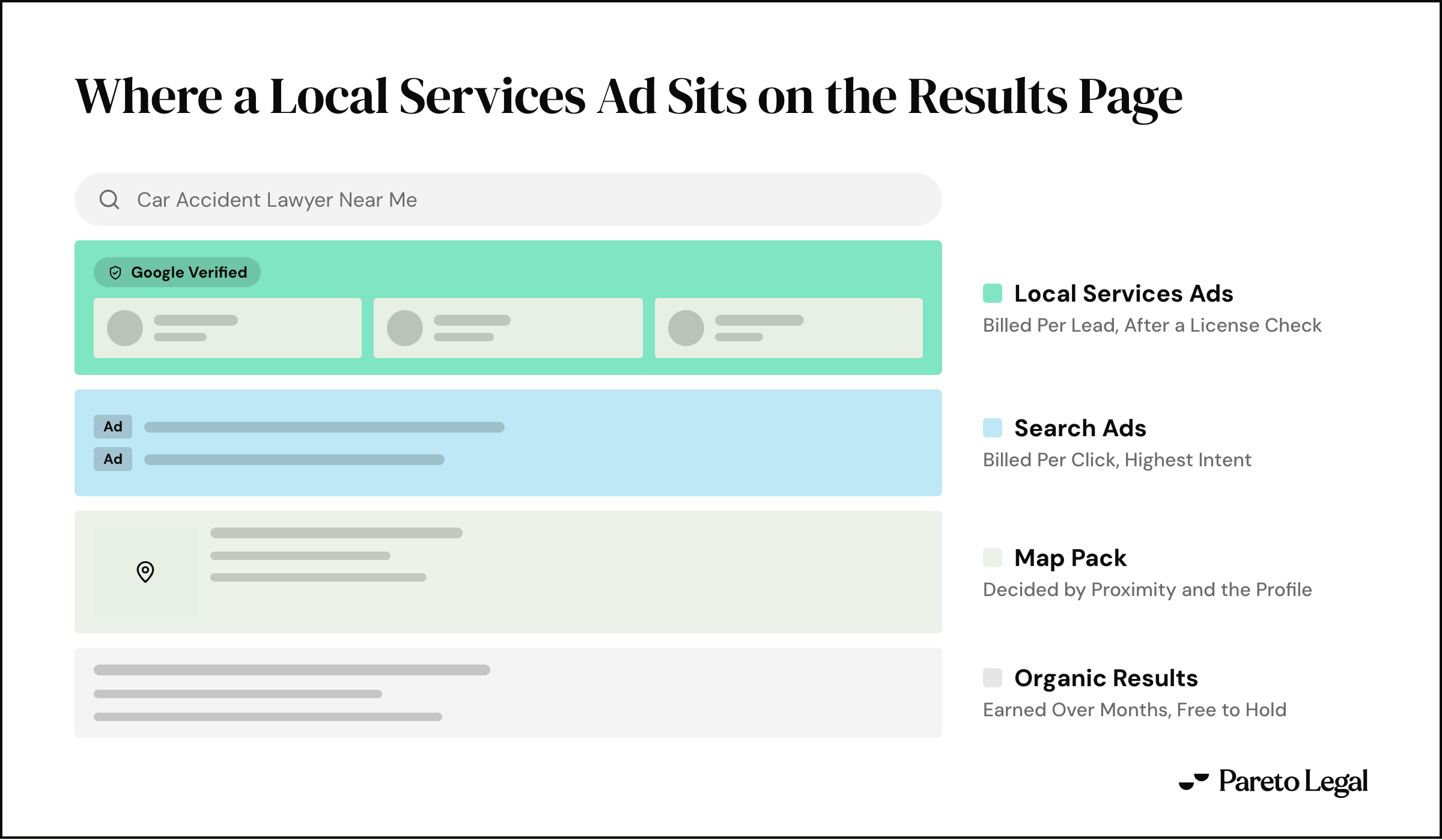
Local Services Ads bill per lead rather than per click. You pay when someone calls, texts or leaves a voicemail.
If you are looking for Google Screened, it is gone. Google has collapsed its separate advertiser badges into a single Google Verified badge.
Firms that already completed verification earn the new badge automatically with no action needed, and Google states the change does not affect ranking.
Verification checks a state bar licence for every attorney in each specialty, a business entity check, an owner check, an identity check, and professional liability insurance where local law requires it, per Google’s US screening requirements. Budget three to four weeks.
The setting that quietly wastes the whole budget is general law firm leads, which drops the practice-area filter entirely.
One motor vehicle firm spending fifteen to twenty thousand a month was signing almost nothing until we turned it off, which cut spend by about 70% while case volume held.
Several categories are not billable at all, per how leads work: contact outside your listed hours, price shopping with no booking intent, a service you do not offer, and a caller who never responds to your callback. Google publishes no minimum call length.
Manual disputes are gone, replaced by an automated credit model that finished rolling out in August 2024. Job type not serviced and geo not serviced never qualify for a credit.
Ranking runs on bid, lead likelihood and profile quality, per Google’s ad rankings page, and profile quality is spelled out as rating, review count, average response time, photos and completed verification checks.
Answer rate is the one that moves it in practice. Pick up inside two or three rings, keep the answer rate above 90%, and route to an answering service after that.
If you cannot pick up after hours, do not run the ads in those hours.
Google evaluates the call itself, not just how fast you answered. Intake hedging on a borderline case type teaches Google you may not want that case type, and the next one goes somewhere else.
Budget is set weekly, and the monthly ceiling equals the weekly figure times 30.4 divided by 7.
The standalone product is folding into Google Ads as a pay-per-lead Performance Max campaign. Home services move first from August 2026 and legal follows in 2027, and historical reporting does not carry over, so export before you migrate.
Cost per lead reverses here. A bankruptcy lead runs $151.85 and personal injury $308.58, both cheaper than the same lead on Google Ads, while criminal defense at $103.95, immigration at $89.74 and workers’ compensation at $379.83 all cost more than they do on search.
It is a per-practice-area question, not a property of the channel.
I broke down the ranking mechanics in local services ads for law firms.
Meta Ads and Paid Social
Meta reaches people who were not looking for a lawyer a minute ago, so the leads cost more. Personal injury runs about $854 a lead there against $409.27 on search, and criminal defense runs $228 against $76.34.
The $854 sits on basic remarketing setups and improves with real prospecting and creative behind it.
Meta’s personal attributes policy bars an ad from asserting or implying the reader’s medical condition, legal situation, criminal record or financial hardship.
The violation is the second person. “Were you injured in a crash?” assigns the trait to the reader. Describing who the firm helps does not.
There is no legal Special Ad Category. A firm only trips that framework on financial-products framing, such as settlement funding or debt relief.
Advantage+ Audience treats your age, gender and interest picks as suggestions rather than gates. Only location, minimum age, language and audience exclusions hold as hard constraints.
An ad set exits the learning phase after about 50 results in the week following its last significant edit, and editing during that week resets it. An account someone tunes every few days never stabilises.
Lead data downloads for 90 days and is then permanently deleted, which is the real argument for piping leads straight into the case management system.
Meta optimises for the cheapest conversion, not the most qualified one. Zero-friction lead forms are the worst offender, so the qualification has to feed back in, which I cover in Meta ads for law firms, and it applies across paid social for lawyers generally.
YouTube and Video Ads
A skippable in-stream ad charges when someone watches 30 seconds, finishes it if it is shorter, or interacts with it, whichever comes first, per Google’s documentation. The first five seconds, the only ones most people see, run free.
In-feed and Shorts ads charge at 10 seconds instead. Bumpers and non-skippable ads bill on impressions and never count as a view.
Video Action Campaigns no longer exist. They were auto-upgraded to Demand Gen through April 2026.
Health, Abuse and trauma, and Negative financial status sit on Google’s restricted targeting policy as sensitive categories that block advertiser-curated audiences, which Demand Gen uses by default.
Creative leaning on accident specifics can restrict its own delivery, which is the trap an injury firm walks into without meaning to.
Measurement has a price of entry. A Brand Lift or Search Lift study needs $10,000 in the US over 28 days, with Google recommending at least 1.5 million impressions, per Google’s budget requirements.
Below that floor the readable signal is branded search rising while the video runs, which is what I check first in YouTube ads for lawyers.
Programmatic and Connected TV
These buy a thousand impressions in a geography rather than a click on a query, so the targeting is only ever as good as the location signal underneath it.
Connected TV geo-targeting in Display & Video 360 resolves to DMA or country. There is no direct IP targeting, so a metro-level buy is the tight end of the range, not a radius.
Where third-party IP geofencing gets sold on connected TV, research reported by Adweek found only 23% of residential IP addresses actually resolved to the intended target.
CTV CPMs sit around $20 to $40, typically near $25, down from $35 to $50 two years earlier, per this benchmark.
This only pays off once acquisition and attribution already work. Brand advertising on a broken funnel accelerates the inefficiency at a larger scale, which is the readiness test I run before recommending programmatic and OTT advertising.
For a smaller firm, 10% to 20% of the marketing budget into brand is the floor, and that share grows with the firm.
Display and Retargeting Ads
Retargeting re-reaches people who visited and left. It is the cheapest inventory of the six, and for personal injury on Google it is not available at all.
Google prohibits retargeting that references dire circumstances, which takes personal injury and health-implying audiences off the table.
It works for estate planning, business and corporate, real estate, intellectual property, contract disputes, tax and lemon law, and estate planning most of all because the decision runs for years. Meta carries no equivalent restriction, which is a real structural difference between the two.
Frequency caps on video campaigns sit at the campaign level only, and Target Frequency averages rather than caps.
The radius floor in Google Ads location targeting is one kilometre, and even at the floor a small target may serve intermittently because it cannot clear the minimum-audience threshold.
Use Presence rather than the default Presence or interest.
A cold audience needs a different page. Sending display traffic to the page that converts search traffic is the named failure.
SEO and Local SEO for Law Firms
Search engine optimization earns a position over months and holds it after the budget stops, which is why it gets funded on a different clock from anything you buy. A paid campaign is rented: turn off the spend and the traffic disappears the same day.
That difference in timing is the one real split in digital marketing for law firms: search engine results you earn, against placements you rent for as long as you pay.
That is also why local SEO is not optional, even for a firm that runs mostly paid media. Your Google Business Profile is a gate on the paid channels, not a channel beside them.
A public verified profile has been mandatory to run Local Services Ads since November 21, 2024, and since July 11, 2025 the reviews those ads are scored on come from that same profile.
A suspended profile takes down the map pack and the paid channel at once.
Practice Area and Location Pages
One page per practice area per city is the standard structure, and it is also the structure Google’s spam policies describe most directly.
Doorway pages is a named, active policy. Google’s spam policies call out pages targeted at specific cities that funnel visitors into one destination.
The test is whether the page answers something specific to that jurisdiction the others do not: which court hears the claim, what the filing deadline is, which state statute applies.
Scaled content abuse, named in March 2024, covers pages generated at volume without adding value, which is the failure mode of a templated city-page build with no jurisdiction-specific content in it.
The awareness stage decides which page answers which search. Someone searching what happens if workers’ comp denies my claim, landing on a page headed workers’ comp attorney near you, leaves, because the heading answers a different question.
I went deeper on that split in lead generation for lawyers.
A bottom-of-funnel page answers three questions in order: can you help me, can I trust you, how do I contact you. Keep the form to five or six fields, or split it across two steps.
Your Google Business Profile and the Map Pack
Google documents three local ranking factors: relevance, distance and prominence. Google’s page states there is no way to pay for a better local ranking, only to earn one across those three.
The profile needs an address where somebody actually works. A virtual office qualifies only if it is staffed during your listed hours. A co-working space qualifies only with signage, staffing and in-person client contact, not just a mailing address on the lease.
One profile per staffed, client-facing office. A multi-attorney firm gets a single location profile, not one per attorney.
Google now assigns the verification method itself rather than letting you choose, and editing categories or core business details can force a re-verification. That is a live risk if you were planning to add practice areas as categories this year.
The primary category states what the firm is, not everything it offers, and Google warns explicitly against stuffing the rest.
Technical SEO and Structured Data
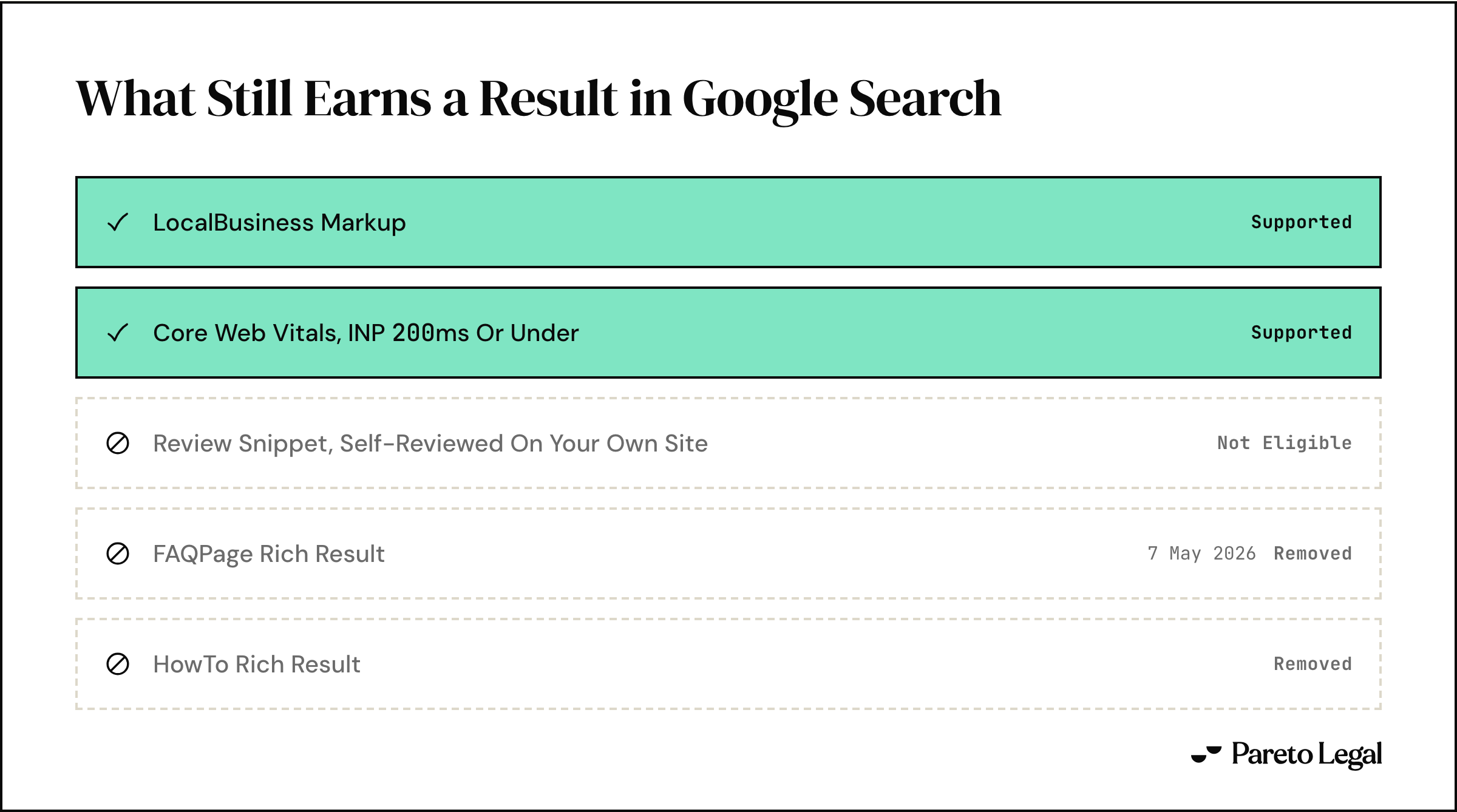
Most of what law firm SEO advice still recommends here stopped earning a result.
FAQ rich results were removed from Google Search entirely as of May 7, 2026, and the HowTo rich result went the same way. The change means the schema still validates and produces nothing visible.
Google also disqualifies a business from the star-rating rich result once it controls its own reviews, which rules out the review widget embedded on your own site, per Google’s review snippet documentation. LocalBusiness markup is still supported and is the one worth keeping.
INP replaced FID as a Core Web Vital on March 12, 2024. An INP at or under 200 milliseconds counts as good, and anything over 500 counts as poor.
Past three seconds to load you start losing visitors, and every additional second adds roughly 20% to the bounce rate.
Fix load time because slow pages lose calls, not because you expect a ranking jump. Google frames Core Web Vitals as a tie-breaker rather than a lever.
AI Search
When an AI summary appears in the results, people click a traditional result on 8% of visits against 15% without one, and 1% click a link inside the summary itself, per Pew Research Center.
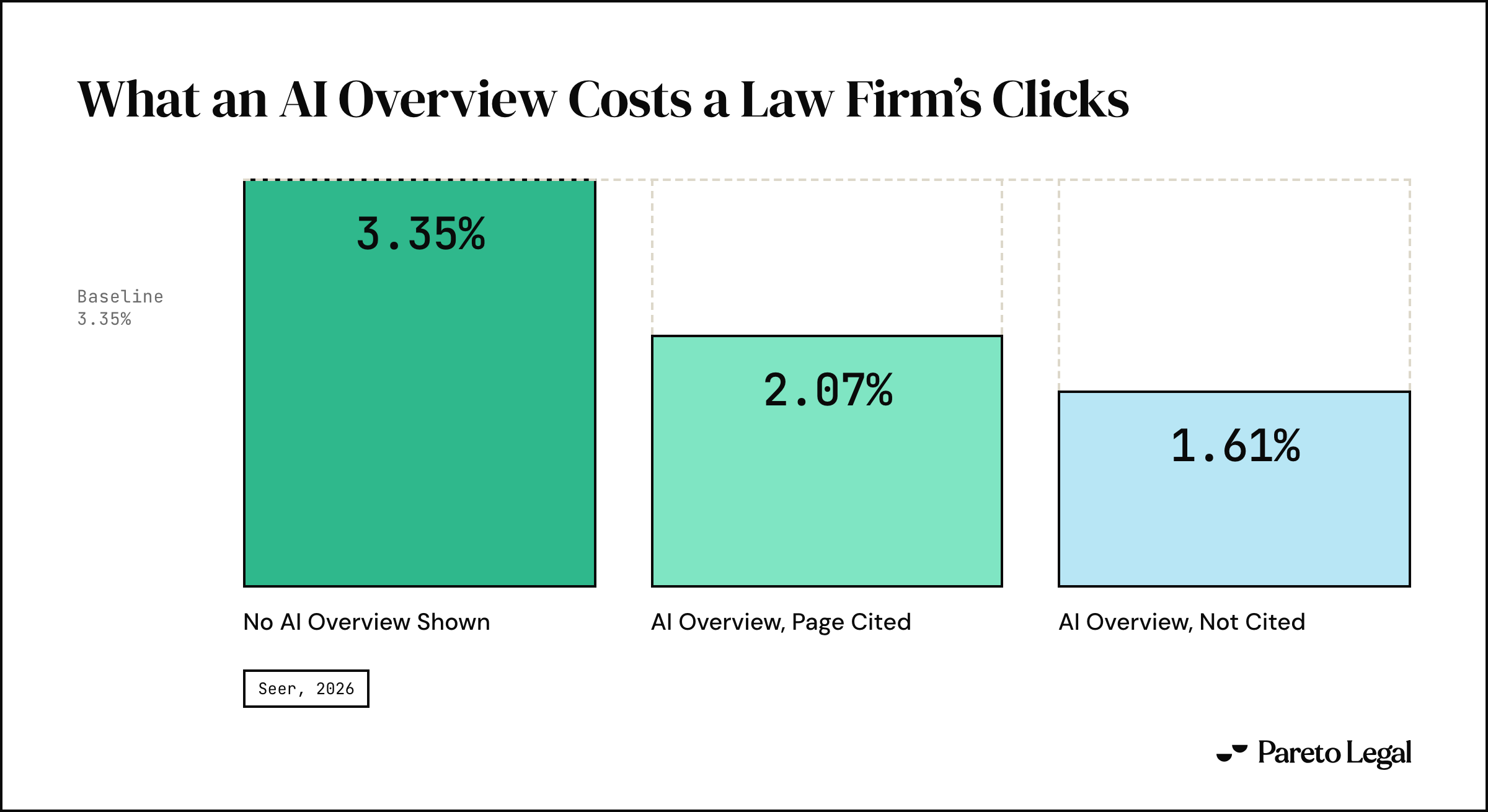
Getting cited does not fix that. Seer Interactive‘s full-year averages put organic click-through at 3.35% with no AI Overview, 2.07% when the page is cited, and about 1.61% when it is not.
Their raw uncited figure of 0.94% is dragged down by one account holding 47% of that segment’s impressions at 0.20%, and excluding it the number runs nearer 1.61%. Citation recovers part of the loss, not all of it.
The searches that decide who gets hired barely touch law firm sites at all. A legal directory was the first-cited source in 77.8% of high-intent hiring queries, led by Justia, SuperLawyers and Avvo, per InterCore Research.
That study tested Perplexity only, so treat it as direction rather than a settled number.
Firms split about 7.5% of citations across 254 different sites, and the most-cited firm appeared 36 times. Your directory profiles are carrying more of the AI-visibility work than your own website is, and that is not where most firms are spending.
You control part of this and not the rest. Google documents no special requirement to appear and no true opt-out beyond snippet controls it warns may not suppress inclusion.
It began testing sponsored placements inside AI Mode in May 2026, which is the same ground I cover in ChatGPT ads for lawyers, and it makes AI visibility a surface you can buy rather than only earn.
Your Law Firm Website and Intake
Every channel converges on the same two chokepoints: a page and a phone.
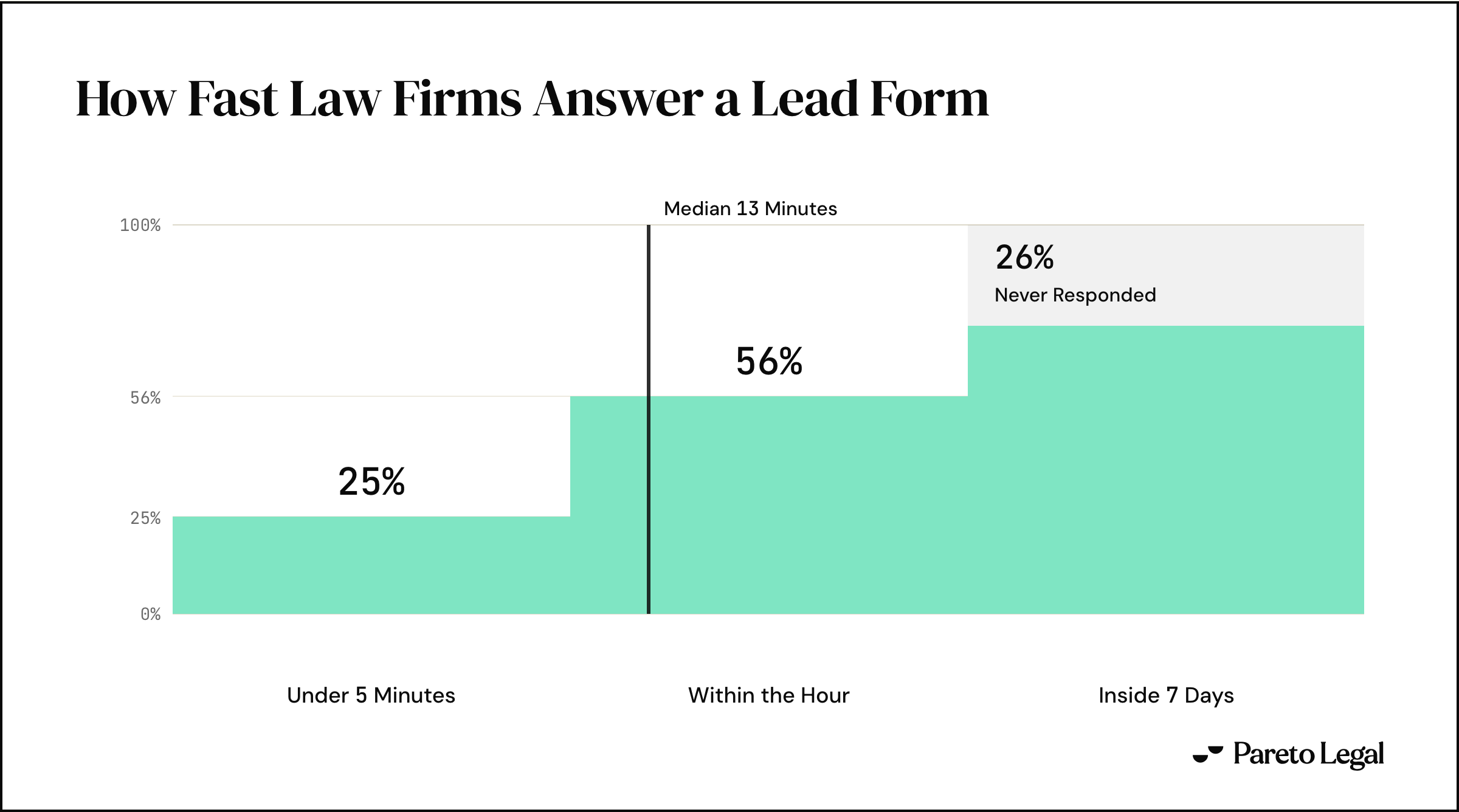
Testing 1,333 US firms, Hennessey Digital’s 2025 study put the median response to a lead form at 13 minutes.
The full distribution matters more than that median. A quarter of firms responded inside five minutes, 56% responded inside the hour, and 26% never responded inside seven days.
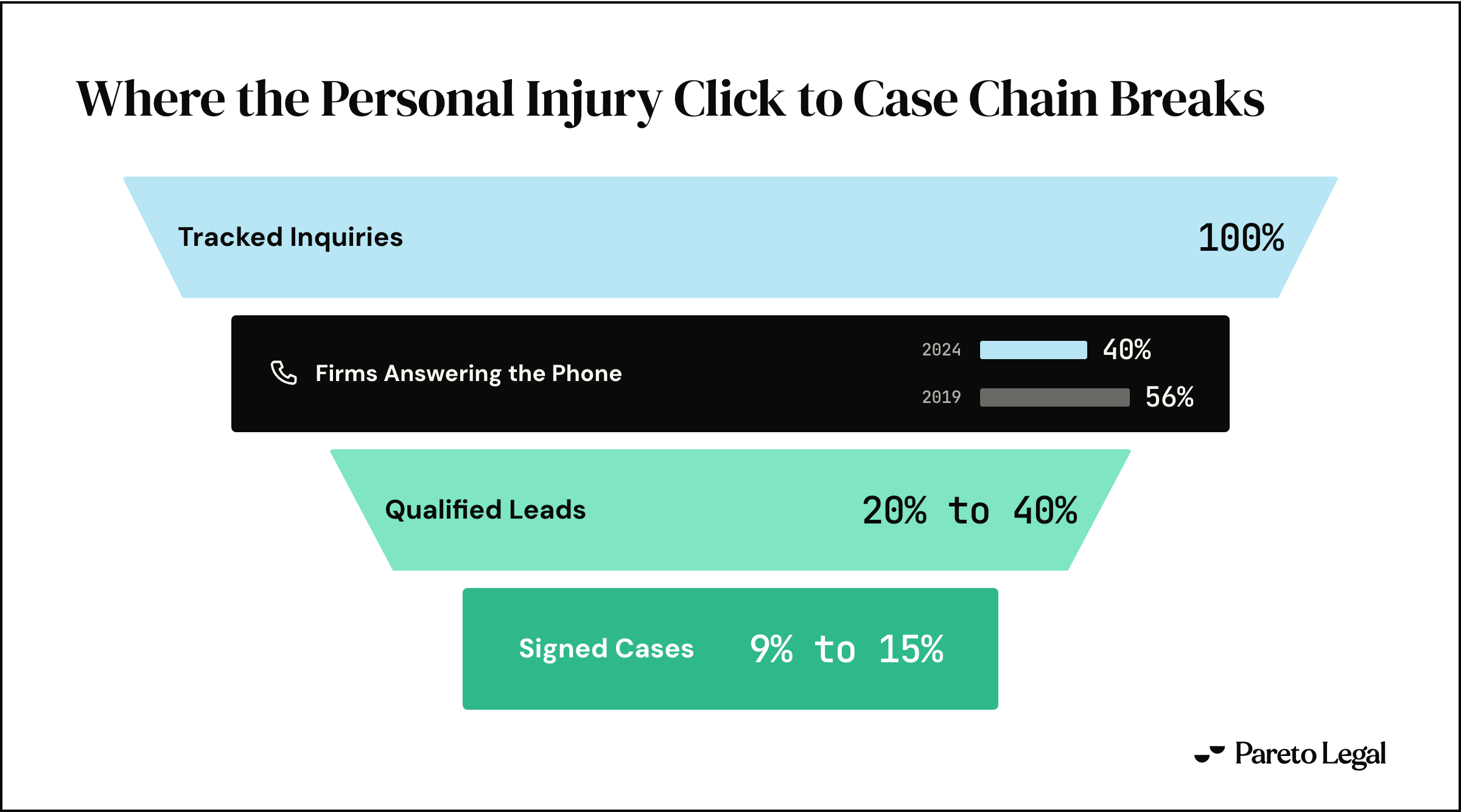
The phone is worse. In a 500-firm secret shopper test, only 40% of firms answered a call from a prospective client at all, down from 56% in 2019, per Clio’s 2024 Legal Trends Report.
About 28% of calls to law firms go unanswered, according to CallRail’s 2025 marketing outlook for law firms.
Intake is inside sales, not reception. The job on a good lead is not to collect information and hang up, it is to not hang up before there is a signed retainer.
That means disqualifying fast, against criteria written down in advance for each practice area: outside the statute of limitations, an injury in a state the firm is not barred in, no bodily injury, or already represented by another attorney.
Three or four characteristics per practice area, in writing, or every agent on the phone invents their own.
The question that exposes whether intake works is what your team’s conversion rate is on qualified leads. Most firms cannot answer it. The bar is 90% and above, and I pulled the rest of those numbers together in legal client intake statistics.
Local Services Ads make the phone problem sharper. There is no landing page at all, the results page is the landing page, and the call itself is the conversion, so nothing on your site compensates for a slow pickup.
Nobody should have to scroll to find a way to reach you, on any page. A fast page beats a good-looking one.
Reviews and Reputation for Law Firms
Reviews decide whether someone who already found you picks you, and the bar has moved.
68% of consumers now require at least four stars before they will consider a business, up from 55% a year earlier, and 31% require 4.5 stars, up from 17%, per BrightLocal’s Local Consumer Review Survey 2026.
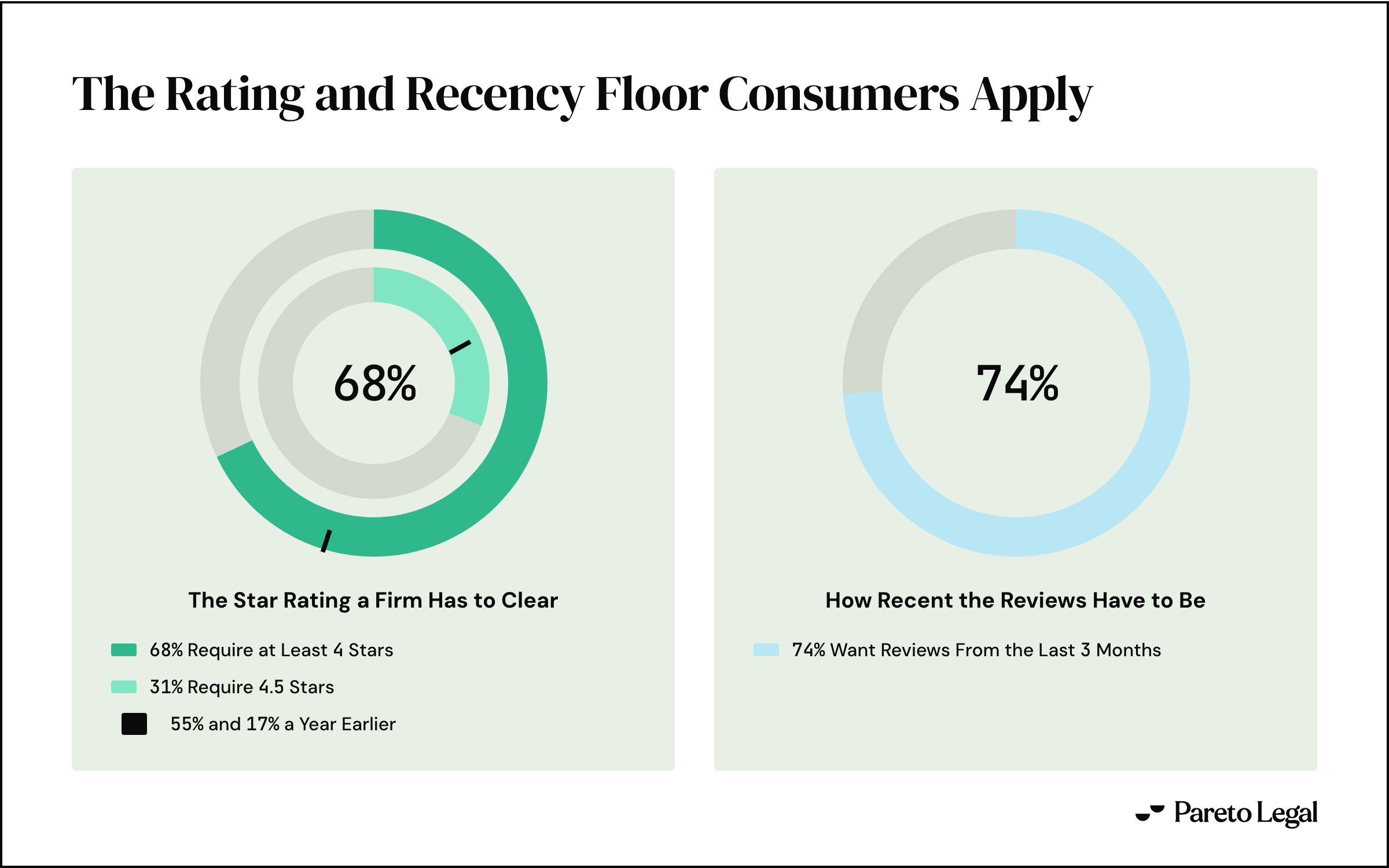
74% want those reviews written in the last three months, so forty strong reviews from two years ago reads as a firm that stopped rather than one that earned trust.
This is not a soft metric. Profile quality is a documented Local Services Ads ranking input, and the same profile feeds the map pack, so reviews are the one thing you work on that shows up in two channels’ costs at once.
Velocity beats count. A firm sitting on 100 reviews and adding them steadily will outrank a firm sitting on 1,000 that stopped.
Aim for one to five a week, tracked weekly, triggered off a case status change in the case management system. Keep it owned by one named person in-house rather than handed to a vendor.
What Digital Marketing Costs a Law Firm
A signed case in personal injury runs anywhere from about $1,500 to $5,000, and averaging channels together tells you nothing useful.
In personal injury, $2,800 is a good result, though the range I actually see runs $1,500 to $5,000.
A cheaper case is not automatically the better business. What matters is the share of the fee it eats.
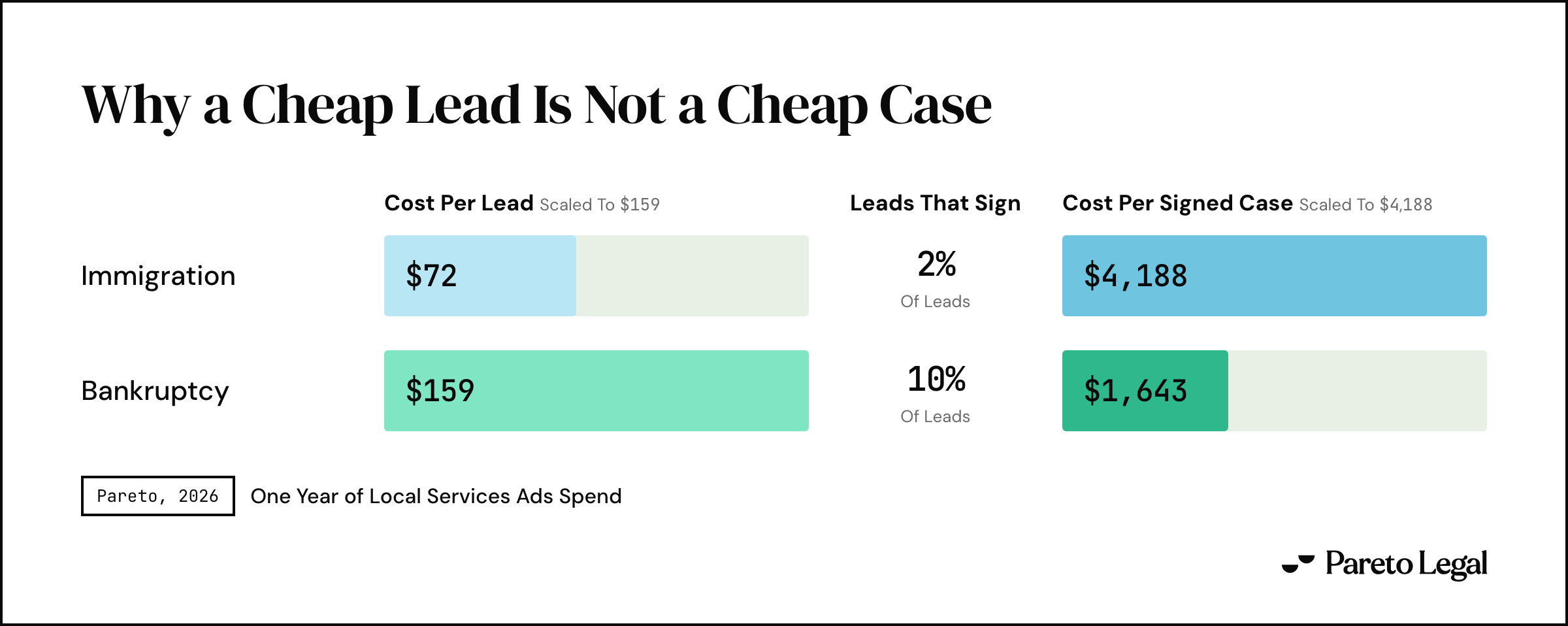
A cheap lead is not the same thing as a cheap case, and the gap between the two is the conversion rate.
Across a year of Local Services Ads spend, immigration leads cost $72 each, the cheapest in the study by a wide margin, and converted at 2%.
Those immigration leads produced a signed case at $4,188. Bankruptcy leads cost more than twice as much at $159, converted at 10%, and produced signed cases at $1,643 each.
Lead price told you almost nothing about which of those two was the better buy.
Treat the immigration figure as a warning rather than a number to plan against. That sample was one client, and only 44% of its outcomes could be matched back to a case, so more than half the picture is missing.
A referral costs a firm about a third of the fee it hands off, so marketing has to beat that trade rather than just turn a profit.
Gross fees from signed cases against ad spend needs to clear three to one before a channel earns its keep over sending the case out.
Two things break a budget built on averages. Forecast off median case value rather than average, because one outsized settlement in the file skews the average and everything built on it.
And a case signed today typically does not pay for 18 to 24 months, so the firm has to be able to front that gap, which is a separate question from whether the marketing worked.
Running your own median case value through a legal PPC calculator before setting a budget catches both problems at once.
Ask whoever runs your account what a signed case cost last quarter. If the answer comes back as a cost per lead, the tracking never made it past the ad platform into the case management system.
That one number is what separates a working law firm PPC account from one that only looks busy, and it is the number to ask any agency for before you sign with them.
What to Measure
Four numbers matter here: cost per signed case, the lead-to-signed rate by channel, the share of leads that actually qualify, and what a case is worth to the firm.
Get there through two separate filters, not one. A marketing qualified lead just has a legal matter attached to it, so it is not the judge, the doctor’s office calling about an existing client, or a vendor pitching software.
An intake qualified lead is narrower: a case type you handle and actually want. Out of a thousand raw contacts in a month, maybe three hundred end up marketing qualified. Most firms report that first number and believe it is the second.
The identifier is the whole game. A click ID or UTM parameter has to survive from the ad into the case management system, and I covered the setup in Google Analytics 4 for law firms.
It gets dropped the moment a lead record is created without it, or when intake re-keys the contact by hand. Once that code is gone, nothing traces the case back to its campaign.
Broken tracking has a signature on the report. Every phone call counts as a lead, including calls from a doctor’s office about an existing client, while forms and live chat read as zero. The dashboard still looks like it is producing insight.
I once audited a firm that had spent close to two million dollars over eighteen months across Google and Meta with no way to say what any of it returned.
Personal injury runs 9% to 15% of leads becoming signed cases, though not every firm tracks qualified leads cleanly enough to know its own number. Aim for 20% to 40% of leads qualifying by channel.
Watch which conversion you are being shown. In criminal defense, 35% to 40% of leads reach a consultation, but only around 6% become a retained client. Quote the first number and the channel looks six times better than it is.
Run all four by channel and by practice area, not just firm-wide. A blended average hides the channel carrying the other three.
And when the ad platform and the case management system disagree about where a case came from, believe the case management system. The platform only knows what it was told.
Frequently Asked Questions
How Do You Do Marketing for a Law Firm?
You fund channels in order. Search and Local Services Ads come first because they capture demand that already exists. Video, social and brand channels like connected TV follow only once that foundation works.
That order holds whichever practice area you run, and it is the part of digital marketing for attorneys that firms most often get backwards by buying awareness before they can answer the phone.
How Do You Attract Clients to Your Law Firm?
Capture channels, paid search and local services ads, meet someone already searching for a lawyer. Create channels, Meta, YouTube and connected TV, reach someone before they know they need one. Fund capture first.
How Much Do Lawyers Spend on Digital Marketing?
A signed personal injury case costs about $1,500 to $5,000 in ad spend, and that is the number to size a budget from rather than a percentage of revenue. What you can afford per case depends on location, platform and what the case is worth to the firm.
What Form of Advertising Signs the Most Cases for a Lawyer?
Paid search, because it reaches someone at the exact moment they are searching for a lawyer rather than before they have decided they need one.
That is also why it carries the most expensive click of any channel. I ran the head-to-head in google ads versus facebook ads.
How Long Does Digital Marketing Take to Produce Signed Cases?
Search and Local Services Ads can produce signed cases within weeks, since they capture demand that already exists. Video and connected TV run on a quarter-long timeline, building recognition before someone is ready to call.
Do Lawyers Need a Marketing Agency or Can They Do It Themselves?
Firms can run their own campaigns until the math turns legal-specific: cost per signed case by practice area, statute-of-limitations disqualifiers, referral-fee economics. That gap is where a legal-specific rather than generalist agency starts to matter.
Do Bar Advertising Rules Apply to Law Firm Digital Marketing?
Yes. ABA Model Rules 7.1 through 7.3 treat a digital ad as any other communication about the firm, and your state’s version is what actually binds you. Clear any results claim with your bar first.
What Does Google Verification Require for a Law Firm?
Google checks a state bar licence for every attorney and specialty advertised, plus checks on the business and its owner. It also requires professional liability insurance where local law calls for it, and an identity check. Budget three to four weeks.
If you want to work through what these numbers look like inside your own firm, get in touch and we can talk it through.