

Law firms obsess over cost per lead and then lose the case in the first five minutes of the client intake process—everything from a potential client’s first call or client intake form through onboarding as a signed client. The data on this is brutal, and most of it comes from watching real firms handle real inquiries.
Every statistic below traces to the organization that ran the study: mystery-shopper experiments, call-platform datasets, consumer surveys, and our own CRM-verified numbers from managing law firm ad spend. No recycled stats.
Law Firm Responsiveness Statistics: The Secret-Shopper Data
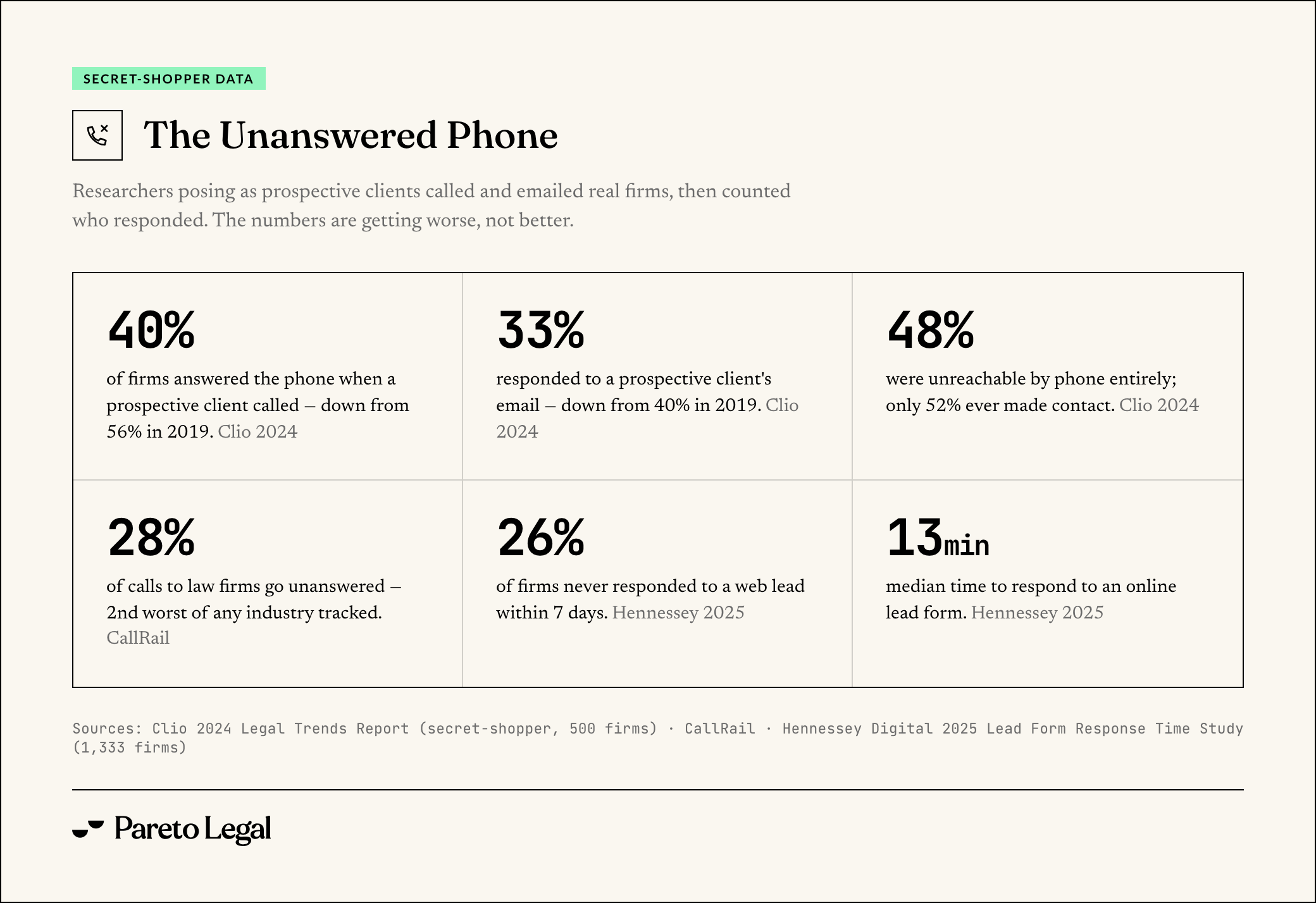
The most damning numbers in the legal intake process come from researchers posing as potential clients and simply counting who picked up.
- Only 40% of law firms answered the phone when a prospective client called, according to Clio’s 2024 Legal Trends Report secret-shopper study of 500 firms. That’s down from 56% when Clio ran the same experiment in 2019.
- Counting callbacks, only 52% of firms ever made contact—48% were essentially unreachable by phone.
- Of the firms that missed the call, only about 20% returned it.
- Email is worse: just 33% of law firms responded to a prospective client’s email in the same study, down from 40% in 2019. Law firm responsiveness is declining while client expectations rise.
- The unanswered phone actively manufactures critics. When firms fail to answer calls, an estimated 73% of those would-be clients become detractors; when calls are answered, that drops to 38%.
- The legal industry has the second-highest missed-call rate of any industry CallRail tracks: 28% of calls to law firms go unanswered, behind only healthcare at 32%, per CallRail’s analysis of 1.1 million tracked leads.
- A smaller 2025 test-call study (Law Leaders, 1,200 calls to small and midsize firms—note the vendor ran it) found 35% of business-hours calls went completely unanswered. Different methodology, same direction as Clio and CallRail.
Every one of those unanswered calls was likely generated by marketing somebody paid for. Which raises the question of how fast the firms that do respond actually move.
Speed-to-Lead Statistics: How Fast Firms Respond vs How Fast Clients Decide
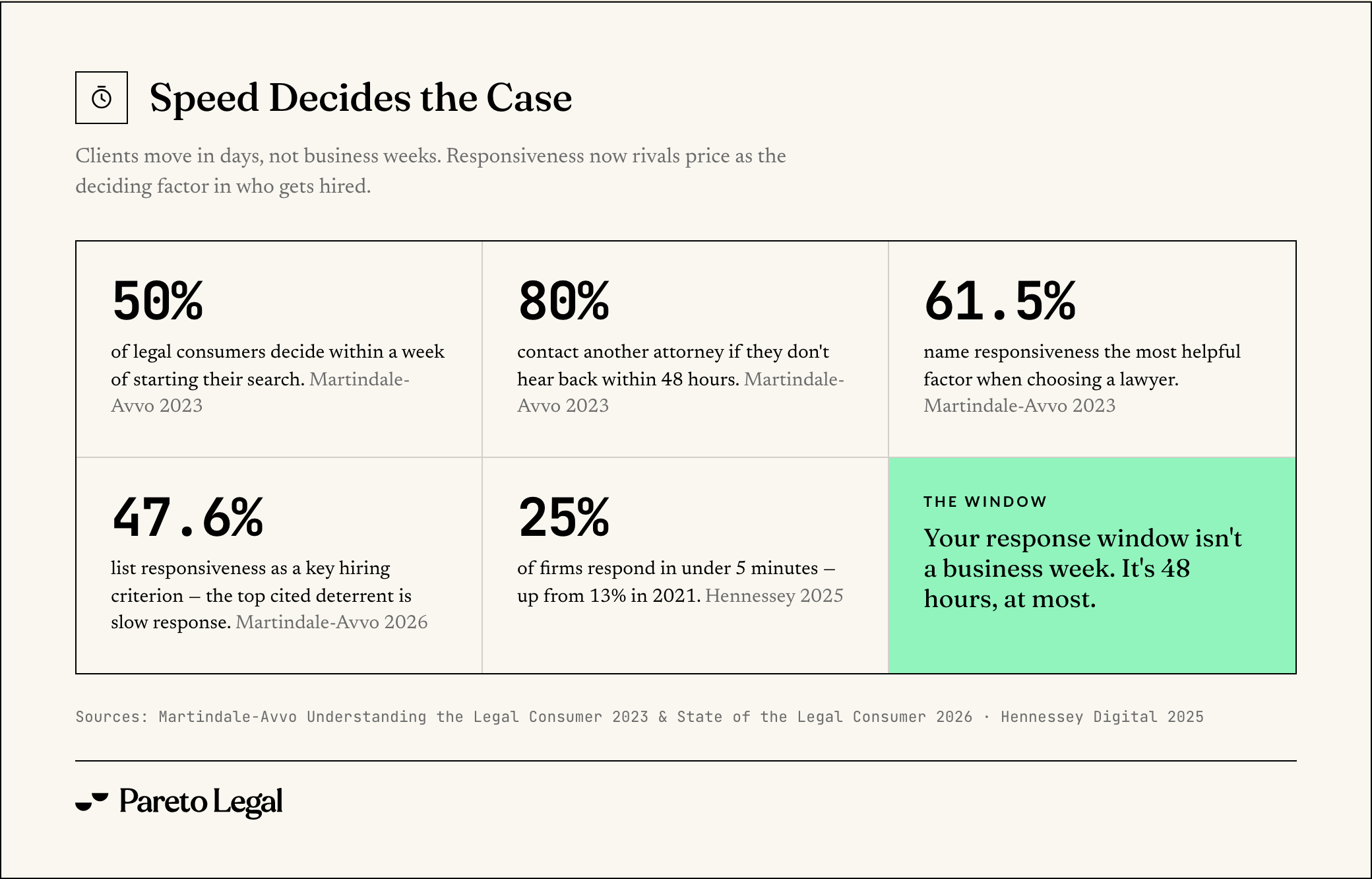
Response speed is where intake either compounds your ad spend or quietly refunds it to your competitors.
- The median law firm takes 13 minutes to respond to an online lead-form inquiry, per Hennessey Digital’s 2025 Lead Form Response Time Study, which submitted test inquiries to 1,333 US law firm websites.
- 25% of firms responded in under 5 minutes—up from 13% in 2021. The fast are getting faster.
- But 26% of firms never responded at all within 7 days. A quarter of legal websites are decorative.
- Clients move fast: 50% of legal consumers made their hiring decision within a week of starting their search, according to Martindale-Avvo’s Understanding the Legal Consumer study (~1,850 consumers surveyed).
- 80% of legal consumers will contact another attorney if they don’t hear back within 48 hours, per the same Martindale-Avvo study. Your response window isn’t a business week. It’s two days, at most.
- Slow response is statistically as damaging as high fees: 46.2% of consumers named “slow to respond” a top deterrent to hiring a lawyer—a whisker from “too expensive” at 46.6%.
- Flip it around and responsiveness is also the top selling point: 61.5% of consumers named attorney responsiveness the most helpful factor when choosing a lawyer—ahead of pricing information (56.8%) and reviews (50.6%).
- The newest edition confirms the trend: 47.6% of consumers list responsiveness as a key hiring criterion, and slow response times are the top cited deterrent, per Martindale-Avvo’s State of the Legal Consumer 2026.
Intake Conversion Rate Statistics: Our Own Data
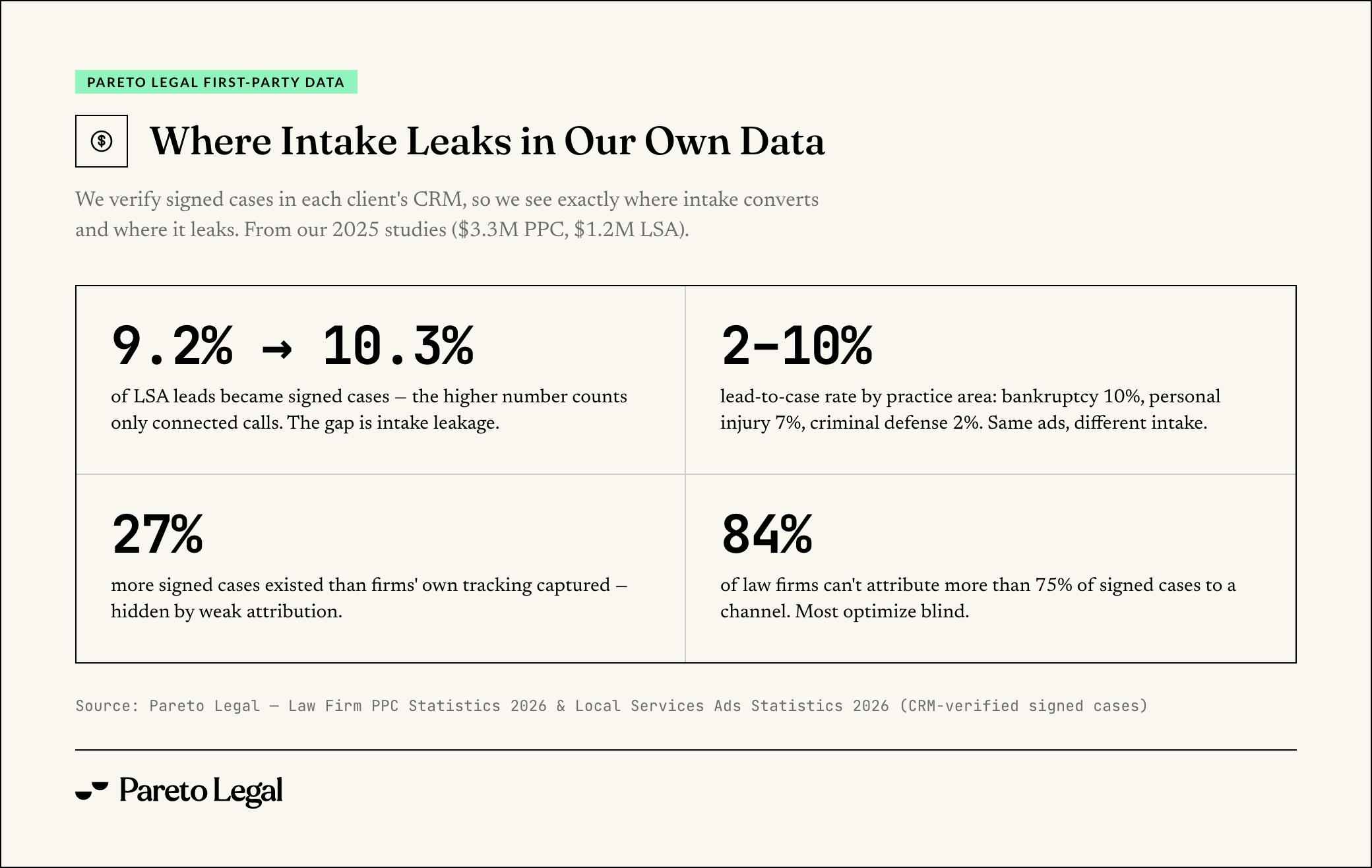
We manage Google Ads and LSA for plaintiff-side firms, and we verify signed cases in each client’s CRM—which means we see exactly where intake converts and where it leaks. From our 2025 studies ($3.3M in PPC spend across 13 firms; $1.2M in LSA spend across 9 firms—full datasets in our law firm PPC statistics and Local Services Ads statistics):
- 9.2% of leads from Local Service Ads for Law Firms became signed cases in our LSA study. Counting only connected calls, the lead-to-case conversion rate rises to 10.3%. The gap between those two numbers is pure intake leakage—calls that never connected.
- Intake conversion varies wildly by practice area. In our PPC study, bankruptcy leads converted to signed cases at 10%, personal injury at 7%, and criminal defense at just 2%. Same ads platform, same year—the difference is lead intent and intake execution.
- Connected-call rates ranged from 98% (personal injury) down to 73% (immigration) across practice areas in our LSA study. Every percentage point below 100 is money already spent on a lead nobody spoke to.
- 84% of law firms can’t attribute more than 75% of their signed cases to specific marketing channels, and roughly one in four can’t attribute even a quarter of them. If intake doesn’t capture where a client came from, you can’t know which ads pay for themselves.
- Our LSA study’s match-rate analysis found firms’ tracking missed roughly 27% of the signed cases their ads actually produced. Intake data quality isn’t bookkeeping—it decides where next quarter’s budget goes.
Our CEO Bo Royal’s intake rule from managing these accounts: if your firm answers fewer than 90% of ad-driven calls, fixing that beats any campaign optimization. In his words: “literally every single one of these calls needs to be answered.”
Call Handling Statistics: What Happens When the Phone Rings
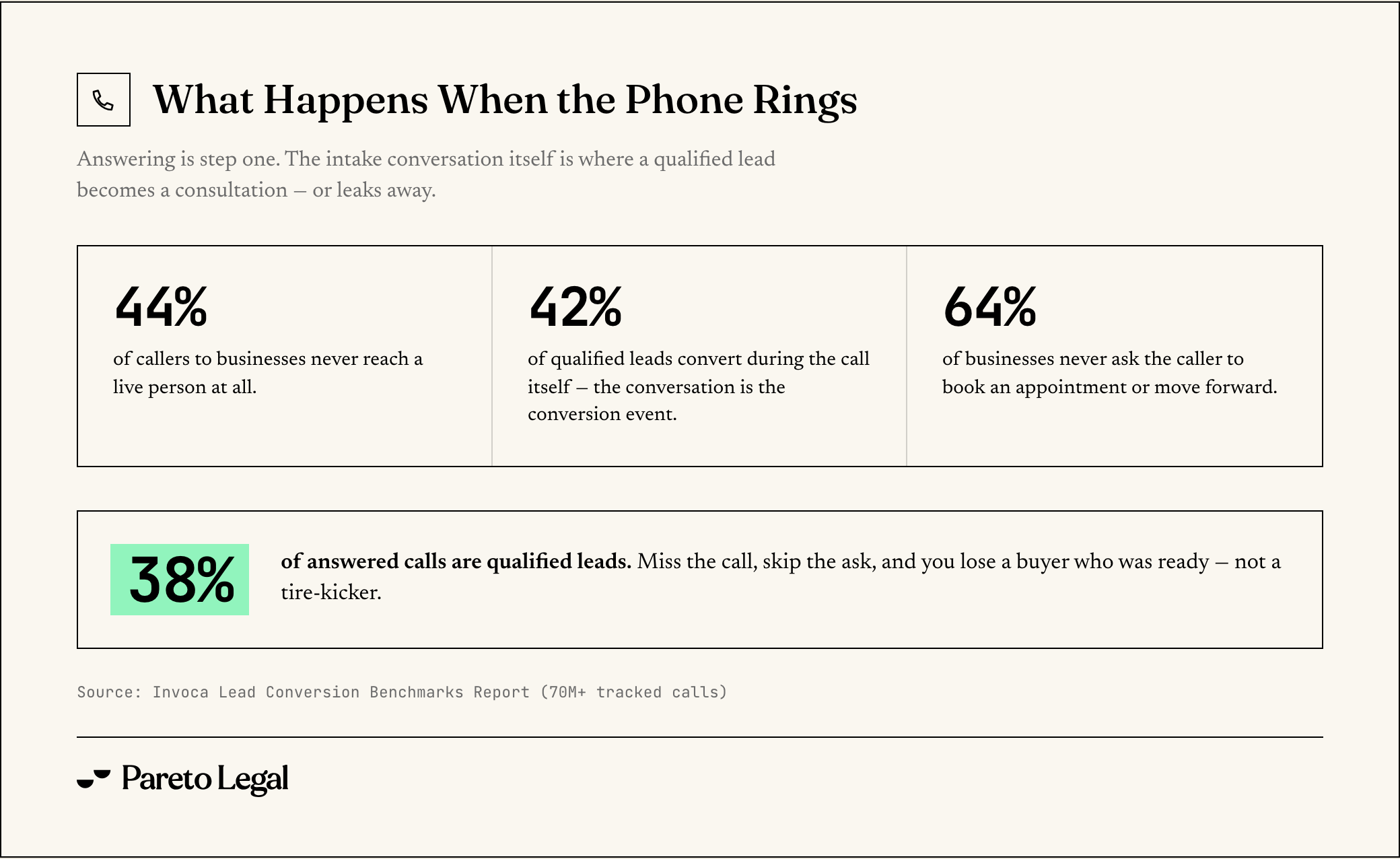
Answering is step one. The intake conversation itself is where qualified leads become consultations—or don’t.
- 44% of callers to businesses never reach a live person, according to Invoca’s Lead Conversion Benchmarks Report, built on 70+ million tracked calls.
- When calls do connect, 38% of answered calls are qualified leads—and 42% of those qualified leads convert during the call itself (Invoca, same dataset). The first conversation is the conversion event, not a screening step.
- 64% of businesses never ask the caller to book an appointment or move forward. Invoca flags the missing ask as the single biggest conversion lever in call handling. For an intake specialist, that’s the cheapest fix in this entire article.
AI and Legal Intake Statistics
AI is entering intake from both sides—law firms automating their intake process, and potential clients starting their search inside AI tools.
- 79% of legal professionals now use AI in some form, per Clio’s 2025 Legal Trends Report—but adoption is shallow. Among solo and small firms, only 8% and 4% respectively use AI widely, per Clio’s solo and small firm edition.
- The ABA’s own survey shows the same curve a step behind: 30% of lawyers report using AI, up from 11% in 2023, per the ABA 2024 Legal Technology Survey. Adoption scales with firm size: 46% at 100+ attorney firms vs 18% of solos.
- Firms that adopt AI widely are nearly 3x more likely to report revenue growth: 69% of wide adopters saw positive revenue impact versus 36% of legal professionals overall (Clio 2025).
- Intake tech pays measurable dividends: Clio’s platform data shows firms using client-facing intake features (online forms, e-signatures, scheduling) generate 51% more leads and 52% higher revenue. E-signatures alone cut time-to-hire by roughly a quarter.
- Clients are already on the other side of the AI conversation: over 50% of legal consumers have used or would consider using AI to answer legal questions, and 28% of those who did were directed to contact a lawyer, per Clio’s 2025 consumer research.
- Those AI-referred inquiries are good ones: calls referred by ChatGPT post a 49% lead rate—the highest of any marketing channel Invoca measures, per Invoca’s July 2026 analysis.
- One trust wrinkle for intake scripts: 78% of clients want disclosure when their lawyer uses AI, while 35% of legal professionals rarely or never disclose it (Clio 2025). If AI screens your intake calls, say so.
Legal Intake KPIs: The Metrics Behind These Statistics
If your firm wants its own version of the numbers on this page, your intake management needs to track six things. Most legal intake software can log all of them; almost no intake team reviews them weekly. These are the best practices hiding inside every statistic above.
- Answer rate. Percentage of inbound calls a human answers live. Bo’s benchmark from our managed accounts: 90% minimum, with every ad-driven call answered.
- Speed to lead. Minutes from form submission or missed call to first personal outreach. The median firm sits at 13 minutes; the top quartile is under 5.
- Lead-to-consultation rate. Share of qualified leads that book a consultation. This is where a weak intake specialist or clunky intake forms shows up first.
- Consultation-to-signed rate. Share of consultations that become signed clients. Practice area drives the baseline (recall the 2-10% lead-to-case spread in our data)—so whether you run a personal injury, family law, or criminal defense practice, benchmark against your own history, not another firm’s.
- Cost per signed case by source. The number that connects intake to marketing. It requires intake staff to capture and log the source of every prospective client—the exact discipline 84% of firms lack.
- Follow-up attempts per lead. How many touches of client communication your team makes before closing a file as dead. Firms that never measure this usually discover the answer is one.
None of this requires new intake technology. It requires treating the client intake process like a revenue system with a workflow, an owner, clean client data, and a weekly report—the same way you’d treat the ad account that feeds it. The prospective client experience improves as a side effect, and the attorney-client relationship starts on time instead of two days late.
The Bottom Line
Every dataset here says the same thing: the legal intake process, not the marketing budget, is the constraint. Firms answer too slowly, follow up too little, and track too loosely to know either is happening. Intake optimization is the cheapest law firm growth lever in this entire article.
The fix isn’t exotic. Answer the phone. Respond in minutes, not days. Log the source of every new client. The firms that do those three things convert the same leads everyone else is paying for—and buying cases their competitors already paid to generate.
We connect law firm ad spend to signed cases, and intake is usually where the money leaks. If your firm spends five figures a month on ads and can’t say what percentage of calls get answered, contact us for an intake-and-attribution audit.