

A criminal defense firm buys its cases inside a window measured in hours. Somebody is arrested on a Friday night, a family member starts searching before the arraignment, and the decision is usually made before the next weekend.
Martindale-Avvo’s consumer research puts numbers on how fast that window shuts. 80% of legal consumers contact another attorney if they do not hear back within 48 hours, and 50% have made a hiring decision inside a week.
Two facts govern everything a defense firm spends. The window is hours, and the fee is flat rather than a share of a recovery.
What Is Criminal Defense Marketing?
Criminal defense marketing is the mix of paid and organic channels a defense firm uses to reach people who have been charged, plus the intake operation that answers when those people call.
The channels buy the phone call. The intake decides whether that call becomes a retained client.
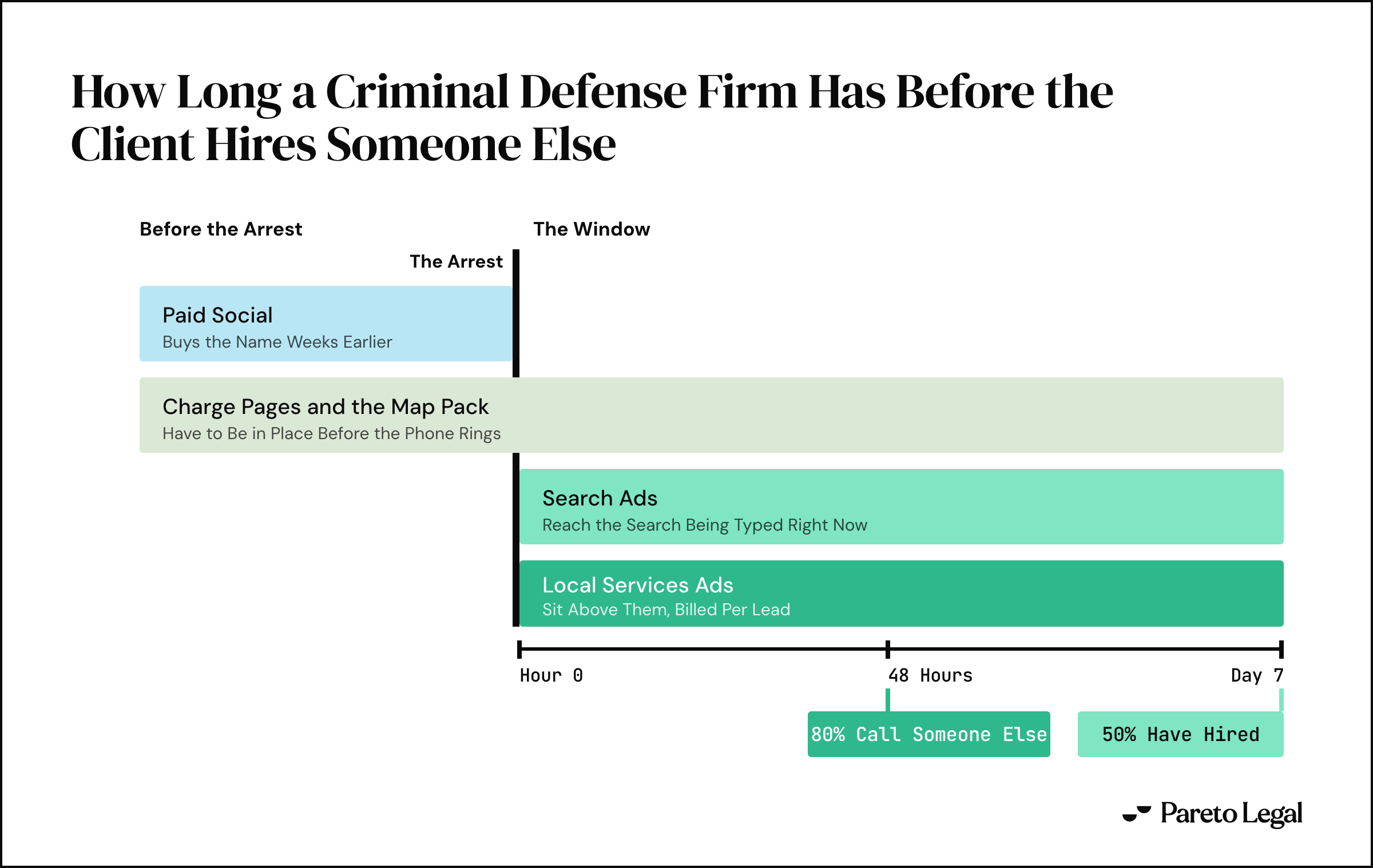
Sort the channels by when they can act rather than by what they cost. The window is seven days wide at the outside, and search ads and Local Services Ads are the only two that reach the search being typed inside it.
Charge pages and your Google Business Profile also work inside the window, but they have to be built and ranking months before the phone rings. Paid social cannot reach anyone at the moment of arrest at all, because nobody has typed anything for it to match.
The flat fee is what makes this harder than personal injury. A firm taking a third of a recovery can absorb an expensive lead because one case pays for a year of them. On a fee, the ceiling is fixed the day you quote it.
So the number that governs the budget is cost per retained client, not cost per click. Keyword sets, negatives, ad scheduling and bid strategy for this practice area sit in criminal defense ppc.
What a Retained Criminal Defense Client Costs
A retained criminal defense client costs around $1,670, against $1,250 when most of the budget runs through the cheapest channel. On an average criminal defense fee of $5,000, that is roughly $3 back for every dollar spent rather than $4.
The formula behind both numbers is short enough to run on a napkin. Cost per lead divided by the rate at which leads become signed cases equals cost per retained client.
Criminal defense leads run about $160 blended across paid channels, with a low near $90 and a high near $250 depending on market and charge type. Around 6% of them become signed cases.
Run that on your own two numbers and it returns a range rather than a point. A $76.34 lead at a 6% signing rate puts a retained client at roughly $1,270. The same signing rate on a $160 blended lead puts it near $2,670.
The $1,670 average sits between the two, and that gap is the channel mix doing the work. The more of your volume comes from the cheapest channel, the closer you land to $1,250.
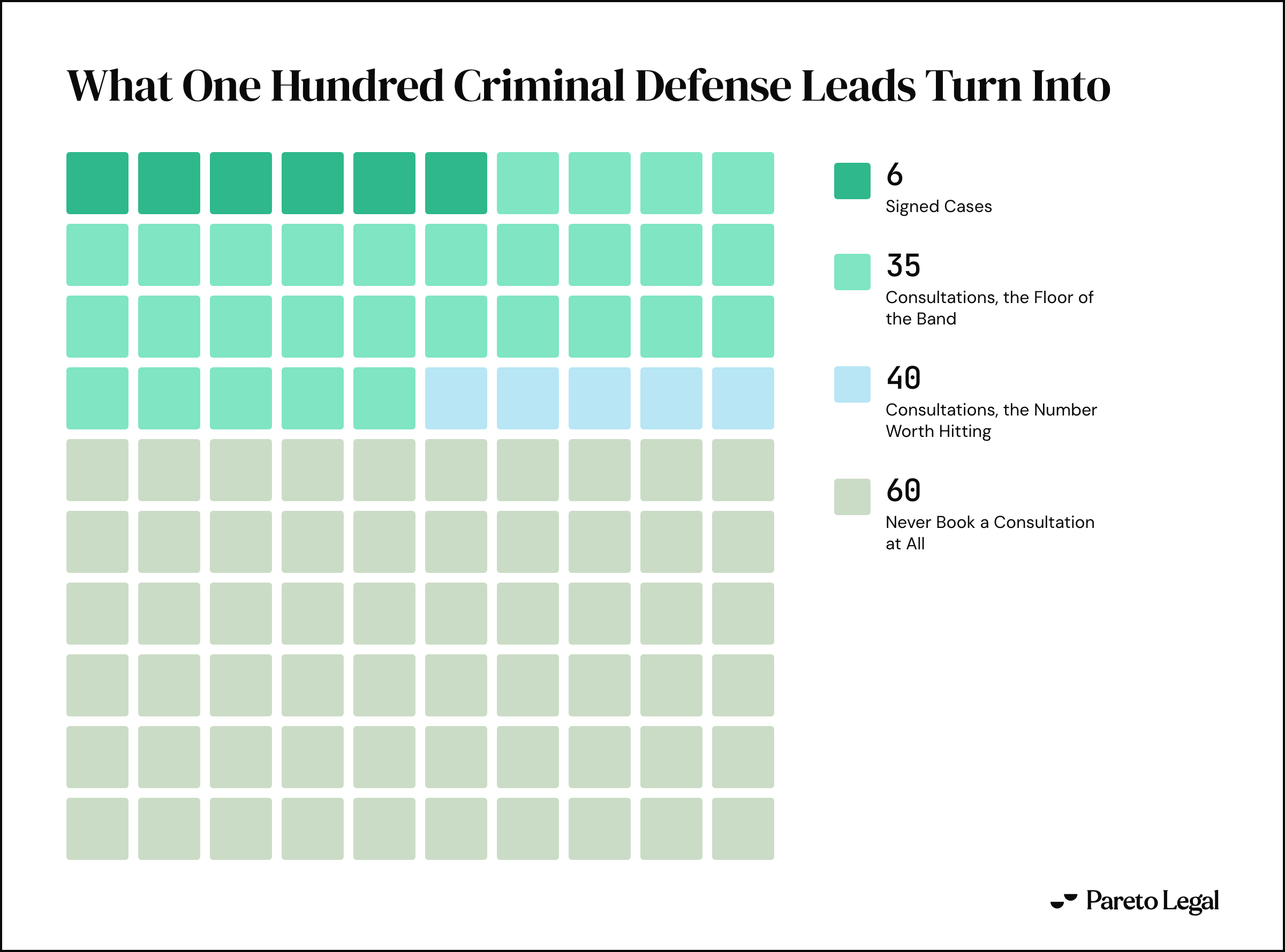
The step most firms misread is the one in the middle. Between 35% and 40% of leads become consultations, and 40% is the number worth hitting rather than a standard. The other 60 in every hundred never book one at all.
A consultation is not a case. A firm reporting a consultation rate near 40% is almost always counting people who agreed to come in, and that number runs about six times higher than the rate at which those same leads sign.
Track both, because they fail for different reasons. The consultation rate moves on how fast and how well intake answers. The signing rate moves on whether the lead had a matter you actually take.
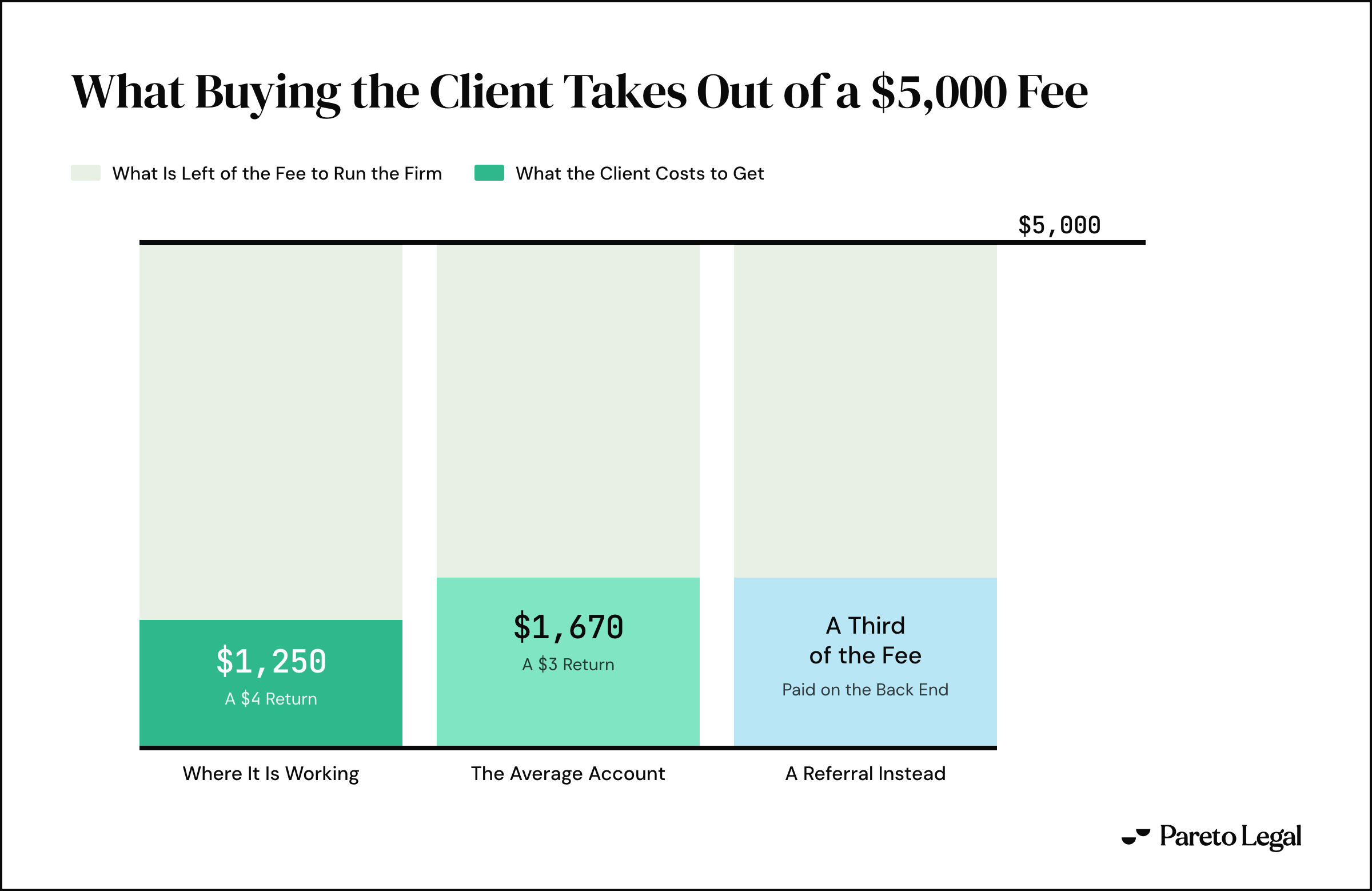
Hold the result against the alternative you already have. A referral from another lawyer costs nothing up front and roughly a third of the fee on the back end. On a $5,000 matter, that referral costs about the same as buying the client outright.
That is the bar, and it is the same bar in ratio form. Marketing has to return better than three to one, because three to one is the inverse of a one third referral fee.
At $1,250 a retained client, it clears that comfortably. At $1,670 it lands exactly on it, while you also carry the cash flow risk a referral does not make you carry.
Paid Advertising for Criminal Defense Firms
Most of a criminal defense marketing budget goes to three paid channels, and the funding order is Google Ads first, Local Services Ads second, paid social third.
The order comes from the cost per lead, not from preference. Ten thousand dollars buys about 131 leads on Google Ads at $76.34, about 96 on Local Services Ads at $103.95, and about 44 on Meta at $228.
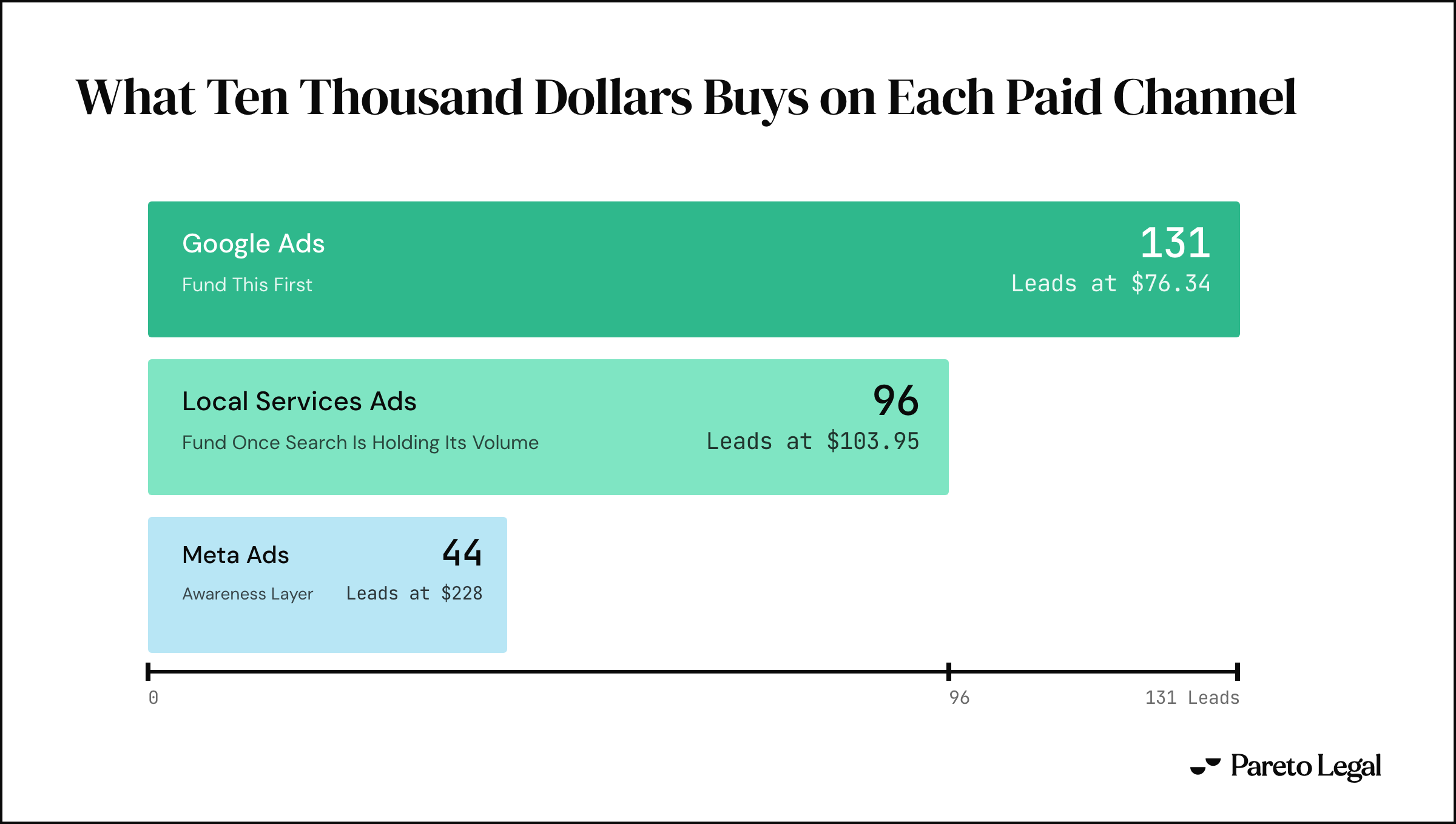
Fund each tier only once the one above it is holding its volume. Adding a channel before that is the most common way a defense firm raises its cost per retained client without noticing. The new channel takes budget from the cheaper leads to buy more expensive ones.
Programmatic and OTT advertising and geofencing for law firms sit outside that order as awareness layers. Geofencing is the one tactic that can reach devices that recently entered a defined physical radius, most often drawn around your own office or an event you are running.
One category is closed to you regardless of budget. Google prohibits the promotion of bail bond services outright, covering bail bond agents, financing and bounty hunters, so a defense firm that also advertises a bonding arm keeps the two accounts separate.
Violations get a warning at least seven days before suspension rather than an instant shutdown.
Google Ads for Criminal Defense Firms
Google Ads reaches the searcher at the moment of the problem, and it produces the cheapest lead of the three paid channels at $76.34. DUI and DWI clicks run $20 to $60, averaging around $40.
What you bid on decides most of that number. Pull the search terms report on a criminal defense campaign that nobody has audited and the leak is usually the same three buckets.
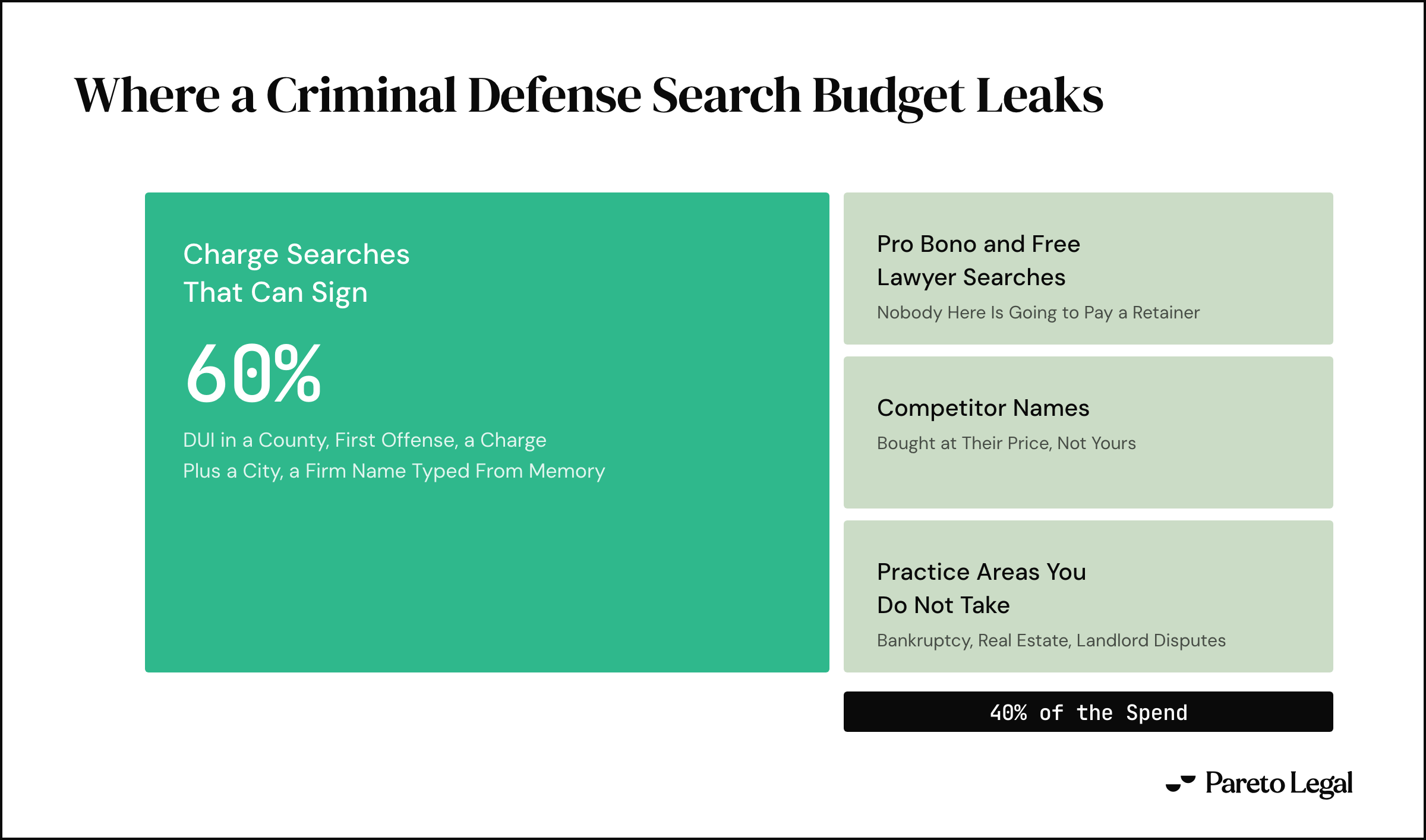
In one defense account those three together held 40% of the spend, leaving 60% to reach a charge search that could actually sign. Pro bono and free-lawyer searches, competitor names, and practice areas the firm did not take, running for years while the firm assumed the channel did not work for criminal defense.
Match type will not save you from that on its own. Google applies close variants to every match type with no way to opt out, so even an exact match on “DUI lawyer” can fire on a paraphrase Google reads as the same intent.
The negative list is the actual control. For this practice area it is specific: free, pro bono, public defender, court appointed, salary, jobs, expungement if you do not handle it, and every competitor name in your county.
Set location targeting to presence rather than the default. Google’s own guidance says presence targeting makes sense for a vertical with strict targeting limits, and a defense firm licensed in one state is exactly that.
Google’s general recommendation is the broader presence-or-interest setting, which will serve your ad to somebody in another state reading about your county.
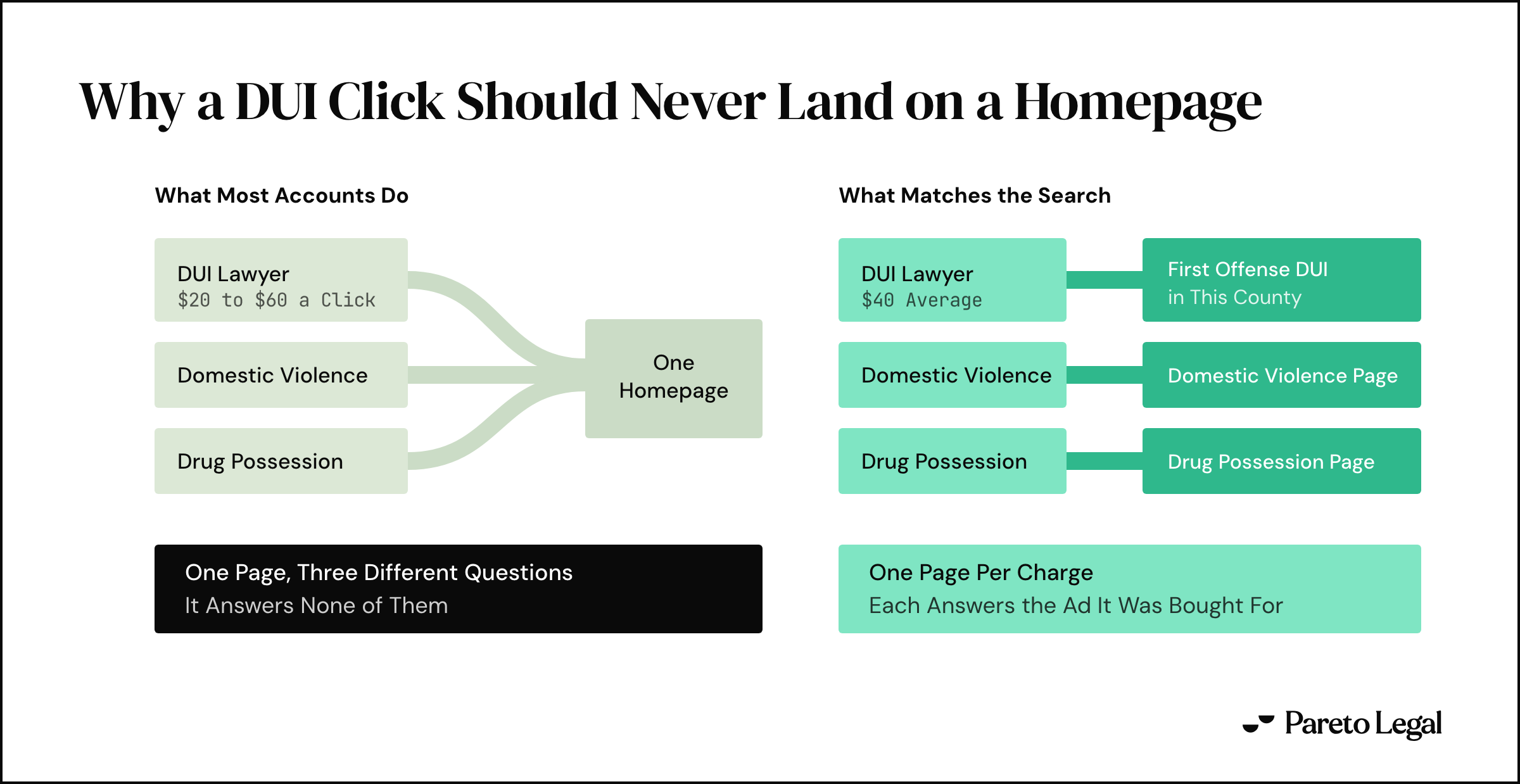
Then send each charge to its own page. A firm running DUI, assault and drug possession keywords into one homepage is paying three different prices for three different questions and answering none of them.
Bid strategy is the last piece, and it is where the account quietly trains itself to fail. Feed Maximize Conversions a conversion action that counts every click-to-call, including the accidental taps that hang up in four seconds, and the algorithm keeps buying more of exactly those.
Restrict the conversion action to calls of two minutes or more and the same campaign starts optimizing toward people who talked to somebody. The auction mechanics underneath all of this are in how pay-per-click works for law firms.
Local Services Ads for Criminal Defense Firms
A Local Services Ad charges per lead instead of per click, sits above the paid search results, and costs about $103.95 a lead in this practice area. It is worth running second, not first.
The reason is not the price. It is that the unit is closer to operations than to marketing, and it exposes an intake problem faster and more publicly than any other channel.
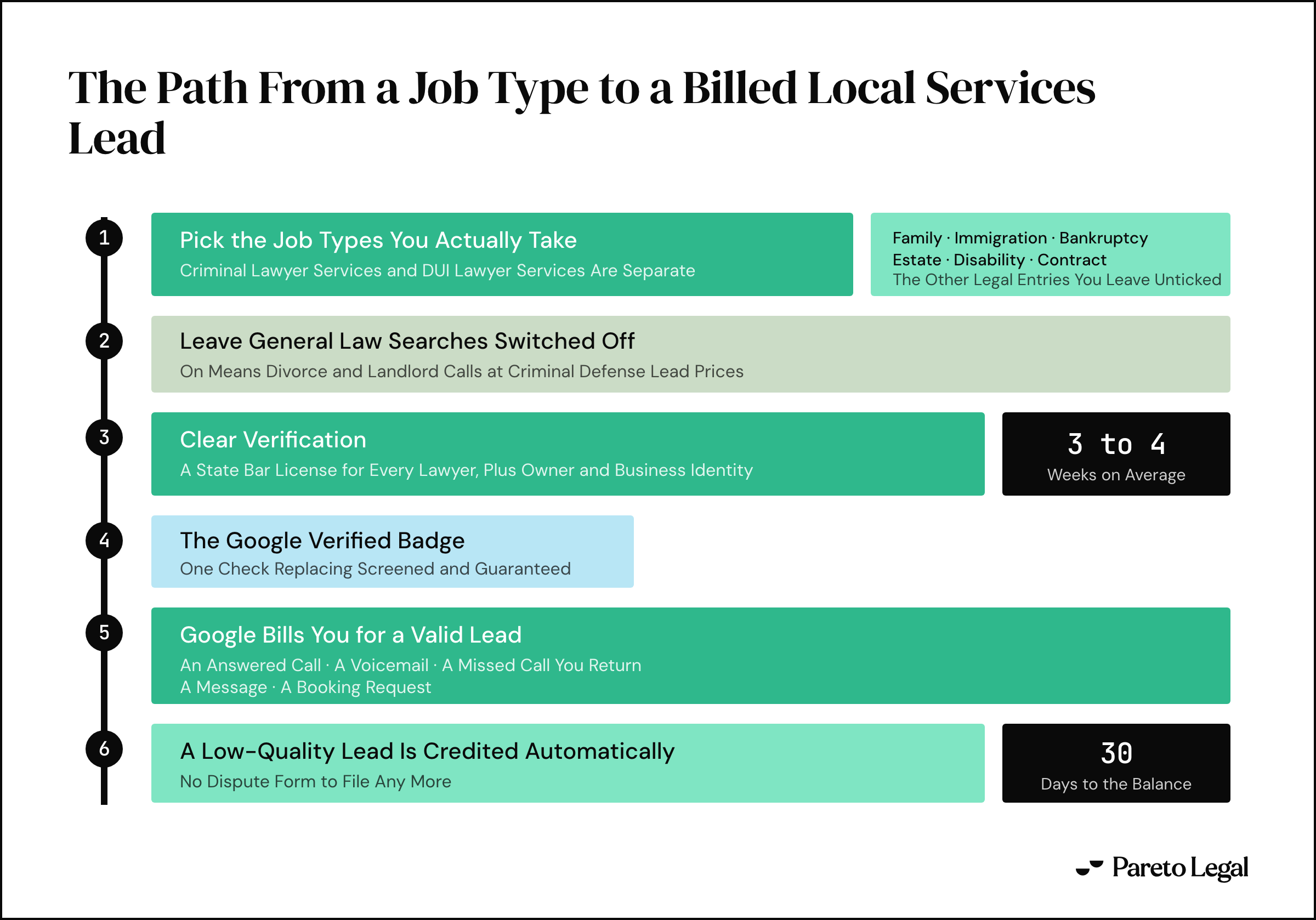
Start with the job types, because that is where most defense accounts lose the quality.
In Google’s category list, criminal lawyer services and DUI lawyer services are two separate selectable entries, sitting alongside family, immigration, bankruptcy and the rest. A DUI practice is not a sub-option of a criminal listing, so a firm that takes both selects both.
Select only what you take, and leave the general law option switched off. Turning it on tells Google to send you anything containing the word lawyer, which for a defense firm means fielding divorce and landlord calls at criminal defense lead prices.
Verification is a real gate rather than a form. Google checks state bar licenses for every lawyer in the firm plus business and owner identity, and states that the process takes three to four weeks on average after documents go in.
The badge on top of that is now Google Verified, a single blue check that replaced Google Screened and Google Guaranteed in October 2025.
Know what you are billed for. Google charges for a valid lead, which means an answered call, a voicemail, a missed call you return, a message or a booking request, with no minimum call length stated.
Low-quality leads are now handled by automatic credits rather than a dispute form, and credits land on the account balance inside about 30 days.
Answer rate is the factor that moves everything else. Google names responsiveness, review rating and review count alongside your bid as ranking inputs, and slow pickup pushes a firm down the unit regardless of budget.
Pick up in three rings or fewer, route anything you miss to a live answering service rather than voicemail, and treat 90% answered as the floor. If you cannot answer at 2am, do not run the ads at 2am.
One structural change is worth knowing before you build the account. Google is moving Local Services Ads into Google Ads as Performance Max campaigns with pay-per-lead goals. It begins in August 2026 with home and storefront services in the United States, expands late in 2026 to service-area businesses without a storefront and to accounts with custom bidding or booking configured, and finishes in 2027 with every remaining category.
Legal is not named in any phase. What you set up now is what you keep, but the dashboard it lives in is going to move. The rest of the mechanics are in local services ads for law firms.
Paid Social for Criminal Defense Firms
Paid social buys the most expensive lead of the three at $228, and it cannot catch anyone at the moment of arrest, because there is no query for it to match.
It has one job worth paying for. Someone sees your firm a few times over a month, gets charged, and types your name instead of a charge. That branded search costs less and signs more often, and rising branded search volume is the signal that the awareness spend is doing anything at all.
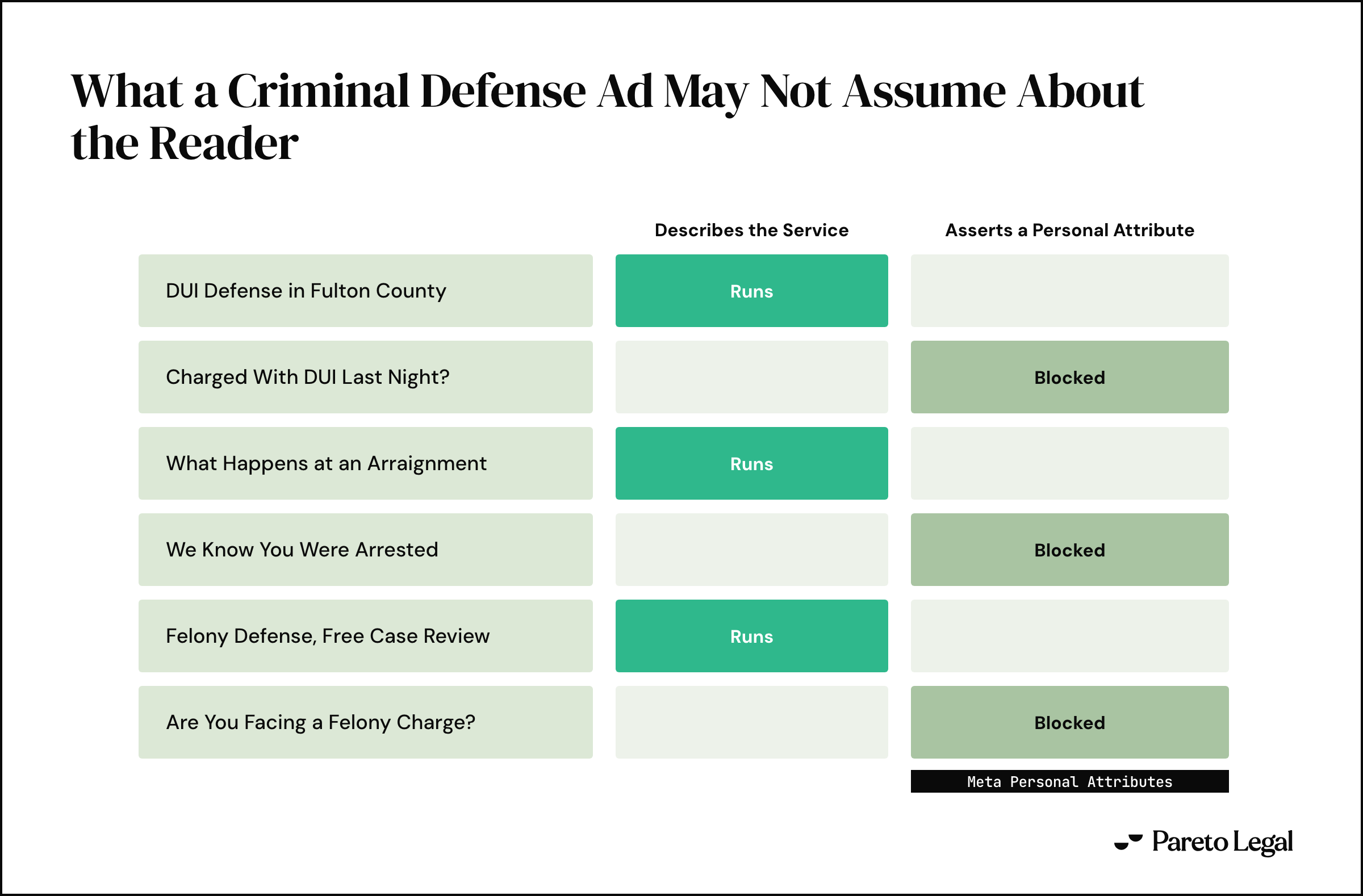
Before writing a single ad, read Meta’s personal attributes standard. It prohibits ads that assert or imply a person’s attributes, and criminal record is on the enumerated list alongside race, religion, health status and financial circumstances.
That rules out the copy most defense firms reach for first. “Charged with DUI last night?”, “We know you were arrested” and “Are you facing a felony charge?” all assert the reader’s legal status, and all three are blocked. “DUI defense in Fulton County”, “What happens at an arraignment” and “Felony defense, free case review” describe the service instead, and all three clear the standard.
The rule sits on the ad copy, not on the targeting. You can still build audiences and retarget site visitors here, which matters because on Google you cannot.
Google lists commission of a crime among its sensitive interest categories and names criminal defense lawyers as an example of it. An advertiser promoting inside one of those categories is barred from using advertiser-curated audiences at all.
That takes your own remarketing lists, your Customer Match uploads and your lookalikes off the table on Google, leaving you its predefined segments. Meta applies no equivalent restriction to a defense firm, because its special ad categories cover housing, employment, financial products and social issues rather than criminal work.
Retargeting is worth less here than the platform’s sales pitch suggests, though, because its value scales with how long a buyer takes to decide. Family law retargets well across months. A charge gets decided inside a week, which is barely enough time for the pixel to serve anyone twice.
Two more things decide whether this channel works. Meta’s in-feed lead form removes all friction, which raises volume and lowers quality in the same motion, so a landing page with a real form filters better than an instant form does.
And creative on Meta is a running cost rather than an asset you write once. The test for every ad before it ships is whether you would be comfortable with a judge putting it on a screen in a courtroom.
I compare the two platforms in google ads vs facebook ads, and go through audiences and creative in meta ads for law firms. Running it as a standing channel rather than a test is paid social for lawyers.
SEO for Criminal Defense Firms
SEO earns a defense firm the search volume paid media cannot afford at scale, over months rather than weeks. The structure that does it is a page per charge per market, not a blog.
DUI, domestic violence, drug possession, felony defense, expungement, each written for that charge where you practice. A charge page published this quarter is still taking calls two years from now, which is the opposite of an ad that stops the day you pause it.
Fund paid first anyway. Paid produces retained clients this quarter and charge pages will not, so the sequence is paid now with charge pages compounding underneath it.
Local SEO for Criminal Defense Firms
The map pack decides whether a defense firm appears at all on the searches a defendant actually types, and it sits above every organic result on them.
Three charge queries pulled in August 2026, criminal defense lawyer near me, DUI lawyer near me and domestic violence lawyer near me, each returned a local pack in the first position.
Nine of the nine firms shown across those three packs publish 24-hour opening hours, and their ratings run from 4.8 to 5.0 on more than a hundred reviews each.
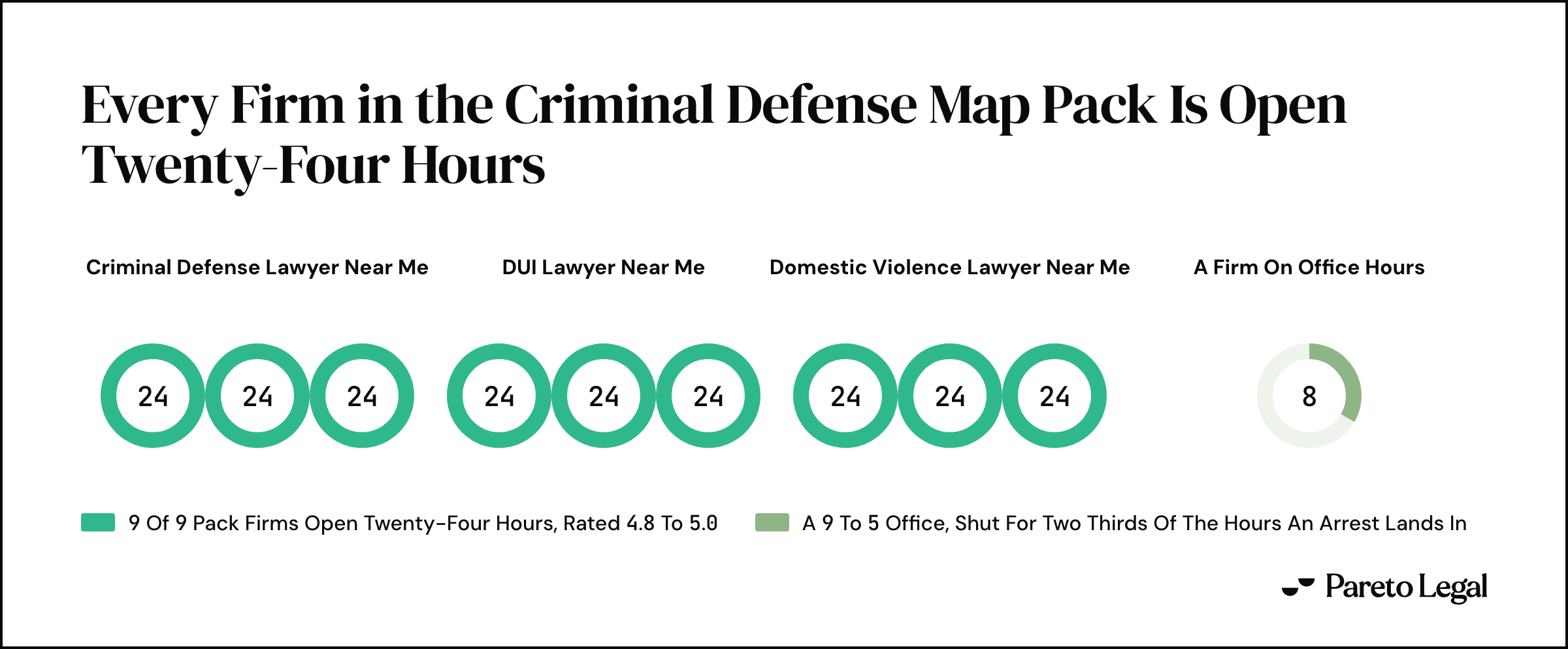
Opening hours are a field you can edit this afternoon and a promise your intake has to keep. Publishing 24 hours and rolling to voicemail at midnight is worse than publishing a 9 to 5, because the call you paid for arrives and finds nobody.
Google names relevance, distance and prominence as what decides local ranking, and ties prominence directly to review count and rating. Distance you cannot change. Prominence is the one you work.
Keep the profile clean while you do it. The business name field takes your real firm name and nothing else, and stuffing a practice area or a city into it risks suspension of the profile the map pack depends on.
Generative Engine Optimization for Criminal Defense
Getting cited in an AI answer takes the same work as ranking, not a separate discipline. Google states there are no additional requirements to appear in AI Overviews or AI Mode, and no special optimizations beyond being crawlable, indexed and snippet-eligible.
What changes is which of your pages gets picked. Google’s AI Mode answer for how criminal defense lawyers get clients assembled 33 cited sources in August 2026.
Several of them were single firm pages shaped like a question: what to do if arrested, should I request a court-appointed lawyer, public defender versus private attorney.
None of them were homepages, and none were a page about why the firm is different. A page that states one specific, quotable thing about one charge gets cited. A brochure does not.
The same answer carried a paid ad inside it, so the AI answer is now an auction surface as well as an editorial one, and being absent from both is a choice.
Content Marketing for Criminal Defense Lawyers
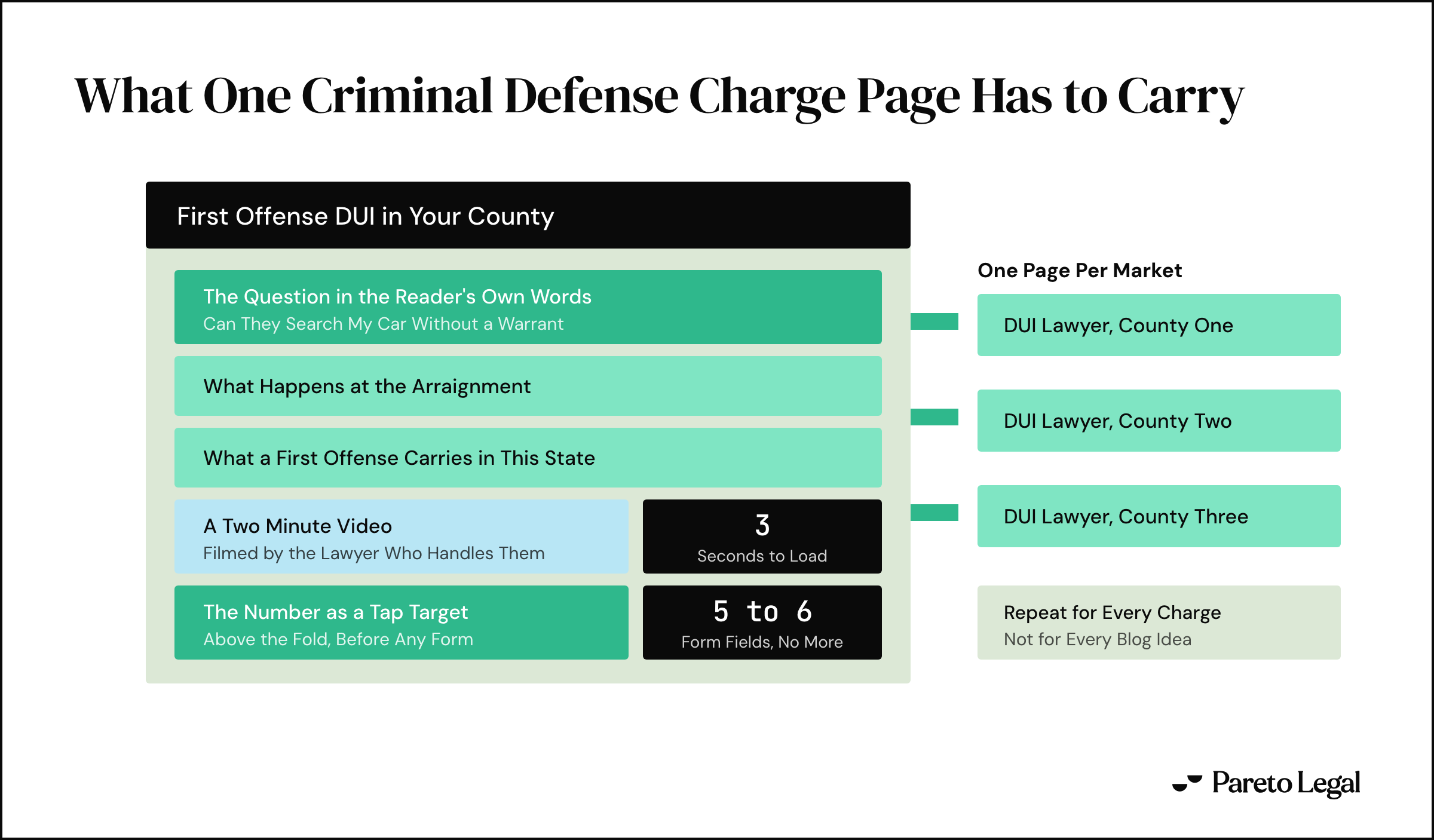
The content that earns a signed case is charge-specific and written for somebody arrested last night. What happens at the arraignment, what a first offense DUI carries in this state, whether to keep talking to the detective who keeps calling.
Write it in the words the client uses. Somebody types “can they search my car without a warrant”, not “Fourth Amendment vehicle exception”, and the page using the first phrasing is the one that gets found and the one that gets read.
Google will hand you the outline if you look. The People Also Ask questions sitting on the charge queries are buyer-shaped and specific. Should I hire a DUI lawyer immediately, how much would a lawyer cost for a DUI case, is it worth it to hire a criminal defense attorney.
The content that fills a blog and converts nobody is the other kind. Five tips for choosing a criminal defense attorney. Understanding the criminal justice system. Nobody facing a charge reads a listicle about how to choose a lawyer.
The test is one question. Would a person arrested twelve hours ago read that page before they call anybody? If yes, write it. If no, you have written a page for other marketers.
Video belongs here too. A two-minute answer to what happens at a bail hearing, filmed on a phone by the lawyer who handles them, gives the charge page something to hold and gives the AI answer something to quote. Organic social works the same way: post the answers, not the case results.
Your Website and Intake Speed for Criminal Defense Firms
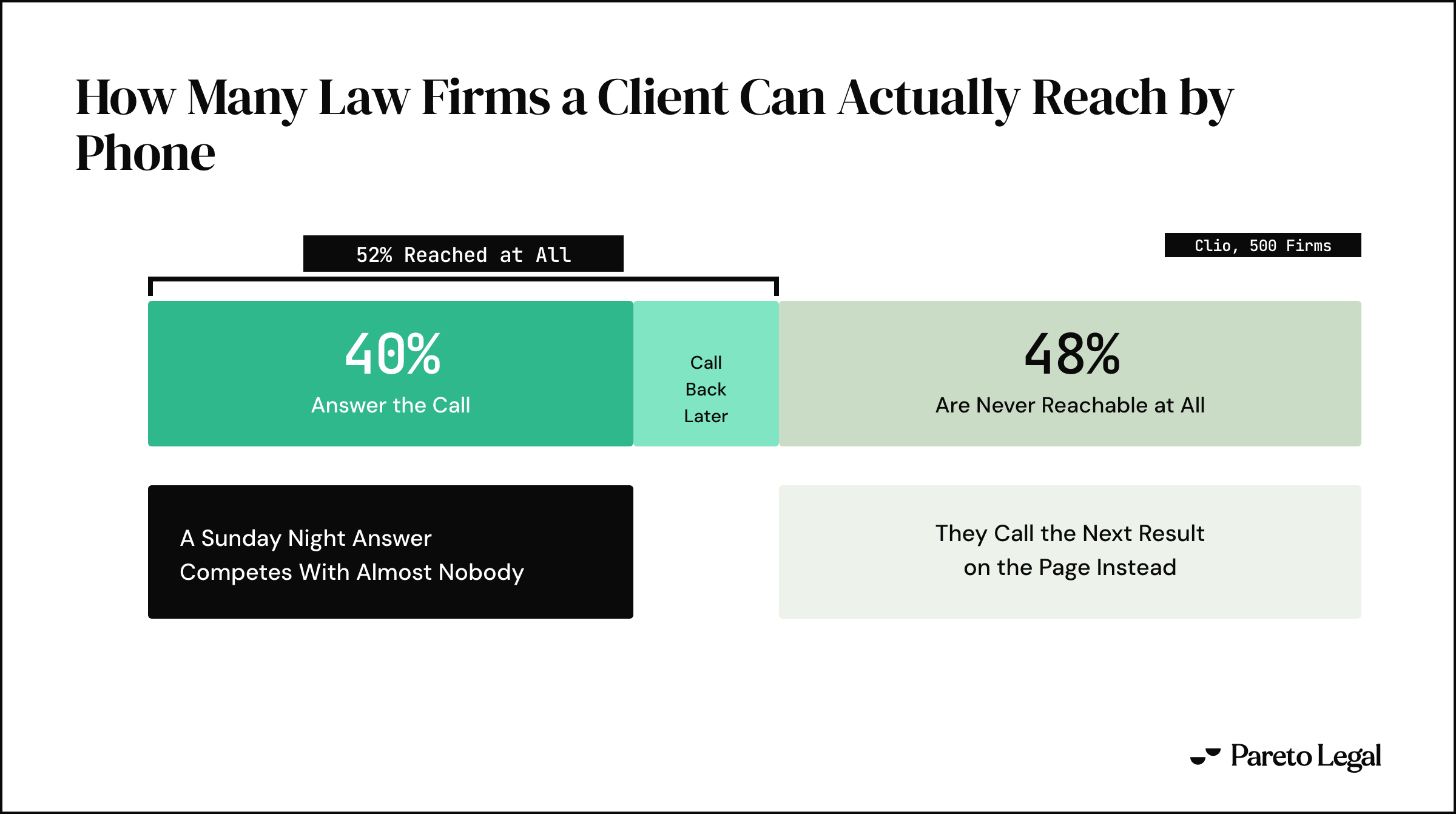
Intake is where most of the money leaks, and the leak is measurable. Clio secret-shopped 500 firms and found only 40% answered the phone when a prospective client called, down from 56% in 2019.
Counting the firms that called back afterwards, the same report found 52% were reachable at all and 48% were not. Half the firms a defendant tries on a Saturday night never speak to them.
Hennessey Digital tested 1,333 law firm websites the same way. 25% replied inside five minutes and 26% never replied at all inside seven days, which on a charge that frightens somebody is the same as not existing.
Price a missed call with your own numbers before deciding it is a staffing question. At $76.34 a lead and six signed cases per hundred leads, a Saturday night nobody answers is not one lost call. It is the front of a chain that ends in a case you paid for and did not get.
Arrests do not keep office hours, which is the part defense firms underweight most. If your ads run on a Saturday night and your phone rolls to voicemail on a Saturday night, you are paying for calls you decided in advance not to take.
Either somebody picks up outside business hours, or the ad schedule matches the hours you answer. An answering service running your intake script counts. A voicemail box does not. The same choice runs through every channel in lead generation for lawyers.
Train intake to disqualify early rather than to sell. Wrong state, wrong charge, already has a lawyer, and the call ends politely in ninety seconds instead of forty minutes. Everything left is a lead worth working.
The site itself has one job on a phone screen. A defendant is standing in a parking lot holding a cracked phone. Put the number in the header as a tap target, keep the form to five or six fields, and get the charge pages loading in under three seconds. More research on the same problem is in legal client intake statistics.
Branding for Criminal Defense Law Firms
A criminal defense brand answers three questions in the ten seconds a frightened person gives it. Have you handled this exact charge, will you actually answer tonight, and will the person calling be judged for calling.
Most defense homepages answer a different set. Years in practice, a verdict total, a photograph of the partners in front of a bookcase. Those answer the firm’s question about itself rather than the buyer’s question about their Saturday night.
The harder problem is that this is a category where the buyer is ashamed to be buying. Nobody wants to be seen shopping for a criminal defense lawyer, and that changes what a homepage can say out loud.
Confidentiality and plain treatment carry further than aggression here. The tough-guy positioning that reads well in a pitch deck reads badly to somebody who is scared. Say what you defend, say who picks up the phone, and say it in charge names rather than statute numbers.
Reviews and Referrals for Criminal Defense
Reviews buy the one thing paid channels cannot: a reason to pick you out of three firms running the same ads. They are also the only thing on the page that did not come from you, which is exactly why they carry.
Where they are seen matters more than how many you have. The Google Business Profile is first, the Local Services Ad carries the same review score inside the ad unit, and the AI answer assembles part of its response from both.
Do not expect to convert that into stars on your own site. Google’s review snippet rules make a business ineligible for the star feature when it controls the reviews about itself, so marking up your own testimonials page earns nothing.
Ask carefully, because two rulebooks apply at once. Google treats a review influenced by a payment, a discount or any other benefit as a policy violation, and counts pressuring a customer for a specific rating as rating manipulation. ABA Model Rule 7.2 bars a lawyer from giving anything of value for a recommendation, which covers paying or discounting for a review.
Then accept the constraint this practice area has and no other does. Plenty of criminal defense clients will not review you under their own name, and that is not a failure of your follow-up. Ask anyway, make it easy, and expect a lower rate than a personal injury firm gets.
Referrals split three ways here: lawyers who do not take criminal work, professionals in the courthouse orbit, and former clients. The first is the largest and the most neglected. Work it like a list, with a quarterly note and a record of who sent what.
Do Criminal Defense Firms Need Email Marketing?
Mostly no. A criminal defense client is not a repeat buyer, does not want your newsletter, and may not want a record of the relationship sitting in a shared inbox.
The exception is the referral list. Other lawyers are a repeat audience, and a short quarterly note to them is worth more than a consumer email program ever will be.
What to Measure
Judge criminal defense marketing on retained clients against ad spend, never on leads against clicks. Cost per lead is not comparable across channels anyway, because a Google Ads lead includes form fills and chats while a Local Services Ads lead is mostly a phone call.
Wiring that up means offline conversion import, which is a real project rather than a setting. Enhanced conversions for leads matches your signed cases back to ad clicks using hashed contact details.
Mind the clock on it. Google will not import an enhanced-conversion upload more than 63 days after the click, or a standard offline conversion more than 90 days after it. A case that takes longer than that to retain never gets counted at all.
You need three things in place first: leads landing in a case management system, the originating campaign stored on the record, and one person accountable for keeping it accurate.
Where intake reliability is the weaker link, feed qualified leads back instead of signed cases, because case data blends marketing performance with intake performance and you lose the ability to tell which one moved.
Watch the retained rate first. It is the number you can move this quarter, and it moves on intake and on the charge pages rather than on bids. A firm that lifts it has cut what a signed case costs without touching a budget.
Model your own before shifting anything. A ppc calculator takes a cost per lead, a signing rate and a case value and returns what a signed case costs you.
The tracking side is in google analytics 4, and the wider benchmark set is in law firm ppc statistics.
If your cost per retained client is drifting above that range and you cannot say why, it is the channel mix or the intake rather than the budget.
Holding that funding order month after month is what law firm ppc management is for, and it is the argument for a legal-specific marketing agency over a generalist. The law firm ppc case studies show what the mix looks like once it is right.
If you want a read on where yours is going, book a strategy call.