

Do Google Ads Work for Lawyers?
Yes — when the account is built to buy signed cases instead of clicks. Here’s proof: one firm we worked with, Snyder Law Group, went from roughly five to ten personal injury cases a month to about 25 to 30 within two months of launching a search and Local Services Ads program, while their cost to acquire a case actually dropped.
Our team has managed or audited more than 1,000 law firm advertising accounts, 600-plus of them in personal injury, and the pattern is consistent: firms that fail at Google Ads usually don’t fail because the channel doesn’t work.
They fail because the account was built backward — optimized for the wrong action, pointed at the wrong page, and measured against the wrong metric.
Injury accounts carry the sharpest version of that problem, and I took them apart separately in google ads for personal injury lawyers.
Why Are Clicks So Expensive?
Now, why the clicks cost so much. Across more than 16,000 US search campaigns, legal posted the highest cost per click of any industry studied, with a median click around $8.58 (WordStream, 2025).
That median hides the real story. It folds in low-competition queries like estate planning and traffic tickets.
The keywords that bring in cases sit far above it — “car accident lawyer” or “DUI attorney near me” run anywhere from $50 to $500-plus depending on the practice area and metro.
The reason is intent. Someone typing “criminal defense lawyer Miami” at 11 p.m. on a Tuesday is not browsing. They are in a triggering moment, ready to talk to a firm right now, which is exactly why criminal defense PPC lives or dies on speed.
There is no tactic that captures the warmest audience possible the way Google can, and that intent is why a single click can cost $200. Firms keep paying it because the math works.
If a keyword costs $500 a click, a firm will buy a hundred of those clicks a month, because they’ve run the numbers: spend $20,000 this month and, over the next 12 to 24 months, that money comes back with a profit on top.
A signed truck-accident case can fund a quarter of ad spend by itself. The firms that win treat that as a long-term investment instead of an experiment they pause after two months because they got impatient.
That last point is the whole game. You are not buying traffic. You are financing the acquisition of signed cases, and every number upstream of a signed case — clicks, leads, cost per lead — is a proxy, useful but never the point.
Most agencies will sell you tactics: do SEO for more clicks, do PPC for more leads. That’s short-sighted. Over a series of months, the work should drive more signed cases at an improving acquisition cost.
If it isn’t, nothing else in the report matters. So the question is never “what’s my cost per lead?” It’s “what can I afford to pay for a signed case, given my average fee?”
A $3,000 cost per signed case is excellent if a case generates $30,000 in fees, and a problem where case values are thinner. The rest of this guide is how to build an account that answers that question honestly — and then wins on it.
How a Law Firm PPC Account Works, and What It Costs
Here is a full walkthrough of how a law firm PPC account turns search demand into signed cases.
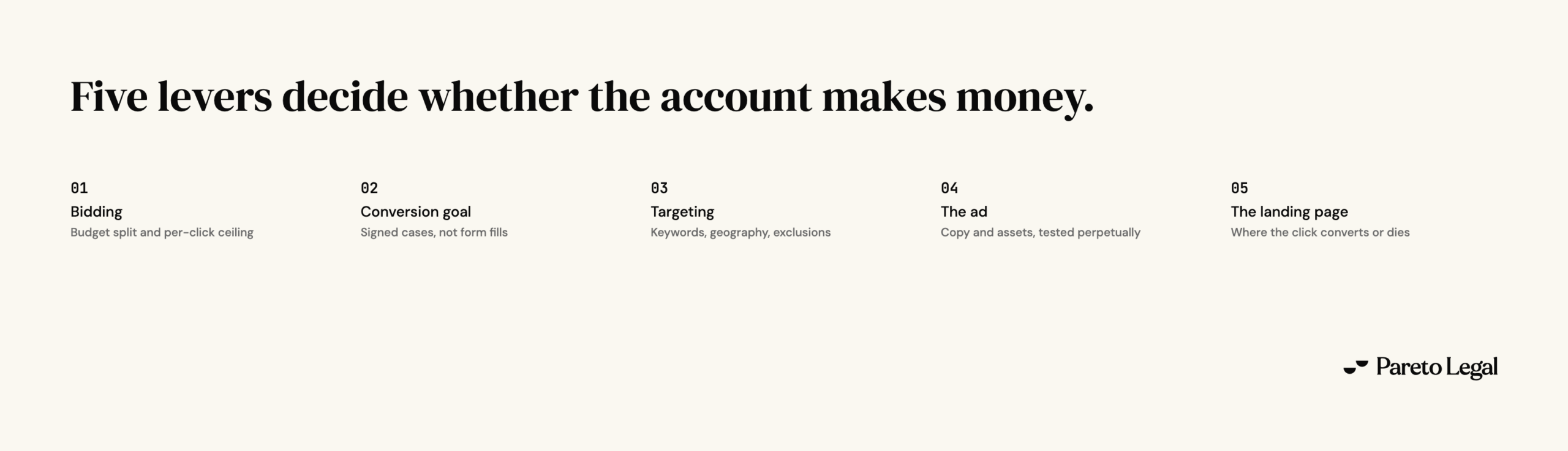
Strip law firm PPC down to what a campaign manager genuinely controls, and there are five levers. Master these and the account works. Neglect any one and it leaks.
- Capital allocation and bidding. How budget is split across channels, campaigns, and keywords — and how much you’ll pay for a single click. Budget is the total; the bid is the per-click ceiling.
- What the campaign optimizes toward. Conversion tracking and settings — telling Google to optimize for phone calls, form submissions, and live chats, not raw clicks. Get this wrong and the algorithm spends your money chasing the wrong outcome.
- Targeting. Keywords, geography down to the ZIP and county, demographics, device, day and hour — and, just as important, who to exclude.
- The ad itself. Copy, creative, and assets, tested perpetually. You launch an ad, learn which headline carries it, then build new variants to beat the top performer.
- The landing page. The most overlooked lever in the stack. Plenty of capable technicians handle the first four and fall short here. The page has to match the intent of the search, make the case for your firm fast, and pull in social proof and settlement amounts.
Notice where the money is usually lost: levers four and five. Firms obsess over bids and keywords, then send a hard-won $200 click to a generic homepage. That’s the leak.
Campaign Types, Ad Groups, and Match Types
Before any of the levers matter, the account has to be organized correctly, because structure is what gives you control over spend.
Campaign types. Not every Google Ads product belongs in a law firm account:
- Search campaigns are the core. Text ads on Google results pages, triggered by keywords, charged per click. This is where the high-intent case volume lives.
- Local Services Ads sit above search results and charge per lead, not per click (more on these below).
- Display campaigns show banner ads across websites. Useful for remarketing to people who already visited your site; weak as a primary lead source for legal.
- Performance Max spreads ads automatically across every Google surface with little visibility. Handle with care — covered later.
- Smart campaigns are Google’s simplified, mostly automated option. Beginners get funneled into them by default. For a firm spending real money, they hand away too much control; you want a standard Search campaign instead.
The hierarchy. Inside a Search campaign, the structure is account → campaign → ad group → keywords and ads.
The rule that separates profitable accounts from messy ones: build one campaign per practice area and per market, then tight ad groups of three to five closely related keywords each, with ad copy and a landing page written specifically for that cluster.
Don’t dump “car accident,” “slip and fall,” and “medical malpractice” into one campaign — you lose the ability to budget by case type and to match each ad to its page.
Match types. Keywords tell Google how loosely to match a search, and the gap between the keywords you bid on and the search terms that actually trigger them is where budget quietly leaks. Exact match ([car accident lawyer]) fires only on that query and its close variants — the safest, highest-intent default for legal.
Phrase match ("car accident lawyer") catches searches that contain the phrase, a controlled way to widen reach. Broad match (car accident lawyer) matches anything Google deems related — and in legal, that means job-seekers, students, and researchers unless you fence it in heavily.
Start with exact and phrase; only reach for broad under the conditions covered later.
How to Set Your Monthly Budget
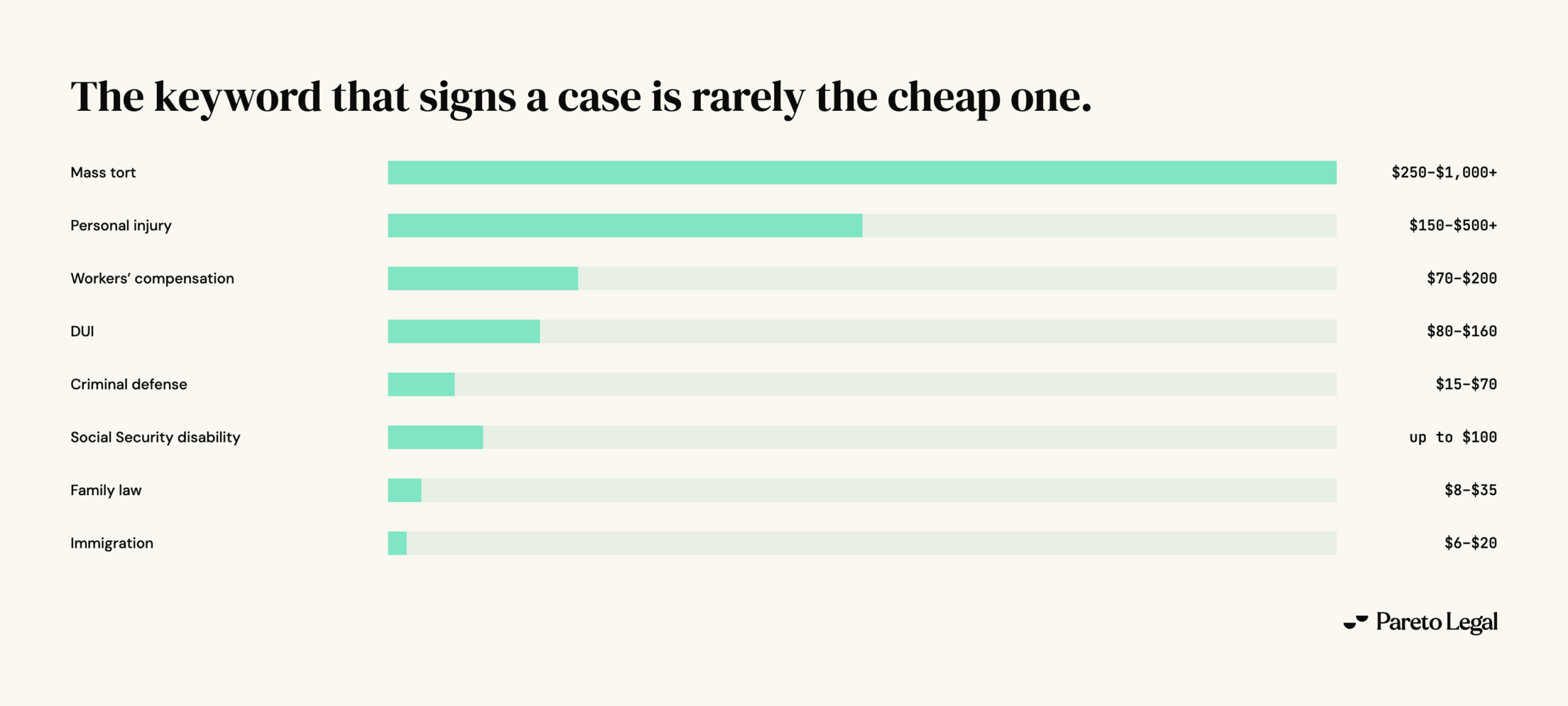
Start with what a click actually costs. These are 2026 ranges from public benchmark data — planning numbers, not promises. Your real costs depend on your metro and your account quality.
| Practice Area | Typical CPC Range | Notes |
|---|---|---|
| Personal injury | $150 to $500+ | Top end in competitive metros and mass-tort overlap |
| Mass tort | $250 to $1,000+ | Highest-value case searches (e.g., mesothelioma, truck) |
| Workers’ compensation | $70 to $200 | Steadier auction than PI |
| DUI | $80 to $160 | Higher than general criminal defense |
| Criminal defense | $15 to $70 | Steady volume, lower intent density |
| Family law | $8 to $35 | Among the lowest CPCs in legal |
| Immigration | $6 to $20 | Lower case values pull bids down |
| Social Security disability | Often under $100 | Among the lower-cost legal areas; higher volume, thinner per-case economics |
Sources: WordStream 2025; LocaliQ 2024 legal benchmarks; Anytime Digital Marketing 2026 guide; Consultwebs via Andava 2025.
For context on cost per lead, LocaliQ’s 2024 legal data put personal injury at about $159, criminal at $101, family at $104, and bankruptcy at $82 per lead.
The most expensive single keywords are eye-watering: “best mesothelioma lawyer” has been clocked near $935 a click, and offshore-accident terms average around $849 (ClickPatrol, July 2025; iLawyer Marketing, October 2025).
Those are extremes, but they tell you why a careless account in a competitive niche can burn a five-figure budget in days. If you run personal injury, I get into budgets by case type in my personal injury PPC guide.
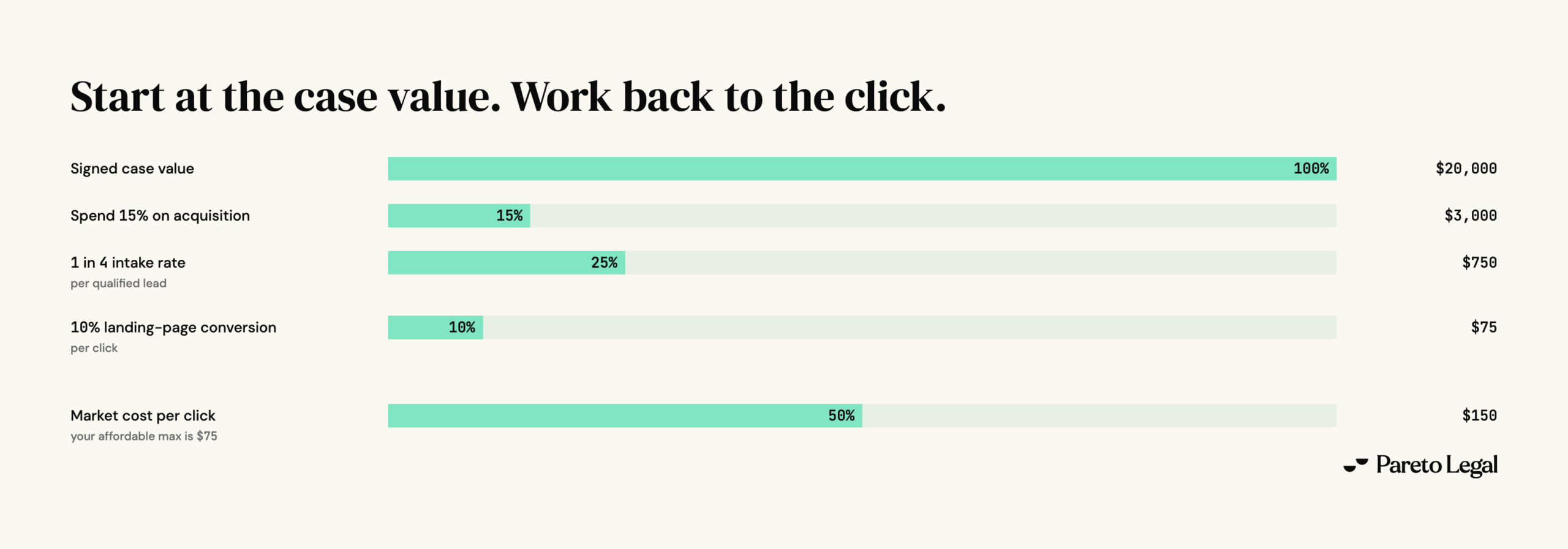
“How much should I spend?” has no flat answer, but it does have a formula. Work backward from a signed case:
- Set a target cost per signed case. Anchor it to your average fee. If a case earns $20,000 and you’re willing to spend 15% to acquire one, your target is $3,000.
- Apply your intake conversion. If your team signs one in four qualified leads, you can afford about $750 per qualified lead.
- Apply your landing-page conversion. If the page turns 10% of clicks into leads, that’s 10 clicks per lead, so your affordable cost per click is roughly $75.
- Compare to market CPC. If your market runs $150 a click, the math doesn’t close at those conversion rates — which tells you exactly which lever to pull: improve the landing page, tighten intake, or accept a higher cost per case. To see how those levers move the outcome, run your numbers through our cost-per-case calculator. The formula isn’t there to produce one number; it’s there to show you whether the market is affordable and where the constraint is.
- Find the budget floor. Smart Bidding needs roughly 30 to 50 conversions a month to learn. At a 10% click-to-lead rate, that’s 300 to 500 clicks a month. In a $150 metro that’s a $45,000 to $75,000 monthly floor for competitive PI; in a lower-CPC practice area it’s a fraction of that. Below the floor, you don’t have enough auction data to optimize — you’re just feeding the machine guesses.
This is also the 80/20 of the account in practice: a small slice of your keywords will drive the majority of your signed cases. Find them, fund them, and stop subsidizing the rest.
Building Campaigns That Sign Cases
Google Search Ads vs. Local Services Ads
There are three buckets worth knowing: Google Ads, which is pay-per-click; Google Local Services Ads, which is pay-per-lead; and paid social like Meta. For most plaintiff-side firms, the first two do the heavy lifting.
Search Ads give you full control — keywords, ad copy, landing pages, bidding. That control is the point and the burden: it’s where skilled management earns its keep, and where DIY accounts quietly hemorrhage money.
Local Service Ads (LSAs) sit above everything else on the page and charge per lead, not per click. Lead quality tends to be strong for two reasons: the format serves on very high-intent attorney keywords from people ready to talk, and you only pay when a lead is generated.
You can dispute junk leads for credit. As of October 27, 2025, the old “Google Screened” badge was retired and replaced with a single “Google Verified” checkmark (Google, 2025).
With every verified firm wearing the same badge, the differentiator shifts to reviews, responsiveness, and reputation — not the badge itself.
The right answer is rarely one or the other. When we launched Snyder Law Group’s program, it was two campaigns at once — LSA and Search. Run both, measure both against signed cases, and fund whichever wins for your firm.
Keyword strategy. Not all clicks are worth buying. The job is to capture transactional intent — “car accident lawyer near me,” “free DUI consultation” — and exclude the rest.
Informational searches like “how long do injury cases take” or “average settlement amounts” pull in researchers, not clients, and they spend your budget at legal click prices. Reverse-engineer your keyword list from the cases you actually want to sign, not from Google’s suggestions.
Group the survivors into tight, themed ad groups (the three-to-five-keyword rule from the structure section), and write the ad and landing page to match each group exactly.
Protecting your spend. Two silent drains eat legal budgets, and both are defensible.
Negative keywords stop you from paying for the wrong searches: before you widen match types at all, exclude the obvious drains — jobs, salary, how to become, school, free, pro bono, legal aid, Reddit, forum, template, DIY. Without that list, an easy 20% to 40% of spend in legal goes to job-seekers, students, and people who will never hire you.
Negatives aren’t a one-time setup; you mine the search-terms report every week and keep adding.
Click fraud and invalid traffic are the second drain, worse in legal than almost anywhere, because competitors, bots, and lead-resellers all have an incentive to drain a $200 click. By some agency estimates roughly a quarter of legal ad clicks are invalid (StubGroup).
Google automatically credits a portion, but don’t rely on it alone: exclude known bad IP ranges, watch for spikes of no-conversion clicks from one source, and for larger accounts run a click-fraud monitoring tool.
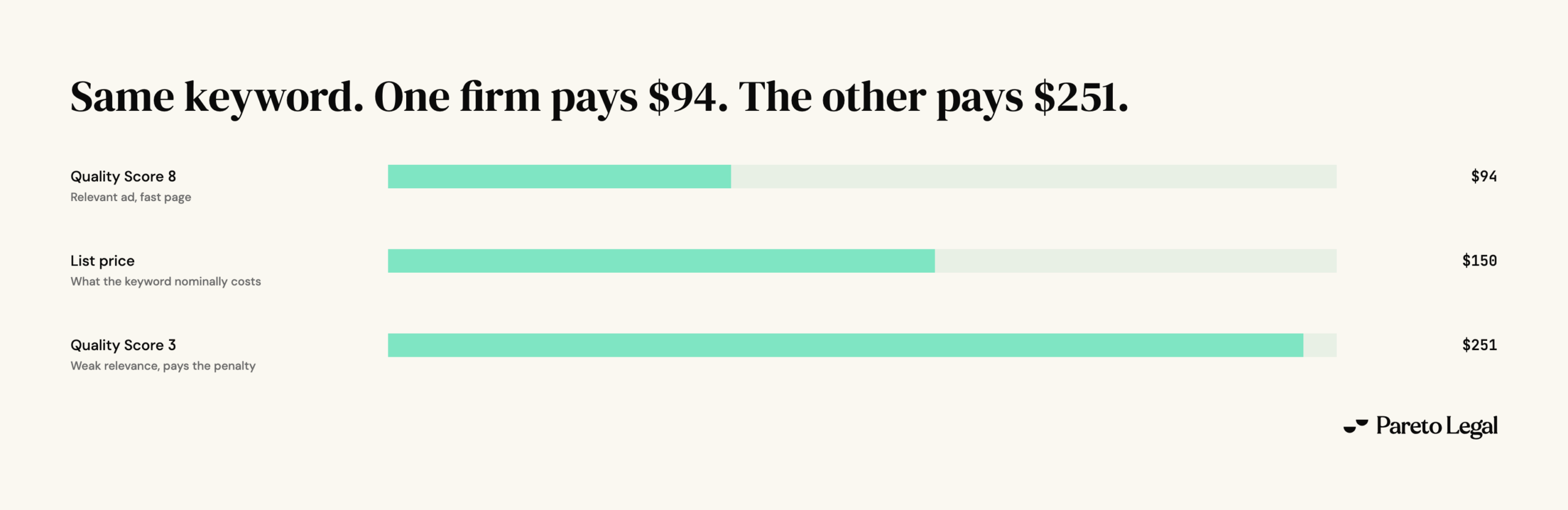
Quality Score is the closest thing Google gives you to a discount, and it’s the lever that ties your ad and landing page directly back to cost. It’s built from three things: expected click-through rate, ad relevance (does the ad match the keyword?), and landing-page experience (does the page match the ad?).
Improve all three and Google charges you less for the same position. The effect is not small: in analyses of personal injury accounts, a keyword priced around $150 can run roughly $94 at a strong Quality Score versus around $251 at a poor one — the same click, nearly tripled (rankings.io).
That’s why tight structure matters: an ad group of three to five closely related keywords, an ad written for exactly those terms, and a landing page that delivers on the ad is the mechanism that lifts Quality Score and pulls your effective CPC down.
Ad assets. Google deprecated call-only ads, with new creation ending in early 2026 (ALM Corp). For a phone-first business like law, the response is to lean harder on responsive search ads with assets attached — the extra pieces below your headline that earn more of the results page.
Call assets put a tap-to-call number directly in the ad, the closest replacement for call-only. Sitelinks send people to specific pages (practice areas, results, free consultation).
Callouts carry trust phrases like “Available 24/7” or “No Fee Unless We Win” (subject to the bar rules below). Location assets surface your office and map pin for nearby searchers.
Assets raise click-through rate and reinforce relevance, which feeds back into Quality Score. Post-call-only, they matter more, not less.
Landing Pages: The Biggest Lever on Cost Per Signed Case
This is where accounts are won or lost. A generic homepage converts legal PPC traffic at roughly 2% to 4%. A dedicated, intent-matched landing page converts at 8% to 15% (Unbounce data via StubGroup).
At $200 a click, that three-to-four-times difference is the line between a profitable campaign and one that quietly drains the account.
A page that converts does a few things well. It matches the search — a “truck accident” ad lands on a truck-accident page, not a general injury page. It makes the case for your firm in seconds, with real social proof and settlement figures.
It puts a tap-to-call number at the top of the screen on mobile, because most legal traffic is mobile and post-incident searchers call first. It keeps the intake form to a few fields.
And it strips out the navigation and exit paths — this page has one job. We’ve built hundreds of these from predefined templates, because the formula holds.
Turning Clicks Into Signed Cases: Intake and Tracking
Here’s the uncomfortable truth most agencies won’t tell you: a lot of “Google Ads doesn’t work” is actually an intake problem wearing a marketing costume. We can drive the lead. Whether it becomes a case depends on what your firm does in the next five minutes.
The data is brutal. A prospect contacted within five minutes is far more likely to qualify than one reached half an hour later (Taqtics). Eighty-five percent of personal injury leads start with a phone call.
A lead that calls at 11 p.m. and hits voicemail usually doesn’t call back — they call the next firm. You can have a flawless account and still lose if the phone isn’t answered.
So we won’t be held accountable to leads alone, and we won’t let a firm off the hook either. The deal is mutual: we drive qualified leads through the campaigns, and you do everything in your power to convert them.
A firm that fixes intake and runs Google Ads beats a firm that only runs Google Ads, every time.
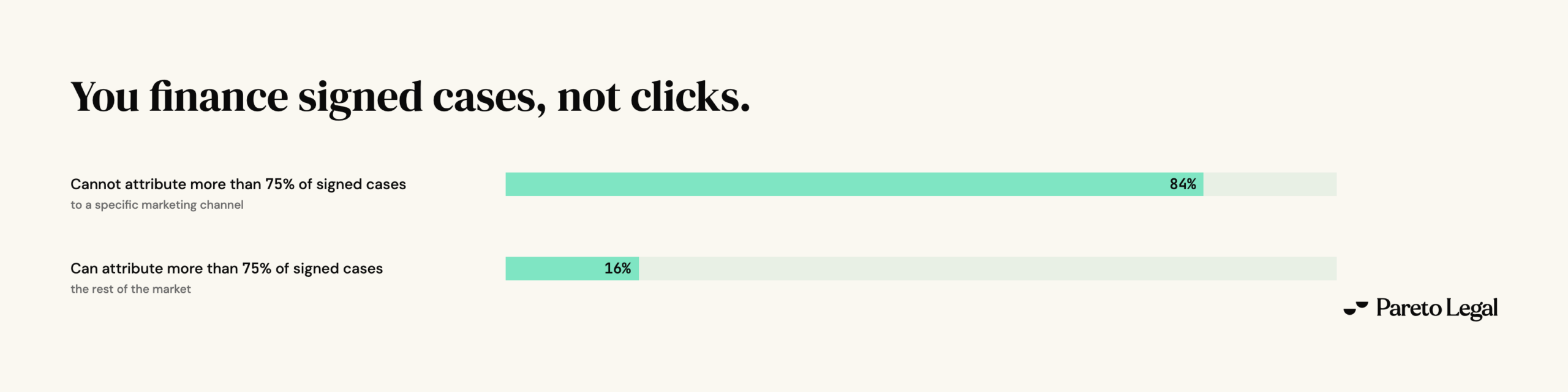
Tracking. If you can’t trace a signed case back to the campaign that produced it, you’re guessing. And most firms are guessing — by one 2026 estimate, 84% of firms can’t confidently say where three of every four signed cases came from (XIRA, 2026).
The fix is closed-loop tracking. Someone clicks an ad, fills out a form or calls, and that lead lands in your CRM carrying a tracking code.
When the lead becomes a signed case, you can look back and see which campaign and channel drove it — “of the ten cases we signed last month, six carried this code.” Then you push that case data back into Google so the algorithm learns what a good case looks like, not just a good form fill.
That loop — call tracking with dynamic numbers, CRM tagging, offline conversion import — is what separates a profitable account from an expensive one.
It’s also why one of the most valuable things we do is fix attribution before touching the bids. One personal injury firm came to us spending heavily with no idea which campaigns worked.
We rebuilt their reporting, and the data quickly showed they were wasting real budget on a Local Services Ads setup that wasn’t producing meaningful cases. With that proof they reallocated — and went on to more than triple their personal injury practice.
The bids didn’t fix that. The data did.
Running Lawyer PPC in 2026: Automation, Compliance, and Hiring
Performance Max and broad match. Google will push you toward automation. Some of it helps; some of it quietly spends your money in places you can’t see.
Performance Max runs ads across Search, Display, YouTube, and Gmail with minimal control, and for law firms that’s a real risk: an independent study of 503 accounts found keyword overlap between PMax and Search in over 91% of them, with Search usually converting better where they competed (Optmyzr, February 2025).
For high-intent practice areas, the consensus among legal-specialist agencies is to keep PMax off your primary lead engine. If you test it, ring-fence the budget, exclude brand terms from day one, and judge it on signed cases — not the inflated conversion numbers it likes to claim.
Broad match plus Smart Bidding can work, but only with an active negative-keyword list and enough conversion volume (roughly 30 to 50 a month per campaign) for the bidding to learn. Below that, broad match in legal just buys noise.
Bar advertising rules. Lawyer advertising is regulated in a way most industries aren’t, and Google Ads is advertising. The specifics vary by state, so confirm with your state bar, but the principles are consistent and they shape your ad copy and landing pages.
No false or misleading claims: under ABA Model Rule 7.1, every statement has to be truthful and not create unjustified expectations. No guarantees of outcome: “We’ll win your case” is off-limits, while “No fee unless we win” describes a fee arrangement and is generally fine if phrased carefully.
Be careful with “specialist” and “expert,” which many states restrict unless you’re certified. And mind disclaimers: some states require specific language, and testimonials or past results often need a “results may vary” qualifier.
Compliance isn’t only ethics — it’s deliverability. Google has its own legal-vertical and healthcare policies, and copy that trips them gets ads disapproved before they ever run.
In-house, generalist, or specialist? Under about $20,000 a month in spend, a firm can sometimes get by with a generalist. Once you’re past roughly a quarter-million dollars a year, it really starts to make sense to hand it to a specialist who runs these campaigns profitably for a living, because whether a legal specialist or a generalist fits your firm comes down to more than budget.
This isn’t a one-person job. Firms assume they can “hire a PPC person” and be done. But does that person know your practice area?
Can they build landing pages that convert and write ad copy that pulls? Can they set up conversion tracking, integrate your legal CRM, and push case data back into the campaigns? Honestly, not many people can do all of it.
Realistically you need a team of four to six: someone who understands data, someone who understands positioning and copywriting, someone who understands the link between marketing and intake, and someone to tie it together and report back reliably.
When you evaluate an agency, grade them on what matters:
- Do they report cost per signed case, or stop at cost per lead?
- Who owns the ad account and the data if you leave?
- Can you see performance intramonth, or only in a monthly PDF?
- Do they understand your practice area and the relationship between marketing and intake?
When you hire the right specialist, you’re not paying them to figure out whether PPC can work for your firm. They already know it can — because it’s all they do, and they’ve done it dozens of times before yours.
If you want to see what your own account is doing right now — which campaigns drive cases, where budget is leaking, and your real cost per signed case — that’s what our Pareto Score assessment surfaces. Book a strategy call and we’ll walk you through it.
Frequently Asked Questions About Google Ads for Lawyers
Do Google Ads work for lawyers?
Yes, when the account is built and measured correctly. Firms that struggle almost always have a broken setup — wrong conversion goals, untargeted keywords, a homepage instead of a landing page, no signed-case tracking — not a broken channel. Fix the build and the channel performs.
What’s a good cost per signed case?
There’s no number that’s good in isolation. The right target is set against your average case value: a $3,000 cost per signed case is excellent against a $30,000 fee and inadequate where case values are thinner. Anchor the target to what a case is worth to you.
Should I use Google Ads or Local Services Ads?
For most firms, both. Search Ads give you control and reach; LSAs deliver high-intent, pay-per-lead volume at the top of the page. Run both and fund whichever produces signed cases more efficiently.
How long until Google Ads produces cases?
Typically a few months before the picture is clear — there’s a learning period while the account gathers conversion data. The firms that win maintain the investment through it instead of pausing after a month.
Should I manage it in-house or hire an agency?
Under roughly $20,000 a month, a generalist can sometimes manage. Past about $250,000 a year, a specialist usually pays for itself — because doing it well takes a team across data, copy, intake, and tracking, not a single hire. If you are weighing that call, I ranked the legal PPC agencies I would actually shortlist, and our own law firm PPC services are built around signed cases rather than raw lead counts.
Do lawyers have to follow special rules when advertising on Google?
Yes. State bar rules generally prohibit false or misleading claims and guarantees of outcome, and many restrict “specialist” language and require disclaimers. Rules vary by state, so confirm with your bar — and remember Google’s own policies can disapprove non-compliant ads regardless.