

A single personal injury click can run past $600 in the accounts my team manages, and even the cheapest case types cost more per click than most practice areas ever see. That is the number most firms want before anything else, so I am putting it first.
It is expensive because it works. Google Search reaches someone at the exact moment they decide they need a lawyer, so dozens of firms bid for that one click, and the price ends up reflecting what a signed personal injury case is worth. The auction runs the same way in every practice area, which I laid out in how paid search works for law firms.
Which keywords deserve that money is the part specific to injury, and I put the 80/20 split behind injury budgets in its own piece. One thing up front, though. I do not make performance guarantees, and any number I state here moves around by market and month, so treat all of it as directional rather than a rate card.
Search is one line item inside a wider plan, and the rest of the channel mix sits in personal injury marketing.
What Personal Injury Google Ads Actually Cost
The spread inside personal injury is wider than most firms expect, and where your case types sit in it decides your whole budget.
Everyday auto accident work is the most expensive, because it is the highest-volume case type and every firm in the market is bidding on it. Slip and fall sits below it. Medical malpractice and trucking average lower per click than people assume, since those searches are rarer.
Averages hide the ceiling, though, and the ceiling is where budgets get eaten. Trucking and wrongful death clicks are the ones we have seen run highest in the most contested cities.
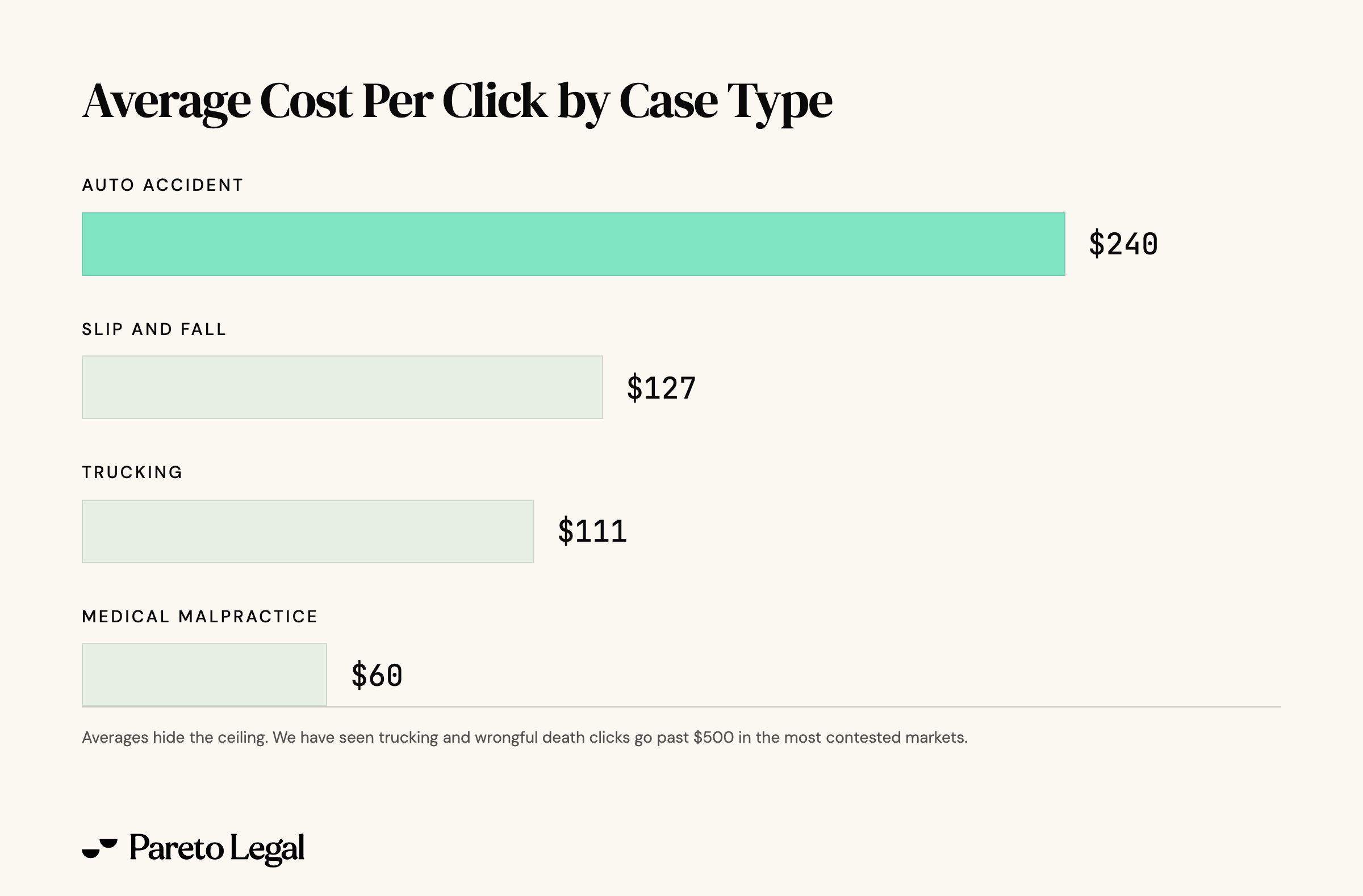
Those are click prices, not lead prices, and the gap between the two is where budget math usually goes wrong. A personal injury lead costs several times what a click does, and in our accounts that lands anywhere from about $170 to north of $800 depending on the case type and how tight the targeting is.
People ask whether a $20 a day budget is enough to test the waters. At injury click prices, a full day of that budget does not buy you one click.
You will not gather enough auction data to learn anything, and you will conclude the channel is broken when you never really ran it.
Realistically, Google Ads spend needs to sit somewhere around $20,000 to $30,000 a month per channel before you get a meaningful read in a real market.
The reason a price like that holds is the case value waiting on the other end of it. A personal injury law firm can carry ad spend that would sink most other practice areas.
If you are optimizing toward cheap clicks instead of signed cases, though, the same budget bleeds. That is where most of this is won or lost.
Account and Campaign Structure
Most firms treat a Google Ads account like one big bucket, with every ad campaign fighting over the same budget. We do not. The structure is what lets you control spend, keep it on the terms that sign cases, and stop paying for the ones that never do.
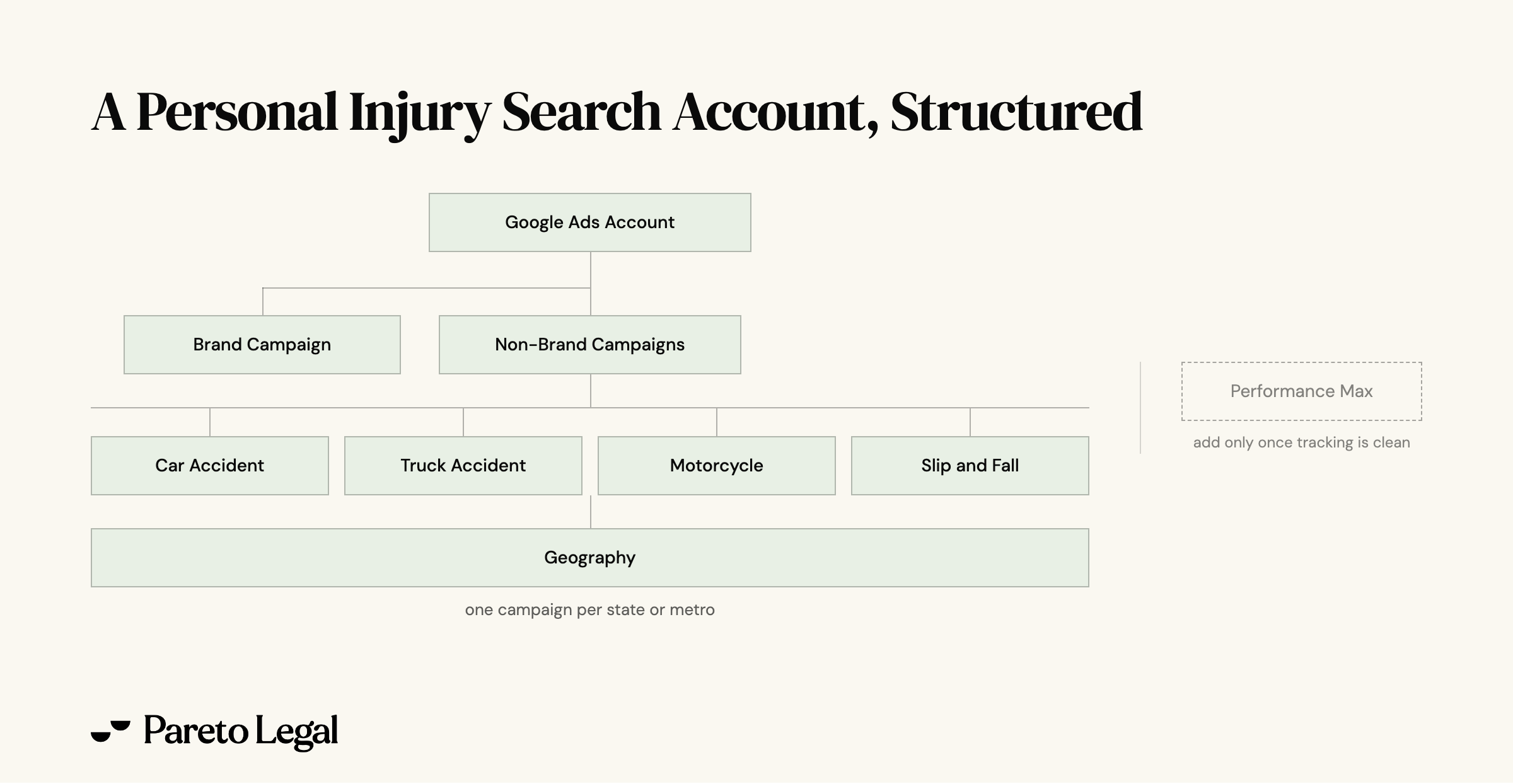
Brand and Non-Brand, Kept Separate
Keep your branded terms, people searching your firm’s name, in their own campaign. Those clicks are cheap and they convert, and mixing them into your non-brand campaigns inflates your numbers and hides your real acquisition cost.
Non-brand, people searching the problem rather than your name, is where the actual money and the actual work live.
Segmenting by Case Type and Geography
Under non-brand, build separate ad groups by case type: car accident, truck accident, motorcycle, slip and fall, and so on. Each case type has different economics and different intent, so each deserves its own ads and its own budget line.
Then split by geography, usually a separate campaign per state or major metro you serve. This gives you clean control over where the money goes, and it shows you which markets actually produce signed cases, not just clicks.
Performance Max, Once You Have Earned It
Performance Max is Google’s goal-based campaign that spans Search, YouTube, Display, Discover, Gmail, and Maps from one campaign.
It can work, but it is not a day-one move for an injury firm. It needs clean conversion data to optimize toward, and on day one you do not have it.
There is also a control problem worth knowing. If a search matches an exact keyword in your Search campaign, Google prioritizes the Search campaign over Performance Max. But Performance Max can still pick up branded and other queries when your Search campaign is budget-limited or narrowly targeted.
Google’s own fix is to use brand exclusions inside Performance Max and add those terms as negatives in the Search campaign. Full separation is managed by rules, not guaranteed. So treat Performance Max as a layer you add after the fundamentals are clean, not the fundamentals themselves.
Keyword Strategy, Match Types, and Negative Keywords
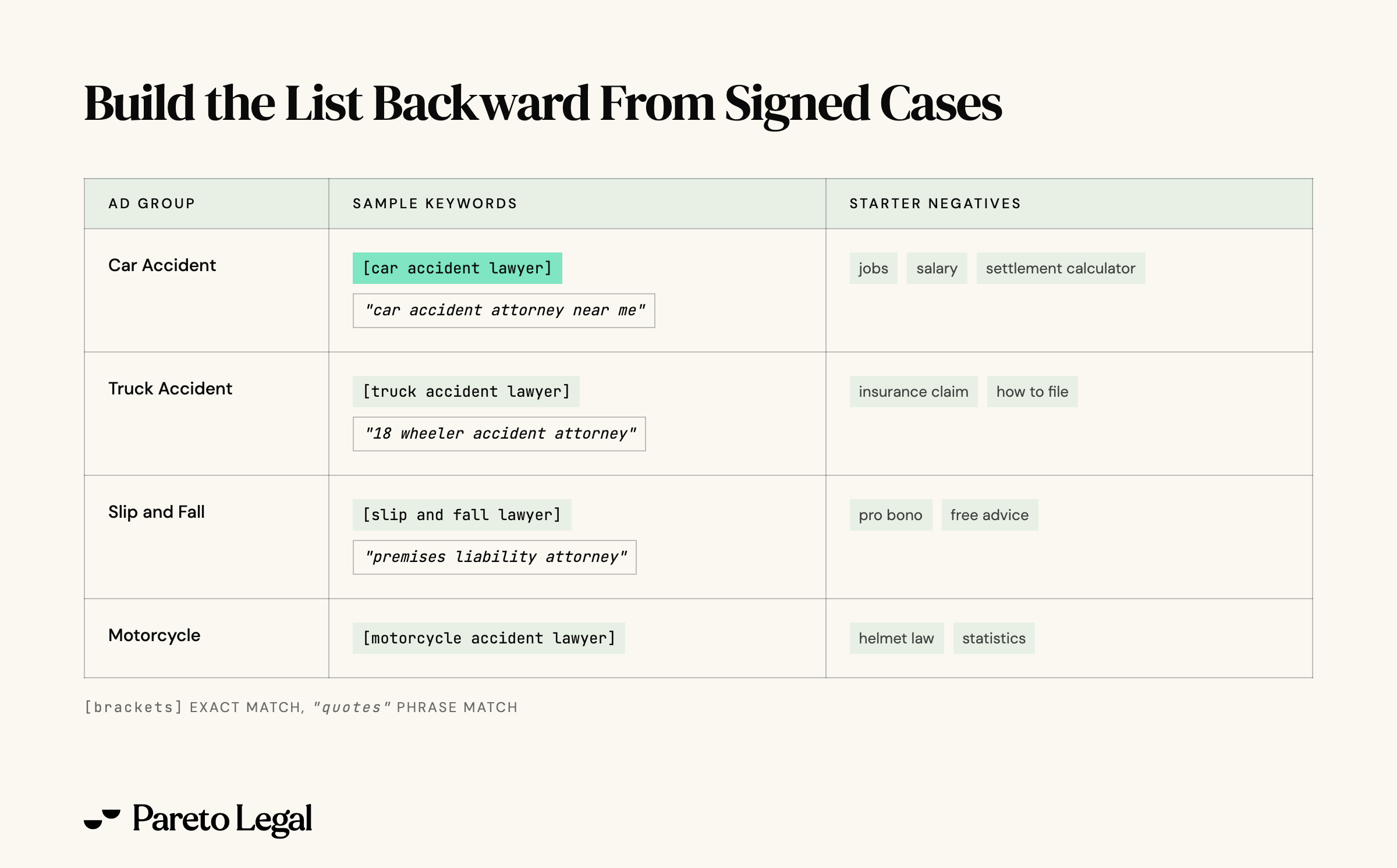
Here is where most of the waste lives. Firms build campaigns forward, starting from Google’s keyword suggestions and broad terms like “injury attorney” or “best lawyer.” Those bring in noise: early-stage, low-intent, unqualified traffic that eats budget and signs nothing.
Our Google Ads strategy is built backward. We reverse-engineer the keyword list from actual signed case data, mining call transcripts, intake notes, and CRM records to find the language that really precedes a retained case.
The personal injury keywords that survive that exercise are exact and phrase terms like “truck accident lawyer near me” or “motorcycle injury attorney [city].” High-intent terms get the budget. Low-intent terms get tested and throttled, or excluded, because one qualified lead is worth more than a dozen curious ones.
Exact, Phrase, and Broad Match
Match type controls how loosely Google interprets your keyword. Exact match shows for searches with the same meaning as your term.
Phrase match shows for searches that include your term’s meaning. Broad match shows for anything Google reads as related, and it leans hard on automated bidding signals.
Lead with exact and phrase for your high-value case-type terms, where precision protects a $250 click. If you use broad match, pair it with automated bidding so bids flex to the actual intent of each search. Google itself calls it critical to run broad match with automated bidding rather than manual bids.
One note on an old habit: the modified broad match type is gone. Google folded it into phrase match back in 2021, so ignore any guide still telling you to build “+truck +accident +lawyer” keywords.
Building a Negative Keyword List
Your negative list is not optional, and it is not a set-it-once task. Personal injury queries are full of traffic you never want to pay for: settlement research, “what to do after an accident,” salary and job searches, do-it-yourself questions, and competitor names you have not decided to bid on.
Read the search terms report every week and add negatives as the junk shows up.
If you run Performance Max, know that you can now add negative keywords to it directly, self-serve, plus shared negative lists. That used to require a Google rep. It does not anymore, so use it.
Quality Score and Why It Costs Injury Firms More
Quality Score is Google’s 1-to-10 rating of how relevant and useful your ad is for a given keyword. It matters everywhere, but it matters most in personal injury, because your clicks are so expensive that a low score costs you real money on every single one.
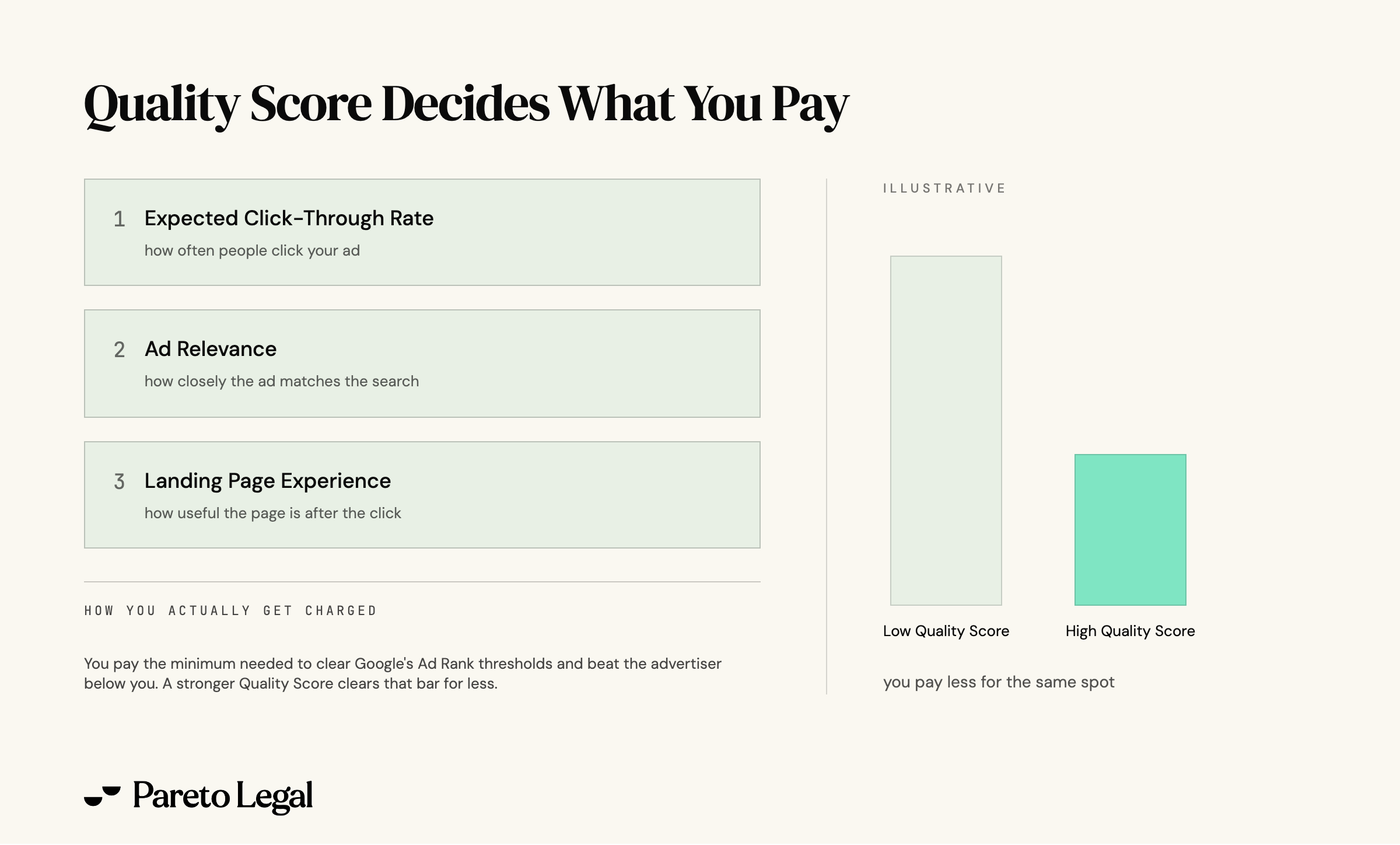
Here is the mechanic. You pay the minimum needed to clear Google’s Ad Rank thresholds and beat the advertiser immediately below you. A stronger Quality Score gets you over that bar for less, so you hold the same position for a lower price.
You will still see an older formula in circulation, the one that divides the Ad Rank below you by your Quality Score and adds a cent. Google does not publish that equation anymore. Ad Rank now comes from your bid, your ad quality at auction time, the thresholds themselves, the competition in the auction, and the context of the search.
The direction holds either way: better quality, cheaper clicks.
At injury click prices, the gap between a strong score and a weak one is not rounding. It is real money on every click, compounded across a month of traffic, and it is the cheapest lever on this whole list because it costs you nothing but the work.
Google builds Quality Score from three parts, and it reports each one in your keyword columns as below average, average, or above average.
Expected Click-Through Rate
This is how likely Google thinks people are to click your ad. Injury searchers scan fast and stressed, so generic copy gets skipped. Ads that lead with a concrete reason to click, a result, a fee structure, a location, tend to earn the clicks that keep this score up.
Ad Relevance
This measures how closely your ad matches the search. The common failure is one broad ad group covering every case type, so the ad never quite matches the query. The fix is the tight, case-type ad groups from the structure section: a truck accident search should hit a truck accident ad.
Landing Page Experience
This is whether the page you send the click to actually delivers on the ad. Sending paid traffic to your homepage is the fastest way to tank this score.
The page has to match the ad’s promise, load fast, and make the next step obvious. More on that below.
Ad Copy and Responsive Search Ads
Every search ad you build now is a Responsive Search Ad. You give Google up to 15 headlines and 4 descriptions, and it assembles combinations per auction. Expanded text ads, the old fixed format, have not been buildable since 2022, so this is the only game.
Headline Strategy by Position
Think in three jobs. Your strongest headline leads with the keyword and the location, because relevance is what earns the click and the Quality Score.
The next carries trust: your fee structure, your results, your review count, the reason to pick you. The third is the call to action, the “call now for a free consultation” that tells people what to do.
Pinning, Carefully
You can pin a headline or description to a fixed slot so it always shows. Pin your keyword-and-location headline to position 1 so relevance is never left to chance.
One caveat people miss: content pinned to position 3 is not guaranteed to appear at all, since Google drops the third slot when there is no room. Pin what must always show to positions 1 and 2, and let Google test the rest.
Ad Extensions and Assets
Google renamed “ad extensions” to “assets” a few years back, but the job is the same: extra pieces that make your ad bigger and more useful, at no extra cost per click.
For an injury firm, use all of them. Sitelinks to your practice-area pages, callouts for “No Fee Unless We Win” and “Available 24/7,” structured snippets listing your case types, a call asset, and a location asset.
One current note that trips up older playbooks. Do not build a standalone call-only ad. Google removed the ability to create new call-only ads in February 2026, and existing ones stop serving in February 2027.
The right move now is a call asset attached to your Responsive Search Ads, which puts your number right on the ad without relying on a format that is being retired.
Bidding Strategies for Personal Injury Campaigns
Bidding is how you tell Google what a conversion is worth to you. The strategies that matter for injury search are Manual CPC, Maximize Conversions, and Target CPA.
Manual CPC still exists, and it is a reasonable way to start a brand-new campaign when you have no conversion history and want tight control.
As data builds, Maximize Conversions and Target CPA let Google’s automated bidding adjust per auction toward your goal. If you have heard of Enhanced CPC, set it aside. Google retired it for Search in 2025.
Be careful about jumping to Target CPA on day one. Google says the strategy can run with no conversion history at all, but its own guidance is to have around 30 conversions in the last 30 days before you measure how it is doing.
That distinction matters. The algorithm will bid either way. What you will not have, below that bar, is enough data to tell whether it is working or whether you got a good month.
On an injury account, where thirty conversions can represent a serious amount of spend, let the volume build before you judge the bidding.
Local Services Ads vs. Search Ads
Local Services Ads are a separate Google product from the text ads we have been discussing, and they usually sit above them at the very top of the page.
They run on a pay-per-lead model, so you pay for a call or message, not a click, and there are no keywords to manage. Instead you set a lead-based bidding approach and Google matches you to searchers.
They also carry the trust badge, now called Google Verified, which replaced Google Screened and the other legacy badges in October 2025.
One warning if you turn them on. Because you are paying per lead rather than per click, every one of those calls needs to be answered. A missed call on this channel is a lead you already bought.
Your Google Business Profile and your review history feed the same trust signals, so get both current before you switch the channel on.
For a lot of personal injury lawyers, running local services ads alongside Search is the right answer, since the two catch the same searcher in different ways.
Landing Pages for Personal Injury Campaigns
The click is only half the purchase. Where you send it decides whether the money converts.
A landing page is a salesperson that works around the clock, lives on a three-second first impression, and either books the case or leaks your budget.
Message Match by Case Type
The page has to continue the ad’s promise. A truck accident ad should land on a truck accident page, not your homepage and not a generic “personal injury” page. When the headline on the page matches the search, conversion rates climb, and your landing page experience score climbs with them.
Dedicated landing pages by case type are the fix. One catch-all page is cheaper to build and it costs you on every campaign you run.
Trust Signals and Call-First Design
Injury clients decide fast and emotionally, so the page has to earn trust in seconds and make contact effortless. Put the phone number above the fold, lead with real results and reviews, keep the form short, and design for a phone call as the primary action.
A little smart friction on the form, a question about accident type or whether someone was injured, filters the junk without killing your volume.
Conversion Tracking and Cost Per Signed Case
This is the section that decides whether everything above was worth doing. You cannot be held accountable to leads, because leads are not what pay the bills.
Cases are. Cost per lead and cost per click can look great while not a single case signs.
So we track cost per signed case. To do that, you connect the ad account to the CRM.
Every lead needs an identifier, a Google Click ID. It rides along from the click through to the signed case, so you can trace which campaign and keyword actually produced revenue.
Then you import that signed-case data back into Google Ads as an offline conversion, which teaches the system what a good case looks like and lets it bid toward more of them. Call tracking with dynamic number insertion captures the calls. When your data sources disagree, the CRM is the truth.
Attribution is never perfectly clean. Referrals, offline conversations, and word of mouth all touch the same case, which is why I treat a plain “what made you reach out today?” question at intake as a real data input rather than a formality.
The chain below is the whole argument. Each step multiplies into the next, which is why a firm watching only the first box can be badly wrong about the last one.
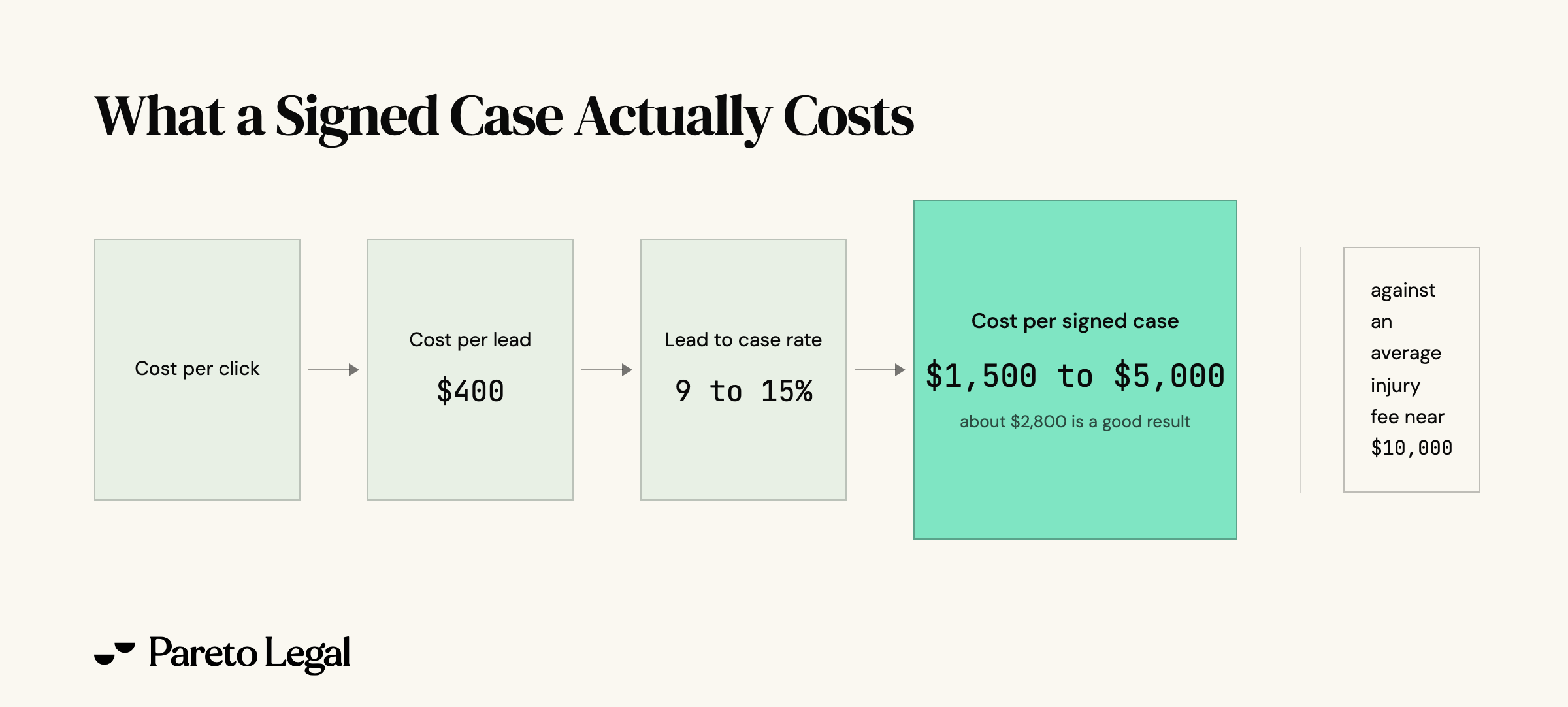
This is also where a firm’s ad budget usually dies for the wrong reason. It is rarely bad targeting. It is a slow or leaky intake process.
If marketing is the engine of growth, intake is the transmission. In most firms it is stuck in first gear.
It is why our law firm PPC services are built around signed cases, not raw lead counts. One Baltimore personal injury firm we work with grew its case volume 117% in six months after we rebuilt the tracking and moved the spend onto the channels that were actually producing cases.
Once tracking is clean, you can finally prove the thing every firm wants to know: what a dollar of spend actually returns.
Some of our clients can show, from their own data, that they put a dollar in and get a few dollars back. I will not promise you that number, because any number I promise is made up. Clean tracking is what lets a firm prove its own.
Bar Rules and Advertising Compliance for Injury Ads
What a personal injury attorney can say in an ad is governed by your state’s rules of professional conduct, and Google Ads copy is advertising. The ABA Model Rules are the general framework most states build on.
Rule 7.1 bars false or misleading communications, including anything that creates an unjustified expectation of results. Rule 7.2 covers advertising and payment for referrals. Rule 7.3 restricts direct solicitation of people known to need legal help in a specific matter.
In practice, that means no guarantees of a settlement or outcome in your ad copy, honest results with proper context, and required disclosures like contingency-fee language where your state demands it.
These are model rules, and your state’s actual rules vary. Confirm the specifics with your state bar before you write ad copy that leans on results or comparisons. I am describing the framework, not giving legal advice on your jurisdiction.
Common Mistakes That Waste Injury Ad Budget
These are the ones I see most often when I audit Google Ads for personal injury lawyers, and none of them get fixed by a bigger budget.
- Pausing and relaunching campaigns instead of leaving them running, which resets the conversion history the bidding depends on every single time.
- Financing the ad budget on a loan or credit line before you have six months of reliable marketing and intake data. Borrow against a number you have proven, not one you are hoping for.
- Counting every phone call as a conversion with no duration or quality filter, which trains the bidding on wrong numbers and job applicants.
- Letting an agency create your ad account inside its own manager account and keep it there. You should be the primary admin on your Google Ads and Microsoft Ads accounts, your analytics, your call tracking, and your CRM.
- Bidding on competitor names with no differentiated offer, so you pay a premium to lose the comparison.
- Leaning on one paid ads channel. Search and Meta for injury firms do different jobs, and a firm on one alone is fragile.
- Scaling spend before tracking and intake are clean, which just pours gasoline on wet wood.
Frequently Asked Questions
Does Google Ads Work for Personal Injury Lawyers?
Running Google Ads works when the account is graded on signed cases and the intake behind it is quick. What trips most firms up is the judging window.
Clicks and leads arrive within days. Signed cases follow your intake and your sales cycle, and an injury matter can take a year or more to resolve. Grade the channel over a couple of quarters, not on week-one lead volume.
How Much Should a Personal Injury Firm Spend on Google Ads?
Size the budget against how many cases your intake can actually absorb, not against a percentage of revenue. Spend that produces more signed cases than your team can work just manufactures its own bottleneck.
Once you know that ceiling, step up toward it in stages, holding each stage long enough to read the search terms and the signed-case data before you add more.
What Is a Realistic Cost Per Signed Case From Google Ads?
The figure on its own tells you nothing without your average case value sitting next to it. The test I actually use is whether it beats what you would pay for a referral fee on the same case. If acquiring the case costs less than being handed it, you are buying well.
What Is the 80/20 Rule for Personal Injury Advertising?
Roughly 20% of your keywords drive 80% of your signed cases, and the other 80% quietly waste budget. The work is identifying which 20%, which is why the search terms report tells you more than any keyword planner will.
Why Do My Injury Ads Keep Getting Flagged Under a Health Policy?
Google’s personalized advertising policy treats health as a sensitive category, and it is triggered by content, not by your practice area. When ad copy or landing pages describe injuries, medical conditions, or treatments in clinical detail, the classifier can flag them.
Google does not name personal injury or legal services as a banned category. The usual fix is adjusting the language on the ad and the landing page, not abandoning the campaign.
Should I Run Google Ads In-House or Hire a Google Ads Agency?
You can run it in-house if you have the team for it, and that is genuinely more than one PPC person. You need someone who understands the data, someone who owns copy and positioning, and someone who lives in the relationship between marketing and intake.
As a rough line, a firm spending under $20,000 a month can often get by with a generalist. Once you are past roughly a quarter of a million dollars a year, it starts to make sense to hand it to a specialist.
Whichever way you go, grade the Google Ads management on signed cases, and on whether search terms and intake get real attention every week.