

Short answer: it depends on how much you’re spending and how competitive your market is. A generalist can handle a small, simple account.
But once you’re spending real money on Google Ads, Meta, or LSAs in a competitive practice area like personal injury or criminal defense, the gap between generalist and specialist shows up fast. It shows up in your cost per signed case.
Here’s how to tell which situation you’re in.
The Generalist Trap: One Playbook for Every Industry
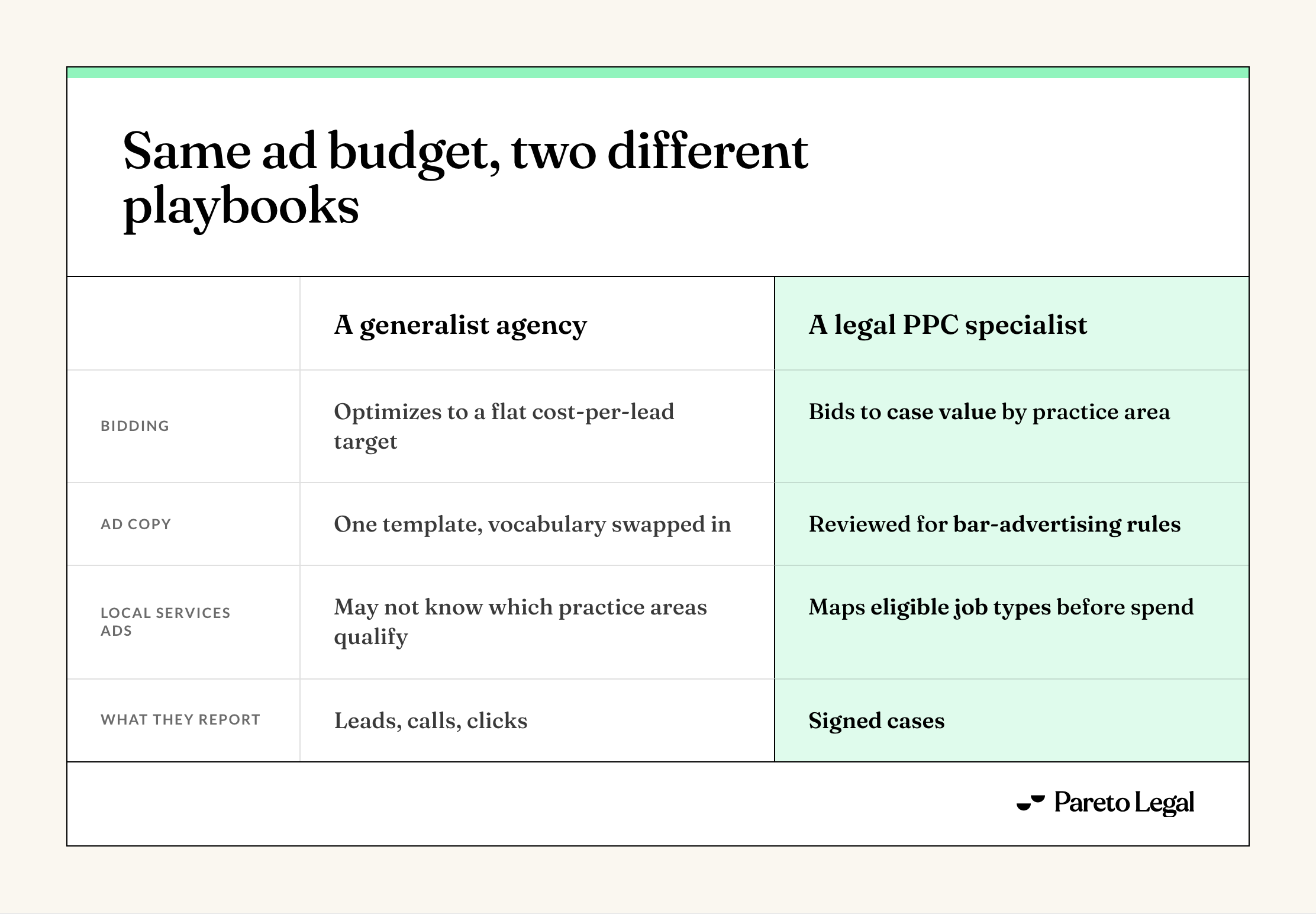
Most marketing agencies serve every industry. Restaurants, roofers, dentists, e-commerce brands, and law firms all get the same playbook, with the vocabulary swapped out.
That works fine for a lot of businesses. Legal is different, and the firms who feel it first are the ones already spending on paid media.
It’s a pattern we hear often from firms that come to us. Their current agency isn’t legal-specific, and the paid media starts to feel like guesswork: plenty of spend, but little sense of what’s actually driving cases.
That’s the generalist trap. Not incompetence. A mismatch between the agency’s playbook and what law firm advertising actually requires.
Four Ways Legal Advertising Is Structurally Different
Legal isn’t just another vertical with different keywords. It has structural differences that change how an account should be built and managed.
Bar Advertising Rules Constrain Your Ad Copy
Attorney advertising is regulated. Many states have their own rules on testimonials, case results, and how you can describe outcomes in ad copy or on landing pages.
A generalist agency writing ad copy the same way they would for a retail client can put a firm’s compliance at risk without realizing it. A legal specialist builds review into the process by default.
Google and Meta Treat Legal as a Restricted Category
Google and Meta both treat legal services as a sensitive category, with their own eligibility and certification requirements layered on top of standard ad policy.
Local Service Ads for Law Firms make this concrete. Not every practice area even qualifies. Personal injury, workers’ compensation, criminal defense, and DUI are commonly eligible job types.
More niche practice areas, like mass torts, tax law, corporate law, or IP and patent work, typically aren’t eligible for LSAs at all. An agency that doesn’t specialize in legal may not know that going in, and can waste budget trying to force a channel that isn’t available.
Case Value Swings Enormously by Practice Area
A signed case in mass tort litigation is not worth the same as a signed case in a minor auto accident claim. Case value varies enormously by practice area, and sometimes within a practice area.
A generalist optimizing to a flat cost-per-lead target has no way to account for that. A specialist builds bidding and budget allocation around what a case is actually worth to the firm.
Signed Cases, Not Leads, Are the Metric That Matters
Most agencies report on leads, calls, or clicks. Those are activity metrics. They tell you the campaign is running, not whether it’s making the firm money.
The number that matters is signed cases. A lead that never gets signed is a cost, not a return. Legal specialists build tracking and reporting around that distinction. Generalists often can’t, because the systems they use weren’t built to connect ad spend to intake outcomes.
Generalist Vs. Specialist: An Honest Comparison
Neither model is universally right. Here’s the honest version of the tradeoff.
- What a generalist agency is usually good at: basic account setup, broad digital marketing skills, lower overhead, and comfort managing a wide range of channels for a wide range of clients.
- What a generalist agency usually misses: practice-area case value differences, bar compliance nuance, LSA job-type eligibility, and tying spend to signed cases instead of leads.
- What a legal specialist is usually good at: practice-area-aware bidding, compliance-aware copy, LSA and platform eligibility knowledge, and reporting built around signed cases.
- What a legal specialist usually costs you: a narrower service menu outside of legal, and sometimes a higher price point than a general-purpose shop.
Price is worth naming directly. It’s rarely the deciding factor for firms that make the switch. Firms tend to care more about whether the agency understands their economics, whether reporting can be trusted, and whether the relationship is easy to work with.
Not Every Legal Specialist Runs Paid Media
“Specialist” gets used loosely, and it hides real layers. A firm shopping for an agency is actually asking two separate questions: does this agency specialize in law firms, and does it specialize in paid media? Most can honestly answer yes to one, not both.
At the widest end are the mega-brands. Scorpion and Thrive run marketing across many industries, and Justia is a legal marketing giant where your firm is one listing among tens of thousands. The work can be competent, but you are one account inside an enormous book.
Relationships at that scale also tend to come with long contracts and lock-in. Firms leaving an agency like Scorpion commonly report that it held the website, the ad accounts, or the tracking data on a proprietary platform, which makes exiting far harder than signing up.
A step in are the legal-specialized shops. Hennessey Digital, Rankings.io, and LawRank built real reputations serving law firms, Rankings.io and LawRank on personal injury SEO and Hennessey as a broader full-service shop. These are strong firms. But their center of gravity is search and full-service work, with paid media a supporting act rather than the main event. Judged purely on advertising, even a respected legal SEO agency is running a generalist’s PPC playbook.
From the other direction are the paid-media specialists who aren’t legal-specific. HawkSEM and Black Propeller run PPC well, but across many industries, with legal as one vertical among several. A plaintiff-side firm there is one account type inside a much wider book, without the case-value economics and bar-compliance instincts a legal-only focus forces by default.
Pareto Legal is built on both axes at once: a law firm advertising specialist, and nothing else. Not SEO with paid search bolted on, not one vertical inside a national brand, not a contract you have to fight your way out of. We measure the work in signed cases and the tracking behind them, not the leads, calls, and clicks that look busy but never tell a firm what its spend actually bought.
If you want specific names, I’ve put together separate rundowns of legal PPC agencies and legal marketing agencies.
When Each Model Makes Sense
When A Generalist Can Actually Be Fine
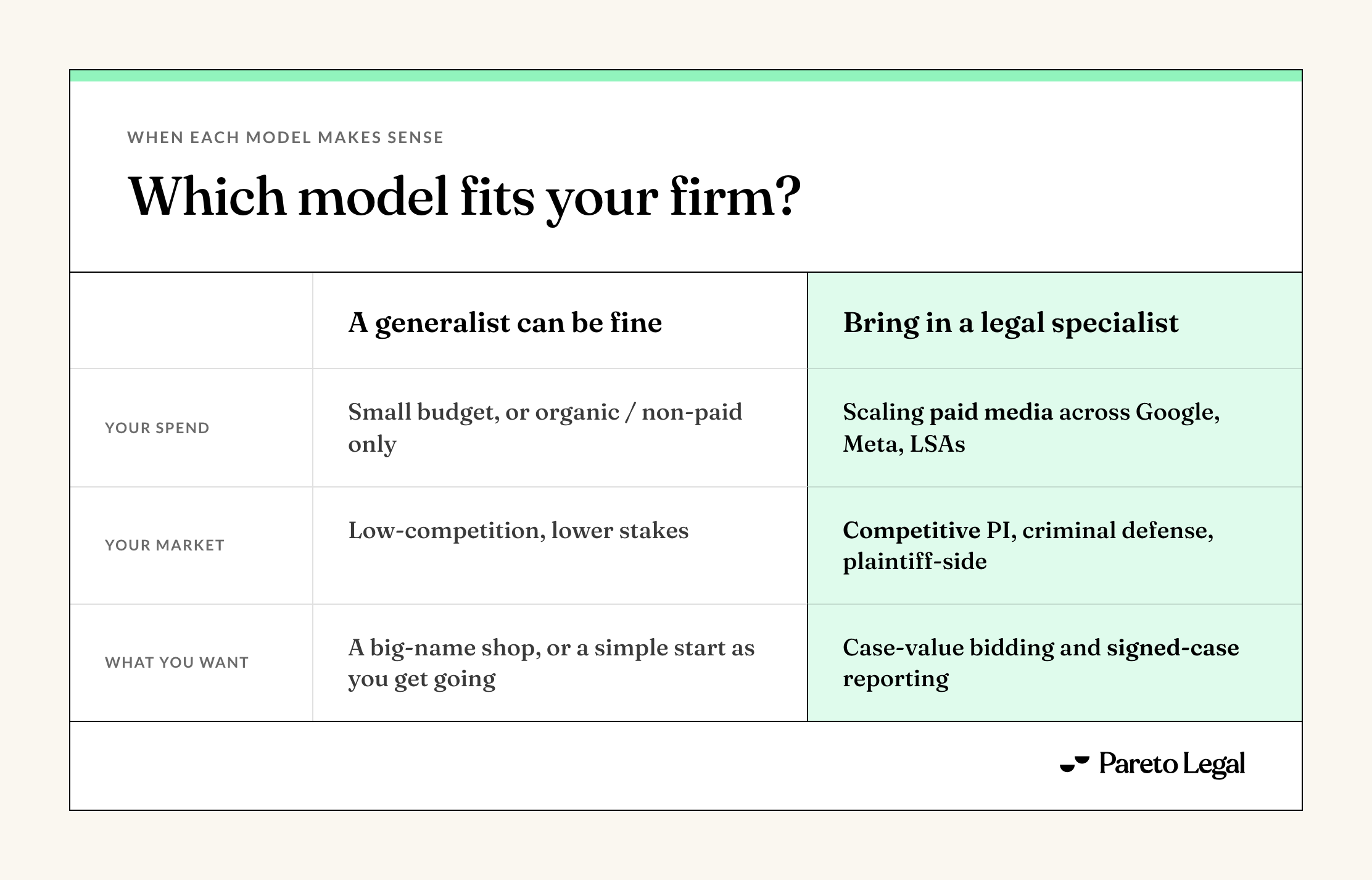
If your budget is small, or you’re only running organic or non-paid marketing, a generalist may be a reasonable fit. The stakes of a mismatch are lower when spend is lower.
The same is true if you’re not yet advertising on a sensitive-category platform, or you’re in a low-competition market where inefficiency doesn’t cost much.
Under roughly $20,000 a month, a generalist can sometimes manage the account fine. A generalist can also be a reasonable fit if what you mainly want is a big, recognizable agency name behind the firm, or if you’re a smaller firm just starting out, where a simple setup matters more than practice-area nuance.
When Specialization Pays Off
Specialization pays off once you’re scaling paid media spend, especially in personal injury, criminal defense, or another competitive plaintiff-side market. That’s when small inefficiencies in bidding, targeting, or compliance start compounding into real dollars.
It also matters once you need to know which specific campaigns are actually producing signed cases, not just leads, so you can make a confident budget decision.
Five Questions That Reveal Which Type of Agency You’re Talking To
A few questions during a sales call will usually reveal which type of agency you’re talking to.
- Can you show me which campaigns drove signed cases last month, not just leads or calls?
- How do you account for different case values across our practice areas in how you bid?
- What percentage of your accounts are law firms, and how many are in personal injury specifically?
- Do you know which of our practice areas are eligible for Local Services Ads?
- Who reviews ad copy for bar compliance before it goes live?
If the answers are vague, or the agency has never had to think about these questions before, that’s worth noting.
I ranked the legal PPC agencies worth a shortlist based on that same vetting criteria.
Where Pareto Legal Fits
Pareto Legal works with plaintiff-side law firms only. We’ve managed or audited over 1,000 law firm advertising accounts, including 600+ in personal injury.
Client retention runs around 95%, with an average client tenure of roughly 2.5 years. We built the agency around one identity: the law firm digital advertising agency, and a strategic thought leader for the injury niche specifically.
That’s not a claim that a generalist can’t ever do the job. It’s a description of what a firm gets when the entire agency is built around plaintiff-side legal economics, compliance, and the signed-case metric, instead of adapting a general playbook to fit.
FAQ About Hiring a Legal Marketing Agency
Is A Legal-Specific Agency Worth The Price?
It depends on your spend and your market. For firms running meaningful paid media budgets in competitive practice areas, the specialization tends to pay for itself through better bidding, fewer wasted dollars, and cleaner signed-case reporting. For very small accounts, the gap matters less.
My Agency Isn’t Legal-Specific. Is That Hurting My Results?
Not necessarily, but it’s worth checking. Ask whether they can show you signed cases by campaign, whether they’ve factored in your case value differences by practice area, and whether they know which of your practice areas qualify for Local Services Ads. If those answers are thin, it may be costing you more than you realize.
What Can A Legal Specialist Do That A Generalist Can’t?
A specialist starts from law firm economics instead of retrofitting a general playbook. That shows up in bidding built around case value, compliance-aware copy, knowledge of platform eligibility rules specific to legal, and reporting tied to signed cases rather than lead volume.
How Do I Know If My Results Are A Marketing Problem Or An Intake Problem?
Both generalists and specialists can struggle to answer this, but it’s a question a legal specialist should be equipped to help you diagnose. If leads are up but signed cases aren’t, the issue often sits in intake, not the ad account. A firm that only reports on leads has no way to tell you which one it is.